

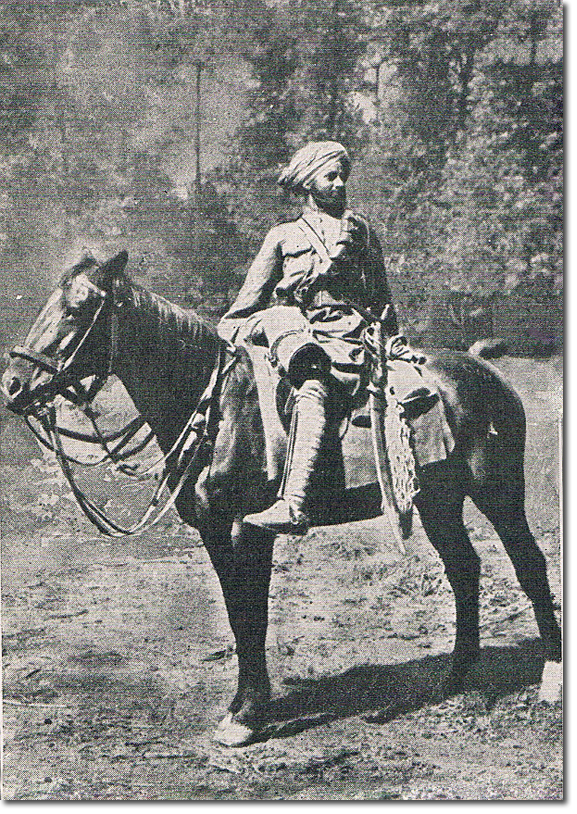
The Indian cavalry in France wore a uniform that was all khaki, including the lungi and the puttees. The serge kurta opened all the way down and had breast pockets. Khaki drill jodhpurs were worn, and brown boots, with spurs when mounted. The Indian cavalry were armed with a Short Magazine Lee Enfield rifle, bayonet, and a sword. Ammunition was carried in the leather bandolier on his left shoulder, also around the horse’s neck. He had a haversack for food and two Mills bombs. Also carried was a gas mask and water-bottle. The 18th had lances. The horse carried two blankets under the saddle, and rolled in front of the saddle were a waterproof sheet, short great coat, and a raincoat. A nose-bag, canvas bucket and built-up rope and backpad. The item hanging behind the sowar’s sword is a rope-bag for forage.
The helmet was issued in 1916 but proved to be problematic. The Sikhs refused to wear them and were under pressure to obey orders. A Staff officer of the Cavalry Division attempted conciliation by pointing out that the old Khalsa army wore steel helmets. The Sikhs insisted that the Khalsa army contained Muslims, and it was only they that wore a helmet. But the Muslim Pakhtuns said this was not the case as their religion contained a curse that said, “May Allah put a hat on you.” So they too objected to the order. In the end the Pakhtuns relented and took the helmet. The Dogras accepted the helmet willingly, and when in Palestine requested the sun topi. The Sikhs agreed to a compromise, to carry the helmet on their saddles on their march to the Somme with a view to using them at the front. However once there, they consulted with Sikhs in the Sialkot Brigade and piled the helmets onto a returning lorry, and no more was said about the matter.

