| Topic | Powerpoints | Key Terms | Historiography | Useful Textbooks | Useful Websites | Videos | Further Reading | News Feeds |
| Cold War | Cold War (ppt) | Superpower | Cold War Historiography |
The Cold War A Very Short Introduction
Cold War in Europe and Asia
|
History Learning Site | This is the first part of a series on the Cold War - you need to follow the rest on Youtube itself. |
The Cold War by John Gaddis
Cold War: For Forty-five Years the World Held Its Breath
|
Cold War Studies BATISTA OUTLAWS THE COMMUNIST PARTY IN COLD WAR CUBA Despite the domestic origins of the coup, the US embraced the
new regime within the framework of the escalating Cold War conflict
since Batista quickly ended relations with the Soviet
Union — which he himself had established in 1942 — and then
outlawed the Cuban Communist Party. The Cold War association with
the US was soon overshadowed, [...]
COLD WAR IRAN: OIL AND WEAPONS (PART 2) By the 1970s Iran’s rentier state had broad influence —
politically, socially, and economically. The shah had adopted a
capitalistic program of industrial and economic expansion to be
fueled by the regime’s expenditures on industry, construction and
services. The program relied on the Third, Fourth, and Fifth
Development Plans (1962-1977) for implementation and planning. The
[...]
GLOBAL THREATS: CRIME, POVERTY, TERRORISM Global Threats Today’s global threats are, in part, rooted in
the urban growth that swept both the Soviet and Western camps
during the half century Cold War. Moreover, today’s
challenges — crime, poverty, and terrorism — are quite different
from those faced in last century’s ideological conflict with the
Soviet Union. As we have seen [...]
As we observed in one of our previous
posts, Havana: Post WW II and Limited Industrialization,
Havana was not Cuba. The capital was quite modern
and habaneros enjoyed relatively high standards of
living. Still, most Cubans did not live in Havana and, by 1952,
Cubans were looking for new leadership. The idea of a military coup
originated [...]
COLD WAR IRAN: OIL AND WEAPONS (PART I) Cold War Iran becomes a rentier state. Iran’s oil income
began rising in the 1950s when the resolution of the oil crisis
made increased state revenues possible. (For background on the oil
crisis see Cold War Iran in the Aftermath of the 1953
Coup.) The first large jump in sales (236%) occurred between
1954 and 1955 [...]
HAVANA AFTER WWII: LIMITED INDUSTRIALIZATION The outbreak of the Korean War gave renewed life to Cuban
sugar production. At the same time, Havana’s other economic sectors
were stunted by widespread government corruption which served to
inhibit economic transformation and entrench the sugar status quo.
In this environment, trade unions pursued a policy of militant
reformism as a way of safeguarding [...]
TRANSNATIONAL CORPORATIONS IN COLD WAR TAIWAN Transnational corporations during the Cold War period
concentrated on three categories of manufactured products from
Taiwan and other less developed countries. The first category (much
smaller than the other two) was made up of capital or technology
intensive goods including chemicals, iron and steel, light
engineering goods, machinery, and transport equipment. In this
area, the initial [...]
HAVANA: THE IMPORTANCE OF SUGAR The importance of sugar to the Cuban economy — and to the
capital city of Havana – has been summed up in the widely
quoted phrase sin azucar, no hay pais (without sugar,
there is no nation). It is notable, then, that as World War II
ended, circumstances surrounding the world market for sugar brought
a period of prosperity [...]
FIFA WORLD CUP SOCCER: COLD WAR GOALLLLLLLLL Soccer fever is building in anticipation of the 2014 World
Cup, so it must be time for Cold War Studies to turn its focus
once again to The Beautiful Game in the context of the Cold
War. Background The first FIFA World Cup, held in 1930, was a
13 team event held in Uruguay. Since then, the [...]
With a population of 935,650 inhabitants, 1945 Havana covered
an area of 724 square kilometers. The city was composed of six
counties or municipios: La Habana, Marianao, Regla,
Guanabacoa, Santa Maria del Rosario, and Santiago de las Vegas. The
six municipios had quite different characteristics. Like
most cities in the developing world, post World War II Havana
reflected several [...]
|
| Colonialism | Empire in Asia.ppt | Assimilation | Reasons for Development of Empire |
The British Empire, 1815-1914 Access to History
Empire
British Imperialism 1750-1970
End of Empires: European Decolonisation 1919 - 1980
The End of the British Empire: The Historical Debate |
The BBC provides a good overview of the Start of Empire and the
End of Empire
There is also my British Empire site which has a bit of information for you to use. French Empire from 1871 to 1914 Lecture Scramble for Africa An interesting Vodcast on the Scramble for Africa |
This is the first part of a series - you can follow the rest on Youtube. |
The Rise and Fall of the British Empire Lawrence James
The French Overseas Empire
Empire: How Britain Made the Modern World
Empire: The British Imperial Experience from 1765 to the Present |
On This Day More events from This Day in History: May 18 (Infoplease) Share With Friends:
|
Fun Stuff - This Day In History Stories,
RSS Feeds and
Widgets
via Feedzilla. |
| Britain 1945 - 1991 | Post War British Politics 1945 to 1991 (ppt) | Welfare state | The Historiography of Post-War Britain |
Britain 1945-2007 Access to History
Britain 1929-98 |
The Making of Modern Britain It has good sections on the Welfare State, End of Empire and Thatcherism
|
This is the first part of a series - you can follow the rest on Youtube. |
A History of Modern Britain by Andrew Marr
Britain Since 1945: The People's Peace
|
The National Archives Podcast Series Australia in War and Peace, 1914-19 Jatinder Mann outlines the main features of a research
project studying historically significant Australian and British
documents and explores the research process.
The Journey’s End Battalion: The 9th East Surrey and R C Sherriff in the Great War Michael Lucas and Andrew Lucas investigate the experiences of
playwright RC Sherriff, writer of Journey’s End, with the 9th East
Surrey Battalion in the First World War.
John Guy tells the story of the family drama of England’s
wealthiest and most powerful king.
Christine Gifford discusses the work and challenges of the
Hillsborough Independent Panel.
A system of spies and informers: intelligence gathering in the period 1780-1830 Using the records of the Home Office, this podcast focuses on
just how the government kept up to date intelligence on the various
threats without a recognised police force or centralised government
agency.
Paul Carlyle looks at records held at The National Archives
on this controversial and unpopular tax.
The post-Restoration army: 1660-1714 Reader Adviser Ralph Thompson follows the history of the army
from its inception as a standing force after the overthrow of the
English republic through its increasing professionalisation during
the War of the Spanish Succession.
Authority, Legitimacy and Orthodoxy: the Accession of Henry V in 1413 Using documents in The National Archives, James Ross explores
the troubled times of Henry's accession and reveals a man very
different to Shakespeare's picture of a playboy prince.
Stalingrad and Berlin: researching the reality of war Antony Beevor, author of Stalingrad, Berlin: the Downfall and
The Battle for Spain, discusses his experience of researching the
reality of war.
An Embarrassing Question: Opium, Britain and China 1856-1860 What part did opium play in the war between Britain and China
from 1856 to 1860? Caroline Dawson uses records held at The
National Archives and elsewhere to investigate.
|
| Fifth Republic |
Post War France (ppt) From the 4th to 5th Republc (doc) The 5th Republc (doc) |
Gaullism | Historiography of Fifth Republic |
Modern France
|
Charles De Gaulle overview | This is the first part of a series - you can follow the rest on Youtube. Also worth watching are Play Time and Mon Oncle Jacques Tati to show the change in France in the 30 Glorieuses. |
La Vie en bleu: France and the French since 1900 by Rod Kedward
France Since 1945
The Fifth French Republic
Charles de Gaulle and the France He Saved |
|
| Globalisation | Globalisation (ppt)
The History of the City(ppt)
|
Globalisation
Transnational corporation (TNC) |
Models | Globalisation Access to History
Globalisation |
Tate Exhibition: Global Cities Foreign Policy: Global Cities Index |
Globalisation is Good |
No-nonsense Guide to Globalization by Wayne Ellwood
|
|
| Major Economic Powers | MEDCs including Japan, USA, EU and China (ppt) | Core/periphery
More economically developed country (MEDC) |
Core-Periphery Model | The European Union A Very Short Introduction
Modern Japan
Modern China
|
Visualising Economics | No-Nonsense Guide to International Migration by Peter Stalker
A European Life |
The Economist: Indicators The worldwide steel and metals industry was the subject of the biggest number of anti-dumping investigations initiated by members of the World Trade Organisation last year. A report by Rowe & Maw, a corporate-law firm, records 95 cases involving steel and metals—more than a third of the year's total. Of these cases, 37 were started by America, in an attempt to protect its ailing steel industry from foreign competition. The steel business has entered a period of restructuring amid a wave of consolidation by the world's biggest producers. Steel accounted for 80% of America's anti-dumping investigations in 2000, and American companies are clamouring for even more cases this year. In relative terms, the paper and wood industries showed the biggest drop in anti-dumping activity over the past year: 25 cases were begun in 1999, but just eight got going in 2000. Investigations involving textiles and related products also fell sharply, from 37 to 16. TRADE, EXCHANGE RATES AND BUDGETS In February, the European Union's current account jumped into surplus for the first time in five months; the 12-month deficit shrank by nearly 10% compared with January. Hurt by weak data from purchasing managers, the euro shed 0.9% against the American dollar. But the greenback fell by 3.0% against the Australian dollar. In trade-weighted terms, the yen rose by 0.2%. The Nasdaq Composite index rose by 7.8%, boosted by an unexpected first-quarter rebound in the American economy. Tokyo reached its highest level of the year after opinion polls showed firm support for Japan's new prime minister, Junichiro Koizumi. Growth rates of both broad- and narrow-money supply in Australia continued to rise in March, to 14.1% and 7.5%, respectively. Danish money supply contracted again in March. Quarterly forecasts from J.P. Morgan Chase suggest that the euro will strengthen a little against the American dollar over the next quarter, and then stay at the same level into next spring. The currency has weakened a little over the past three months. The exchange rates for sterling and Swiss francs are also expected to remain broadly stable over the next year. The Swedish krona is expected to appreciate in the next three months and to hit still loftier highs by April 2002. The yen is expected to weaken against the dollar, before regaining a little ground by next April. On an opposite course, the Brazilian real will strengthen a little this summer, before softening over the following nine months. The Mexican peso is predicted to experience a 10% fall against the dollar over the next year. Interest rates eased in many euro area markets. Britain's broad-money growth slowed to 8.4% in the 12 months to March, down from a revised 9.4% in February; Canadian broad-money growth slowed for the third month running, to 5.6%. TRADE, EXCHANGE RATES AND BUDGETS The visible-trade deficit in the euro area, which now includes Greece, narrowed to $9.7 billion in the year to February. In the same period Britain's visible-trade deficit shrank to $43.3 billion, and Italy's trade surplus remained at $1.6 billion. The dollar fell by 1.7% in trade-weighted terms, and the euro gained 1.8%. Further weakness in high-tech and telecom shares, as well as concerns about corporate profits, pushed the S&P 500 and the FTSE 100 down by 0.8% and 1.1% respectively. Political uncertainty in Japan made investors cautious, but the Nikkei still gained 1.4%. Tax wedges measure the share of labour costs attributable to income taxes and social-security contributions less cash benefits. In the past three years, they have fallen in most OECD countries. The biggest declines have occurred in Ireland and Australia, where the wedge for a one-earner family with two children fell from 14.5% to 7.7%. The Czech Republic also trimmed its wedge substantially from 31.2% to 24.8%. However, Japan and South Korea have moved in the opposite direction as their governments have tried to spend their way out of economic crises. The tax wedge has risen in both countries by about a third. In a surprise move between scheduled meetings, America's Federal Reserve cut the federal-funds rate by 50 basis points to 4.5%. It was the fourth cut this year and brought its target for interest rates to the lowest level for 6 1/2 years. |
|
| Development | Development (ppt) Inside Brazil (pdf) |
The global South
Less economically developed country (LEDC) |
Demographic Transition Model |
Development Access to History
Population |
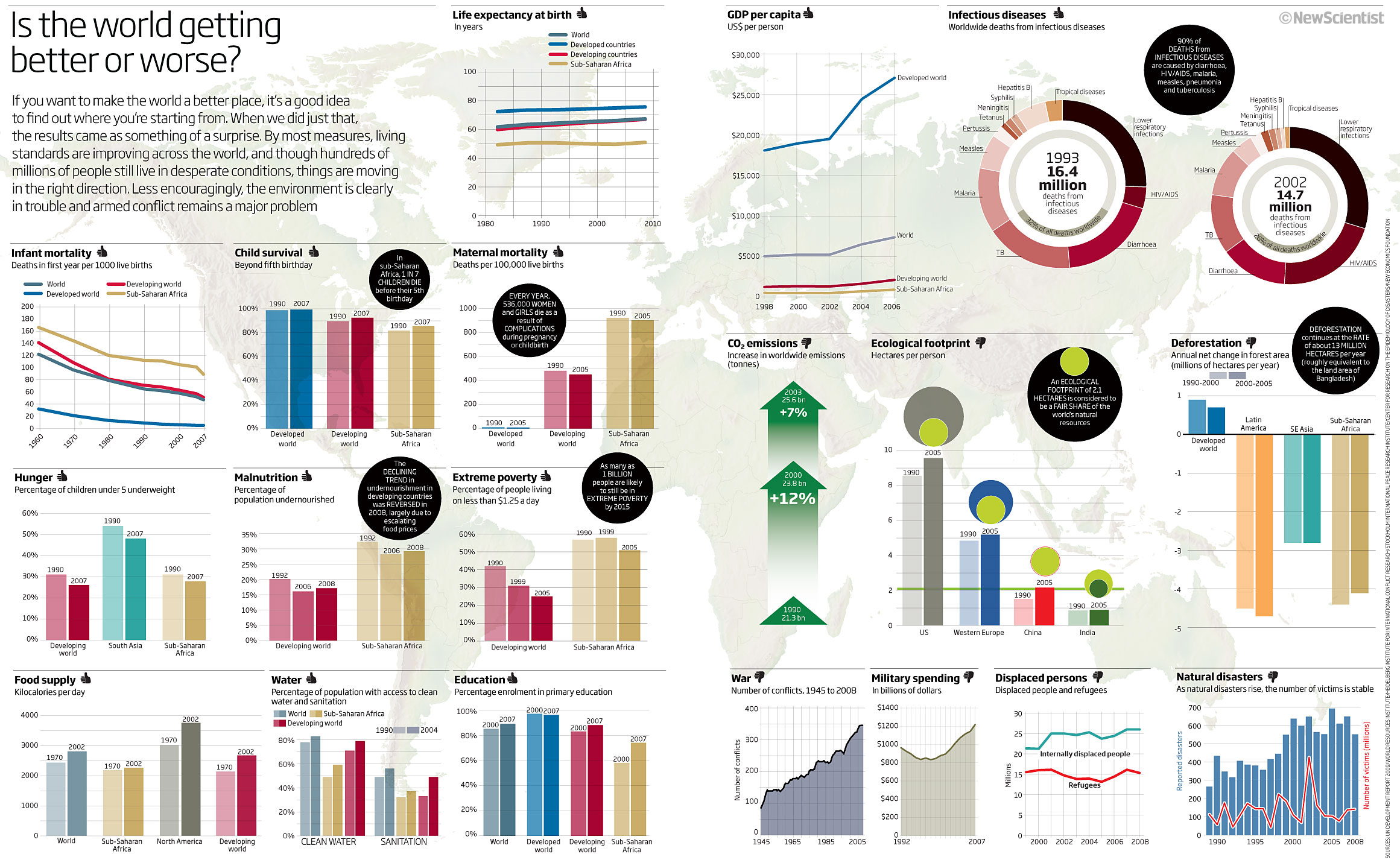
Is the World Getting Better | No-nonsense Guide to International Development by Maggie Black
No-nonsense Guide to Poverty
|
Global Issues Austerity and Structural Adjustment for Europe
However, as has been warned countless times, excessive austerity rarely works. Furthermore, focusing on debts and deficits appears to miss the point that the economic problems were caused by a collapse in markets and banking sector in particular, resulting in less revenues for governments; not necessarily an excessive overspend by governments. Some of the policies being forced through even when evidence appears to show they do not work lead many to think that austerity and structural adjustment policies are being ideologically pushed for — just as they were on most of the developing countries for almost 2 decades with devastating results. Indeed, in the US, investigations have found billionaires pouring hundreds of millions of dollars on campaigns to fix the debt making it appear as a grassroots movement. Fixing the debt of course happens to leave the elite less affected, so it works to their advantage to push for something like that. Without more focus on appropriate economic growth, there is a real risk in going backwards, and even undermining democracy. The global financial crisis page on this web site has been updated with new sections and videos on this issue. 19% of reptiles under threat of extinction and 100 million sharks being killed each year
A recent study also estimated that some 100 million sharks are being killed each year — an unsustainable rate, given how long some species take to mature and reproduce. Much of the demand is driven by Chinese rising affluence and demand for shark fin soup in the mistaken belief it has various health benefits. This small update to the biodiversity loss page has further details. Even a small increase in global temperature will have a severe impact on coral reefs
For lions, another iconic animal whose numbers are in decline, countries like Zambia and Botswana are banning hunting. Zambia for example has banned hunting on lions and leopards due to a big decline in their numbers, and because they believe tourism revenues by those who want to see these animals in the wild will bring in more revenue than blood sport tourism. This small update to the conservation page has further details. The world is awash with money; trillions hidden offshore
Tax avoidance by the super rich results in lost revenues in the order of hundreds of billions a year, which would (in theory at least) benefit most of society. But if you can afford an army of ingenious lawyers and accountants, it seems you can play by a different set of rules. Recent high profile cases of companies and individuals avoiding taxes in recent years has resulted in governments claiming they will address this issue thoroughly. But that is as far as it seems to go. This update includes additional figures and examples of recent tax avoidance issues that have come to light. Read full article: Tax Avoidance and Tax Havens; Undermining Democracy Global arms sales sharply increased in 2011 compared to 2010
One major factor for the increase was the US sales of arms to Saudi Arabia. Most other major arms sellers otherwise saw a decrease in sales and the trend in recent years had been declining sales. The global financial crisis has affected many countries, and many developing countries started to see a decrease in purchases in the last few years. However, just 10 developing countries account for some 85% of all sales to developing countries in the period 2004 to 2011, which the data covers. Saudi Arabia tops that list followed by India and the United Arab Emirates. (As well as concerns about some of the regimes in the top buyers, some of this spending is also said to be due to modernizing efforts.) Updated graphs and charts on arms sales data are provided here. The arms trade is big business. The 5 permanent members of the UN Security Council (US, Russia, France, United Kingdom and China), together with Germany and Italy, account for approximately 85% of all arms sold between 2004 and 2011. Some of the arms sold go to regimes where human rights violations will occur. Corruption often accompanies arms sales due to the large sums of money involved. COP18 - Doha Climate Conference
Predictably and sadly, the same issues have resurfaced: lack of media coverage, West stalling on doing anything, lack of funding, disagreement on how to address it, etc. This page is an overview of the Doha Climate conference. It also includes a feed of latest news stories from Inter Press Service’s coverage of the conference. Rio+20 UN Conference on Sustainable Development
This page provides coverage of recent events via Inter Press Service’s news feed. Read full article: Rio+20 UN Conference on Sustainable Development
This page provides coverage of recent events via Inter Press Service’s news feed. World military spending exceeds $1.6 trillion, continuing high trend despite economic conditions In recent years, global military expenditure has increased again and is now comparable to Cold War levels. Recent data shows global spending at over $1.6 trillion, despite the global economic conditions. It is still a 1.3% increase since 2008 when the financial crisis began, for example. For some nations, they can increase their spending as they grow economically. For others, there are geopolitical interests at stake. The highest military spender is the US accounting for 41% of the world’s spending, more than the next top 14 countries combined, and more than all its potential enemies, combined. But this represents a slight decline over previous years as other nations, especially China, increases spending and the US begins to very slightly feel budgetary pressures on its military spending. This update includes updated figures, graphs and charts exploring this further. |
| The British option of the OIB (Option Internationale Du Baccalaureat) or otherwise known as 'The International Option of the French Baccalaureat' should not be confused with the International Baccalaaureat. The French government, in collaboration with Cambridge University, run an exam system that is conducted entirely in English although the majority of the candidates sit the examination in France. This page gives information on the History and Geography component of the British Section of the OIB exam. There are seven topics (see above) taught to what might be regarded as an A-Level standard. The students have to take a four hour written examination and a 15 minute oral examination. Further information can be found at ASIBA, CIEP and a handbook is available from Cambridge |
Armed Forces | Art and Culture | Articles | Biographies | Discussion | Glossary | Home | Library | Links | Map Room | Sources and Media | Science and Technology | Search | Student Zone | Timelines | TV & Film | Wargames |