

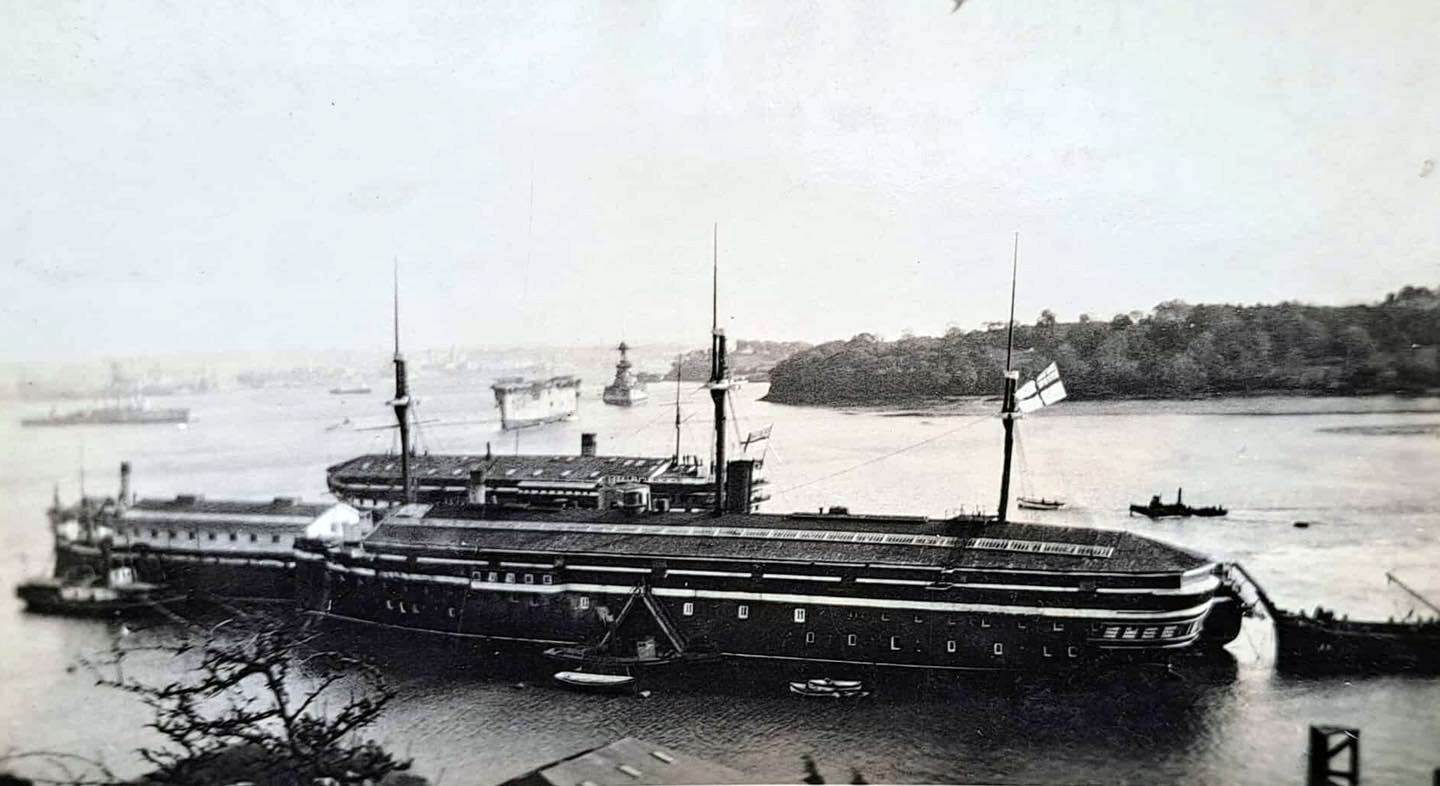
This period photograph, taken at Wearde Quay on the River Tamar, captures HMS Inconstant in front of HMS Defiance. HMS Defiance had already been assigned as the Royal Navy’s torpedo and signals training ship. Moored in the Hamoaze, these vessels would serve as a floating laboratory for some of Britain’s earliest naval experiments in wireless telegraphy. The photograph documents not only the layout of the establisment but the broader context of technological transition within the Royal Navy at the turn of the twentieth century. You can also see the experimental Aircraft Carrier Argus behind it.
HMS Defiance was stationed at Wearde Quay from the 1880s, and by the early 1900s had become a focal point for trials in radio communication. These experiments were prompted by the Admiralty’s growing interest in Marconi’s wireless system, which offered the promise of ship-to-ship and ship-to-shore messaging without reliance on fixed cable infrastructure. The sheltered waters of the Tamar provided an ideal environment for controlled testing, shielded from urban interference yet close to Devonport’s naval facilities.
Wireless apparatus was installed aboard Defiance and on nearby shore stations. Spark-gap transmitters and coherer-based receivers were used to send and receive signals across the estuary and out into Plymouth Sound. Operators tested antenna configurations, signal clarity, and range under varying weather and tidal conditions. These trials helped establish protocols for naval use, including frequency management and message formatting, which would later be standardised across the fleet.
The significance of these experiments extended beyond technical refinement. Wireless telegraphy offered strategic advantages: ships could remain in contact while underway, coordinate manoeuvres in real time, and receive orders without returning to port. For the Royal Navy, this marked a shift in operational doctrine—one that would prove decisive in both peacetime patrols and wartime engagements.
HMS Defiance continued to serve as a training and instructional platform for naval ratings learning the new technology. The ship’s role in pioneering wireless communication was later overshadowed by larger developments, but its contribution remains foundational. The photograph, with its clear depiction of the vessel and surrounding support craft, offers a rare glimpse into the physical setting of Britain’s early naval radio work.
Today, the legacy of HMS Defiance and the wireless trials at Wearde Quay is embedded in the evolution of maritime communications. The River Tamar, once a quiet testbed for spark signals, became a proving ground for technologies that would reshape naval command and control across the twentieth century.

