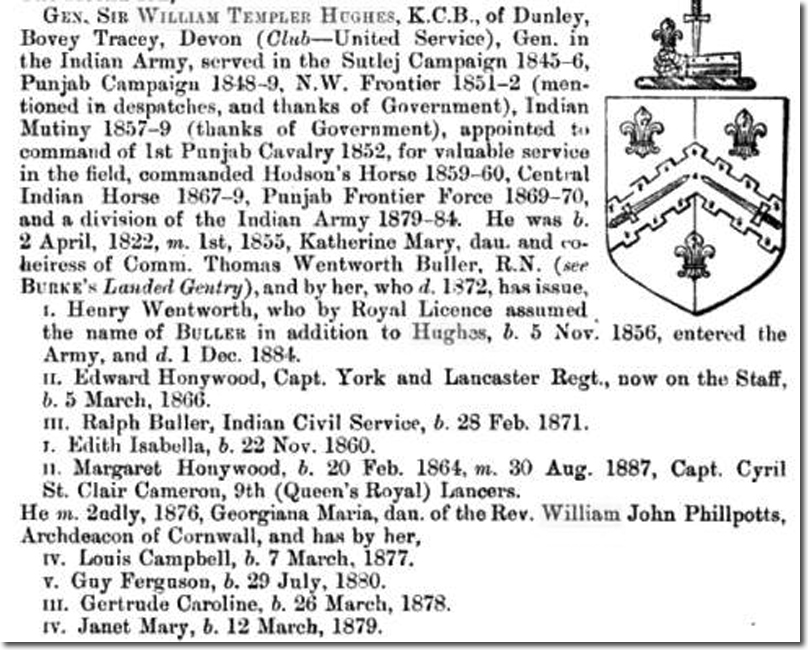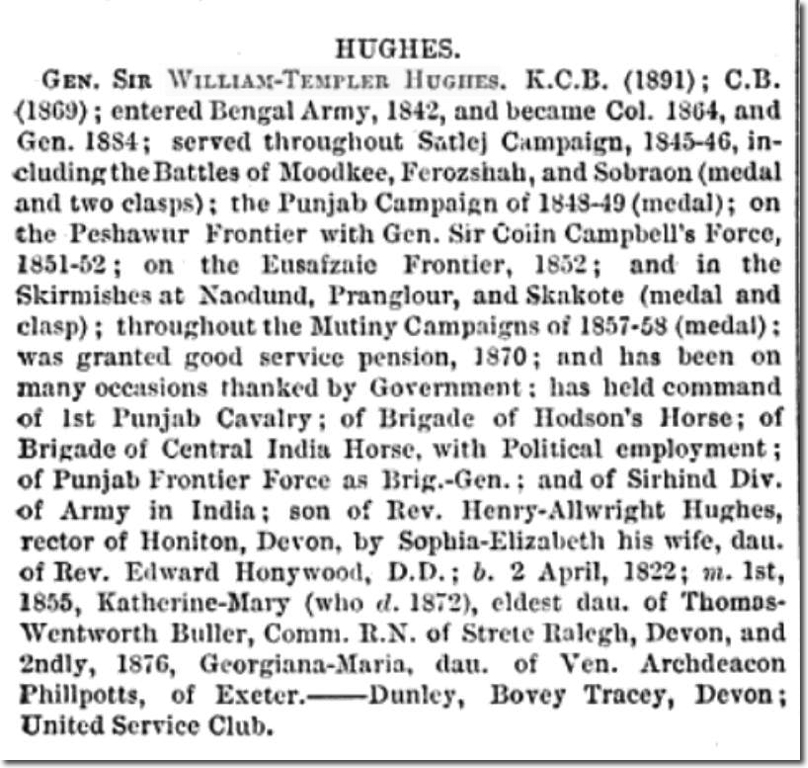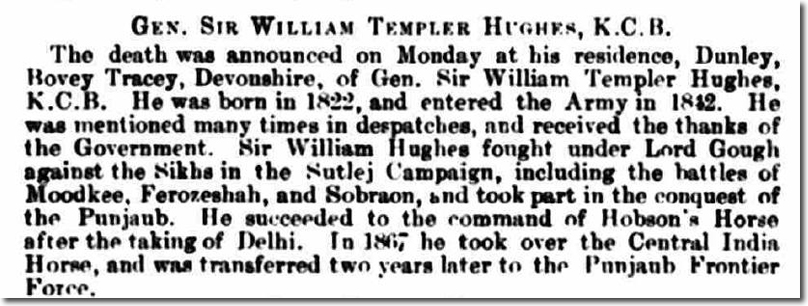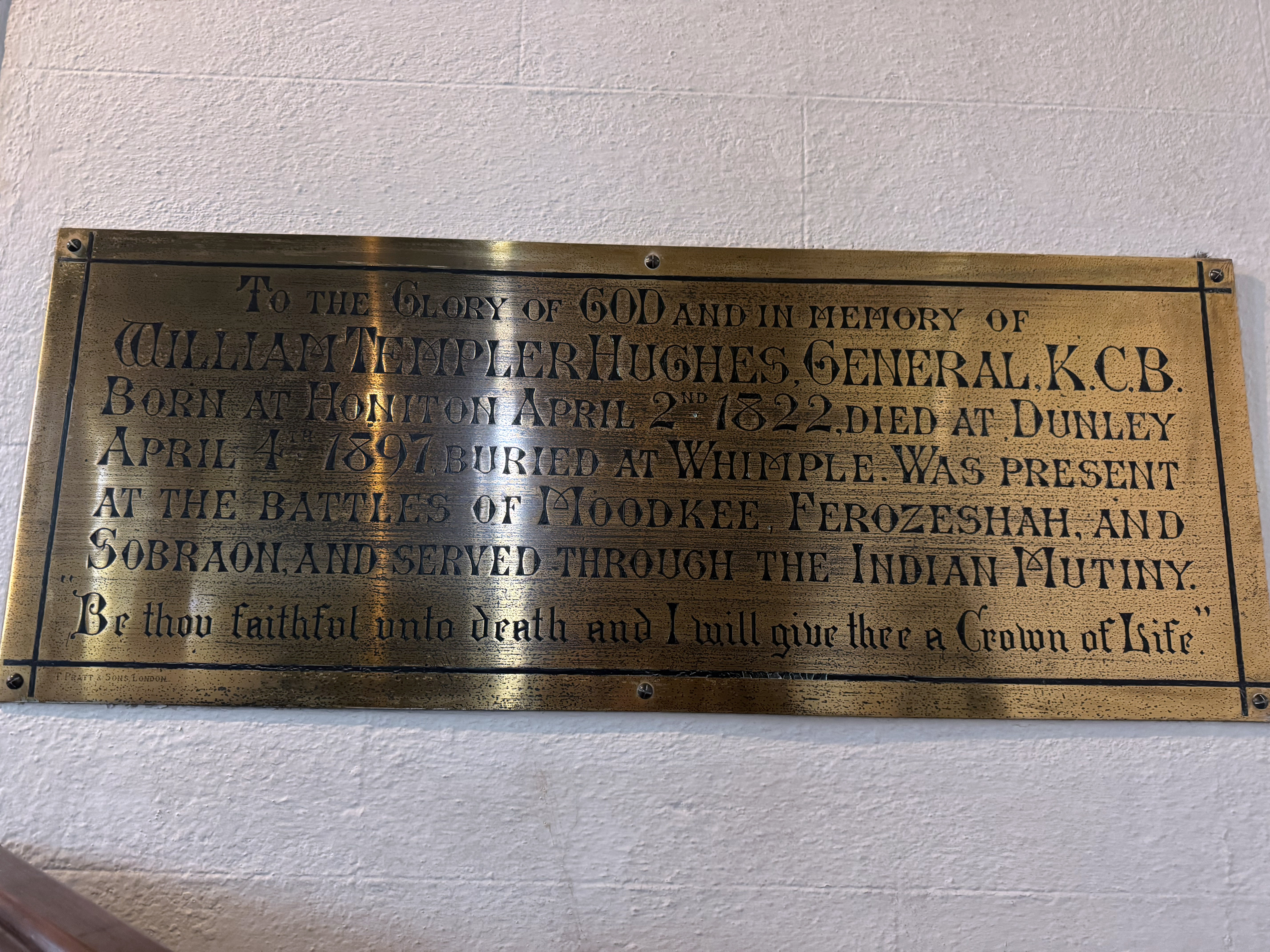
General Sir William Templer Hughes KCB was born on 2 April 1822, the son of the Revd Henry Allwright Hughes, rector of Honiton, and Sophia Elizabeth, daughter of the Revd Edward Honywood. He entered the Bengal Army in 1842 and began a career that placed him in the principal campaigns of the mid‑nineteenth century on the North‑West frontier and in northern India. His early service was in the Sutlej Campaign of 1845–46 under Lord Gough, where he fought at Moodkee, Ferozeshah and Sobraon.
At Moodkee on 18 December 1845, Hughes took part in the first major engagement of the Sutlej Campaign. The battle was fought late in the afternoon after a long march, with British and Company troops meeting the Sikh Khalsa Army unexpectedly in broken, sandy ground. The fighting was confused and close‑range, conducted in failing light, with cavalry charges delivered on both sides and artillery brought into action at short distances. Casualties among senior officers were heavy, and the action demonstrated the strength and discipline of the Sikh forces. Moodkee opened the campaign and forced the British to concentrate their scattered units for the larger battles that followed.
At Ferozeshah on 21–22 December 1845, Hughes was engaged in a two‑day battle against entrenched Sikh positions. The British assault on the first day was made across open ground under sustained artillery fire, and although parts of the Sikh line were entered, the attackers were unable to secure the whole position before nightfall. Fighting continued in darkness, with units becoming intermixed and ammunition running low. The second day saw renewed attacks supported by fresh troops, eventually forcing the Sikhs to withdraw. The battle was marked by severe losses, disorganisation during the night, and the recognition that the Khalsa Army’s artillery and field fortifications posed a serious challenge to British methods of attack.
At Sobraon on 10 February 1846, Hughes took part in the decisive action of the campaign. The Sikh Army had constructed a fortified bridgehead on the eastern bank of the Sutlej, protected by earthworks, artillery and a pontoon bridge to the opposite bank. The British assault was made along the whole line, with repeated infantry attacks supported by massed artillery fire. Once breaches were made in the Sikh works, the defenders were driven back towards the river, where the pontoon bridge collapsed under the weight of retreating troops. Many were killed attempting to cross. The destruction of the bridgehead ended organised Sikh resistance and brought the campaign to a close. Sobraon was regarded by contemporaries as one of the hardest‑fought battles of the period, and it secured British control of the Punjab.
Hughes next served in the Punjab Campaign of 1848–49, which completed the annexation of the Sikh kingdom. The fighting included the battles of Chillianwala and Gujrat, although his obituary records his service more generally as participation in the conquest of the Punjab. The campaign involved extended marches, river crossings and engagements against Sikh and Afghan forces resisting British control. He received the Punjab medal for this service.
He then served on the Peshawar frontier with General Sir Colin Campbell’s force in 1851–52, and on the Eusufzai frontier in 1852. These operations consisted of punitive expeditions and skirmishes against tribal groups resisting British authority. The actions at Naodund, Pranghur and Skakote, in which he was engaged, were typical of frontier warfare: rapid movements, attacks on fortified villages, and the dispersal of local forces. For this he received a medal and clasp.
During the Indian Mutiny of 1857–58 he served throughout the campaign and was repeatedly mentioned in despatches. After the fall of Delhi he succeeded to the command of Hodson’s Horse, a cavalry regiment raised during the siege and subsequently incorporated into the reorganised Indian cavalry establishment. His obituary notes that he took over the regiment after the taking of Delhi, placing him in command during the period of pursuit and pacification that followed the storming of the city. He later commanded the Central India Horse from 1856 and, after transfer, the Punjab Frontier Force as Brigadier‑General, and subsequently the Sirhind Division of the Army in India.
His long service was recognised by appointment as Companion of the Bath in 1869 and Knight Commander of the Bath in 1891. He was granted a good service pension in 1870 and was repeatedly thanked by Government for his conduct in the field. His commands included the 1st Punjab Cavalry, a brigade of Hodson’s Horse, a brigade of the Central India Horse with associated political duties, and senior frontier and divisional commands. These appointments reflect the pattern of his career: cavalry leadership, frontier operations and administrative responsibility in regions where military and political authority were closely linked.
Hughes married first, in 1855, Katherine Mary Buller, daughter of Thomson Wentworth Buller RN of Street Raleigh, Devon. After her death in 1872 he married, in 1876, Georgiana Maria Phillpotts, daughter of the Archdeacon of Exeter. He retired to Dunley, Bovey Tracey, where he died on 5 April 1897. His memorial at Chudleigh Knighton summarises a career that spanned the major campaigns of the Company’s final decades and the early years of Crown rule, and records the battles in which he served as they were understood by his contemporaries: Moodkee, Ferozeshah, Sobraon, the Punjab, the frontier expeditions and the Mutiny.