

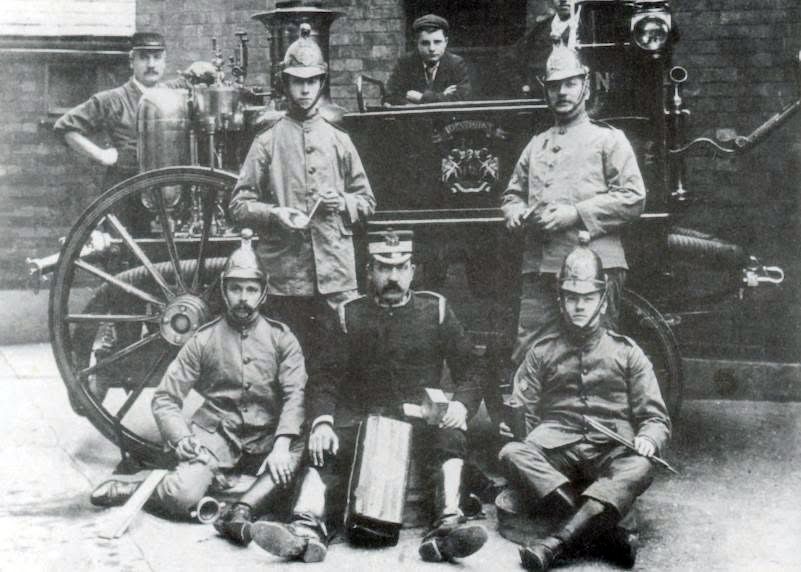
Exeter’s reputation as “The Fiery City” was well established by the nineteenth century, and the disaster at the Theatre Royal on 5 September 1887, when 186 people died, forced the Corporation to take direct responsibility for fire‑fighting. Until then the task had been left largely to the fire‑insurance companies, but the scale of the tragedy made that arrangement indefensible. When the new municipal brigade was created the councillors appointed a Kentish fireman, William Pett, to organise and command it.
Pett had been born in Kent in 1858 into a family with long connections to engineering and fire‑fighting. Earlier generations had worked in the Chatham dockyards, and when that industry declined the family moved to Sevenoaks to establish an engineering works. Pett joined the Sevenoaks Fire Brigade at sixteen, rising to sub‑engineer and then chief engineer. By the time he applied for the Exeter post he was married with two sons, and his experience stood out among the thirty‑eight candidates interviewed. He was appointed in January 1888 at forty shillings a week, and on 1 March the Exeter Fire Brigade formally came into being.
He set about the task with energy, introducing new equipment, new methods and a disciplined training regime for the locally recruited firemen. Pett led from the front and refused to ask any man to do something he would not do himself. His competitive streak was well known. In 1893 he became national champion for single‑man fire‑engine drill, and in the same year his brigade won the International Challenge Trophy at the Grand International Fire Tournament and Exhibition. Local competitions were taken seriously, and Pett frequently topped the results, whether in manual engine drills or the more eccentric bicycle hurdle races.
He continued to modernise the service throughout the 1890s. He patented improvements to fire‑fighting equipment, devised a coded whistle system to replace shouted orders, and travelled widely to inspect other brigades in Britain and Europe. In January 1914 he introduced Exeter’s first motor fire engine, the Merryweather Exonia, which towed the older steam‑driven Devonia pump. He also rescued and restored one of the country’s earliest fire appliances, dating from 1626, which he later loaned to the International Fire Exhibition at Earl’s Court.
Pett lived at the Fire House in New North Road and was often the first to answer the telephone when a call came in. Away from duty he enjoyed shooting and played cricket for the Exeter Cricket Club. In one representative match against a visiting MCC side that included W. G. Grace, Pett scored seventy runs while Grace was dismissed without scoring, a detail that suited his competitive nature. His wife Emily was active in the Red Cross and served as Quartermaster, later Commandant, of Devon’s 52nd Exeter Division.
His sons inherited the family inclination towards fire‑fighting. Montague William Pett, born in 1880, joined the Exeter Brigade before volunteering for service with the Imperial Yeomanry Hospitals during the Boer War. After returning to England he worked with Merryweather and Sons to deepen his technical knowledge, and in 1905 he became the first professional English fireman appointed to command the Singapore Fire Brigade. He reorganised the service, oversaw the construction of the Central Fire Station on Hill Street, modernised equipment and improved conditions for the firemen. After seven years he left Singapore to take charge of the Shanghai Municipal Fire Brigade, where he introduced street fire alarms and wireless telephones. He died in Exeter in 1940 after a long illness.
Algernon Pett, the younger son, took the family’s expertise in a different direction. He was the first man to take a fire engine to South Africa, helping to introduce mechanised fire‑fighting to a part of the world where such equipment had scarcely been seen. His work there was practical and technical rather than administrative, but it extended the reach of the Pett family’s influence and demonstrated how far Exeter’s fire‑fighting methods had travelled by the early twentieth century.
After nearly forty years of service to Exeter, William Pett retired in May 1927. He was presented with £100, a gold watch and an illuminated address, and was awarded the firemen’s VC by Lord Ampthill. He died on 15 July 1934 after being taken ill in his garden and was buried in Higher Cemetery beneath a headstone carved in the form of a fireman’s helmet, a fitting acknowledgement of a man who had shaped the city’s fire‑fighting service from its beginning.