

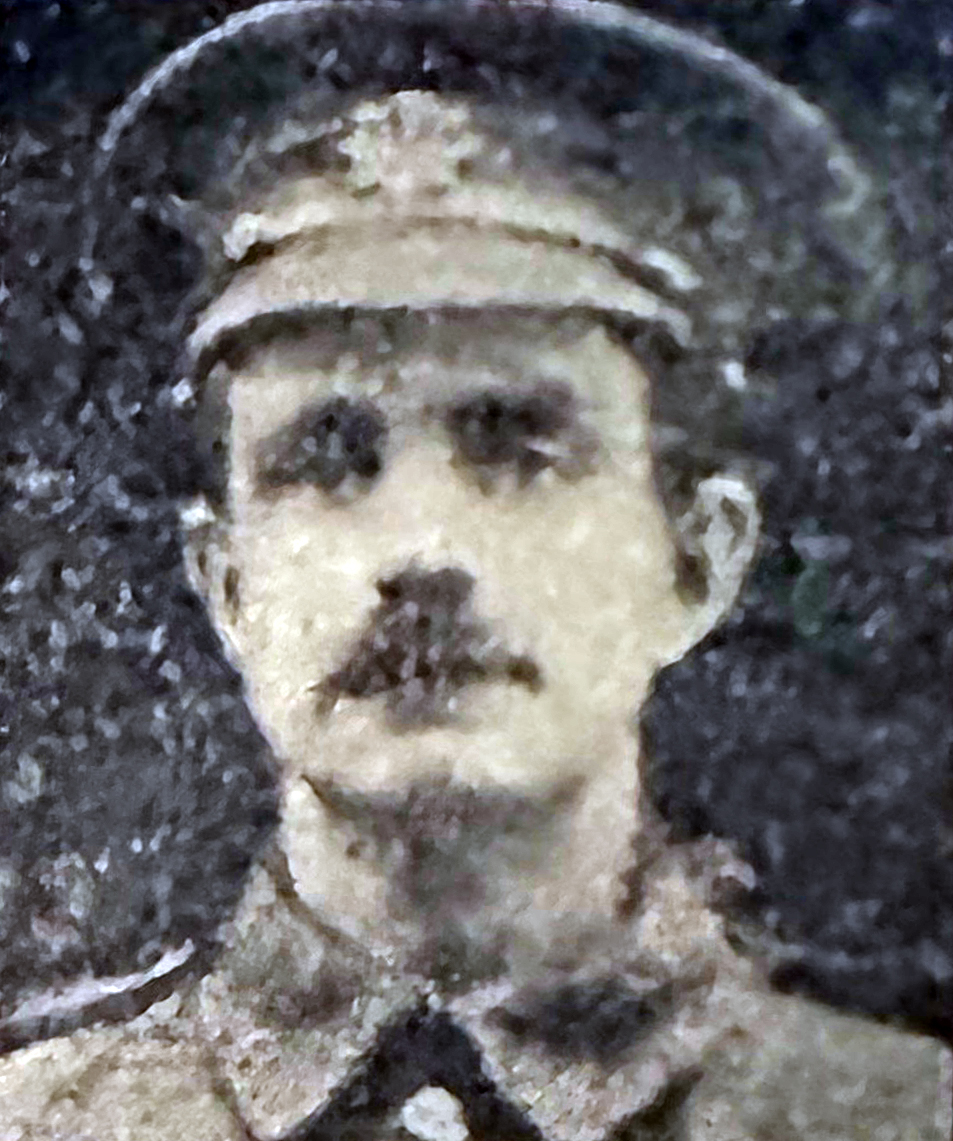
William Henry Hunt was born on 14 February 1877 at Upton Hellions, near Sandford in Devon, the second son of Thomas Hunt and Lydia Bennett. His father, originally a soldier and later an agricultural labourer, came from Cheriton Fitzpaine; his mother from Morchard Bishop. The family moved frequently, a pattern typical of rural working households. In 1881 Lydia was recorded as a soldier’s wife living at New Buildings, Sandford, with four children, while Thomas was absent on service. By 1891 the family was at Traysbeare Cottage, Clyst Honiton, where William, aged fourteen, was working as a farmhand after attending school at Sowton.
Thomas Hunt died in 1896, leaving Lydia widowed with several children. By 1901 the family was living at Hookway, Crediton. William, then twenty‑four, was employed as a horseman on a farm, a physically demanding but common occupation in Devon at the turn of the century. On 8 February 1902 he married Rose Alice Moore of Hookway. Their daughter, Alice Elizabeth, was born the following year. The 1911 census places the family at Lower Marshrow, Exminster, where William was working as a wagoner, a job requiring competence with horses, equipment and transport.
William first attempted to enlist in the Army Service Corps at Exeter on 26 January 1915, joining as T/4/056001. He was sent to Aldershot but discharged after five days under King’s Regulations 392(iii) as “not likely to become an efficient soldier”. Despite this, he successfully enlisted again later that year, in August 1915, as Private 20041, 2nd Battalion, The Devonshire Regiment. His younger brother Albert enlisted at the same time.
Hunt joined the 2nd Devons in France during the build‑up to the Somme offensive. In the spring and early summer of 1916 the battalion was engaged in constructing communication trenches, assembly positions, cable lines and water systems — the unglamorous but essential groundwork for the attack. On 1 July 1916, the first day of the Battle of the Somme, the battalion advanced at 7.30 a.m. behind the lifting barrage. They were met almost immediately by concentrated machine‑gun fire. The battalion suffered 248 killed and 194 wounded. Hunt was among those killed in the opening assault.
He was thirty‑nine years old. His body was later identified during exhumation in 1927 by his uniform, boots and titles, and he now lies in Serre Road Cemetery No. 2, grave XV.B.10. His service entitled him to the British War Medal and the Victory Medal. His personal effects, amounting to £1 16s 1d, were paid to his widow on 19 September 1916, followed by a war gratuity of £3 in 1919. Rose Alice Hunt received a dependant’s pension of 25 shillings per week for herself and their children. She remarried in 1920 to R. J. Mills of Sowton and died in 1923 at the age of forty‑three.
William Hunt’s name appears on the memorial plaque in St Mary’s Church, Clyst St Mary, and on the memorials at Exminster and Clyst Honiton. His brother Albert, serving as Private 20037, 8th/9th Battalion, Devonshire Regiment, died of pneumonia in Italy on 6 November 1918. The two brothers, who enlisted together in 1915, are commemorated on separate fronts of the war.

