

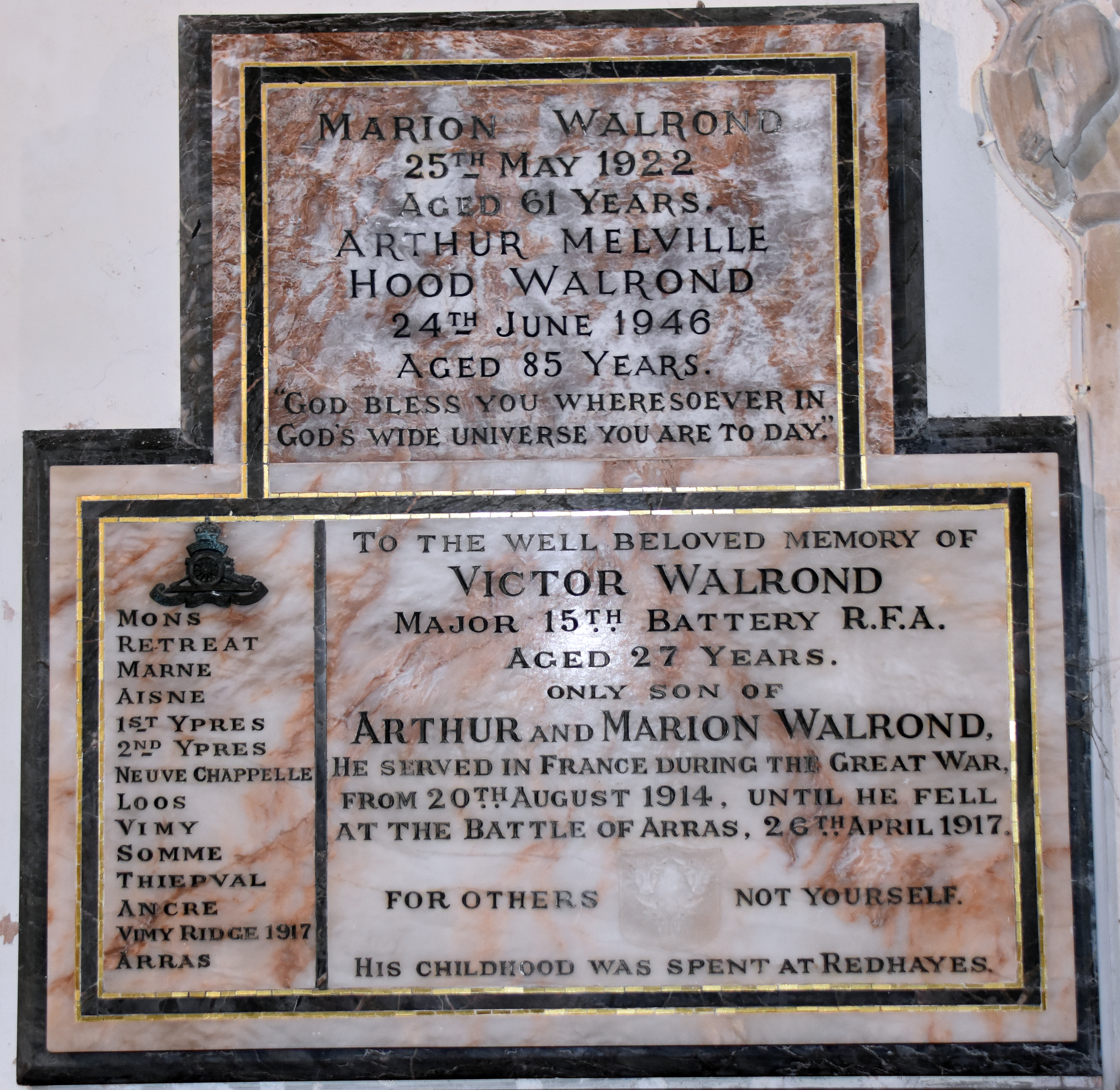
Major Victor Walrond, commemorated in St Michael and All Angels, Sowton, came from a prominent Devon family whose connections ran through both county society and national politics. He was a nephew of Lord Walrond of Bradfield House near Cullompton, an influential Conservative politician, and the son of Arthur Melville Hood Walrond, also born at Bradfield. His mother came from the Coleridge family of Ottery St Mary, linking him to another notable local lineage. The memorial in Sowton records not only his name and rank but a long list of battles, tracing a career that took him through almost every major British engagement on the Western Front before his death at Arras in 1917.
Walrond served in the Royal Field Artillery from the very start of the war and was present with the guns during the Retreat from Mons, the first major action of the British Expeditionary Force in August 1914. From there he went on to the Marne and the Aisne, as the Allied armies checked the German advance and the war settled into trench stalemate. He saw further action at Neuve Chapelle and La Bassée, at Givenchy and Festubert, and in both the First and Second Battles of Ypres. The Sowton memorial also records his presence at Loos, Vimy, the Somme, Thiepval and the Ancre, a sequence that mirrors the grim itinerary of the British Army’s Western Front campaigns between 1914 and 1916.
By 1917 Walrond was a major commanding the 15th Battery of the XXXVI Brigade, Royal Field Artillery. In the spring of that year the brigade was positioned north of Bailleul in preparation for the Battle of Arras, part of General Nivelle’s wider offensive. The German artillery in this sector was particularly active and accurate, and the divisional guns came under heavy and sustained fire in the days before the main attack. Contemporary accounts note that the gunners had a strenuous time, with batteries repeatedly shelled and casualties mounting even before the infantry went forward.
On 26 April 1917 the officers of the XXXVI Brigade were gathered in a dug-out for their afternoon meal. A German shell fell at the entrance and exploded, with devastating effect. Major Victor Walrond, commanding the 15th Battery, was killed outright, along with Major Philip Gerald Bailey of the 48th Battery and Second Lieutenants W. H. Manifold and Howell Thomas Ball of the 15th. The loss of two battery commanders and two junior officers in a single moment was a severe blow to the brigade and a stark illustration of the vulnerability of artillery headquarters positions under accurate enemy fire.
The days around Walrond’s death were costly for the artillery as a whole. The XXXIV (Army) Brigade reported three 18‑pounder guns and one 4.5‑inch howitzer completely destroyed, together with twenty casualties among the gunners. The XLI Brigade also suffered losses in officers and men. The Arras offensive would later be remembered for the high daily casualty rate suffered by the British Army, higher even than at the Somme, and the artillery’s exposure to counter‑battery fire was a significant part of that toll.
In Sowton Church, Major Walrond’s memorial stands close to that of Lieutenant Thomas Marwood Hext of the King’s Royal Rifle Corps, another local man killed in the same Battle of Arras just two days later, near Oppy. Hext had only reached the front in January 1917 and was dead within three months; his body was never recovered and his name is recorded on the Arras Memorial. The presence of both names in the same small parish church, and the likelihood that their families knew each other, underlines how the great battles of the Western Front reached deep into the rural communities of Devon.

