

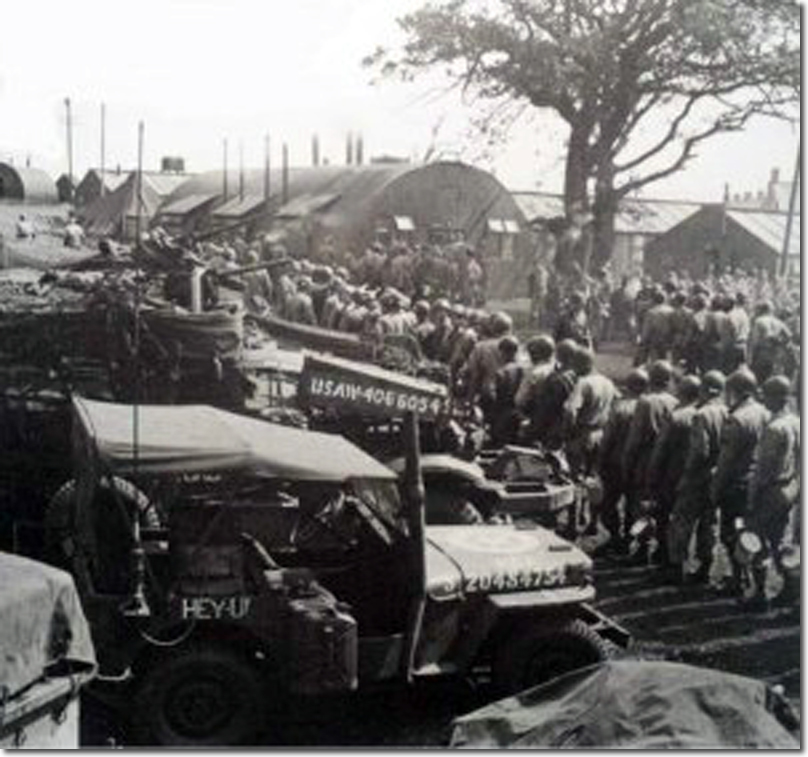
The arrival of the United States Army in Marldon during the Second World War was one of the most dramatic transformations the village had ever experienced, a sudden shift from rural quiet to the restless energy of a foreign army preparing for the largest amphibious invasion in history. Before 1943, the war had touched Marldon only at the edges. Elizabeth Goudge remembered the early years as a time when Westerland remained “as peaceful as it was beautiful,” the war something heard in the distance rather than seen. The first bombs to fall on the parish were two jettisoned by a German aircraft in a sloping field opposite her cottage, a reminder that danger could arrive without warning, but the village itself remained largely untouched. The nearest true horror was the destruction of St Marychurch parish church in Torquay, where a Sunday school full of children was killed in May 1943. Even then, Marldon felt sheltered, a place where the war was something endured rather than directly suffered.
That sense of distance vanished with the first American arrivals. They were Black non‑combat engineers, sent ahead of the main force to prepare the camps, lay out services, and build the infrastructure that would support tens of thousands of troops. They were the first Americans many villagers had ever seen, and they were welcomed with a warmth and equality that contrasted sharply with the segregation they faced at home. In Marldon they were simply soldiers, and they responded with courtesy, humour, and a generosity that quickly made them popular. Social evenings were arranged, and many were invited into local homes. For a brief moment, the village offered them a glimpse of a life without the racial barriers that shaped their own country.
As the build‑up intensified, the white conscripts arrived in overwhelming numbers, taking over the camps and bringing with them the swagger, confidence, and prejudices of young men far from home. Tensions flared, especially when local girls were involved, and the military authorities eventually imposed strict zoning to keep units apart. One boundary ran at Churscombe Cross, and crossing it could lead to trouble. The villagers, unused to American racial divisions, found the situation baffling, but the sheer scale of the influx left little room for negotiation. The Americans were everywhere, and the village had to adapt.
Despite the tensions, the Americans were unfailingly generous to the local children. They recognised instinctively that the schoolboys were the first link in village society, and the boys in turn supplied them with local knowledge: where they were in England, where the dances were held, and where the prettiest girls lived. In return came gifts from the PX stores — chocolate, gum, cigarettes, and luxuries unseen since the war began. Their camp shops were vast warehouses of abundance, and some of that abundance inevitably spilled into the village. To children who had grown up under rationing, the Americans seemed impossibly well supplied, their pockets full of things that had become almost mythical.
The roads filled with convoys of jeeps, trucks, and half‑tracks, driven with exuberance through lanes never designed for such traffic. In the pubs, trade boomed. For a while, life seemed almost festive. But the scale of the American presence soon became overwhelming. Waste from the camps grew so great that a special pig‑food processing centre had to be created at Edginswell. Dances in the Village Hall became impossible as the numbers swelled, and the camps began hosting their own events, drawing away most of the local girls. The British soldiers who had been stationed in the area earlier — older, quieter, and equipped with little more than a few trucks and bicycles — were eclipsed by the Americans with their smart uniforms, their money, their transport, and their Hollywood glamour.
Elizabeth Goudge’s memories capture the moment when the American presence shifted from novelty to something more ominous. “The American army was now everywhere,” she wrote, “and gradually all of us in the village began to realise that some hidden undertaking was going on around us.” Lanes were sealed off, orchards and woods closed, and the rumble of heavy lorries became a nightly soundtrack. Only when a neighbour remarked that a single air‑raid could blow the village “sky‑high” did she understand that the quiet Devon countryside was filling with ammunition dumps. The leafy, shady places she loved were no longer simply part of the landscape; they were part of a vast military machine.
By early 1944 the build‑up was unmistakable. Bulldozers and cranes arrived, some of them machines the villagers had never seen before. Engineers practised endlessly in the fields off Farthing Lane, sometimes racing their machines for amusement. Schoolboys were given rides and, in the way of wartime childhoods, learned more about explosives than any adult would have thought wise. At Kiln Road quarry, American combat troops practised cliff‑climbing in preparation for the assault on Pointe du Hoc. Amphibious DUKWs arrived from Plymouth, lumbering through the lanes and alarming anyone who met them head‑on. Mines were laid and cleared in training exercises between Occombe and Five Lanes, and the boys, fascinated, sometimes crept out at night to set off harmless detonators for the entertainment of their classmates.
The scale of the American presence was such that the village became a kind of theatre of war in miniature. The fields at Cadewell were taken over; the playing field at Cricketfield Road was fenced with barbed wire; Shiphay filled with tents and engineers; and the woods at Berry Pomeroy became one of the largest ammunition dumps in the area. The American 7th Field Hospital arrived and set up its tents opposite the Vicarage, its nurses relying on local women for laundry and small domestic tasks. The Americans paid well, and the arrangement suited everyone.
Elizabeth Goudge’s account of the night before D‑Day is one of the most evocative descriptions of that moment in South Devon. She remembered a still, windless night filled with a low, ceaseless rumble “like a lot of grumbling dragons,” as the American convoys moved out towards the coast. No bombs fell, and the next morning brought a silence so complete that the village seemed deserted. Torbay, once crowded with shipping, lay empty. The sealed lanes and guarded orchards were suddenly open again, “silent and a little haunted.” The Americans had gone. The invasion had begun.
In the days that followed, the scale of what had been happening became clear. The troops had embarked for Slapton Sands to rehearse the landings in Operation Tiger, and then, in early June, they left for Normandy. When they returned briefly on 29 April after the rehearsal, they came over the hill from the Beacon in a procession of tanks, guns, half‑tracks, and lorries that seemed endless. But by 2 June they were gone again, this time for good. On D‑Day, 23,250 men of the “Torbay Army” landed at Utah Beach, along with more than 1,700 vehicles.
What remained in Marldon was an uncanny emptiness. After years of saturation, the sudden absence of men and machines was almost unsettling. But the village had been part of something vast, and for a short time its lanes, fields, and hedgerows had held the weight of an army preparing for the most ambitious amphibious assault in history. Elizabeth Goudge later wrote that peace returned and Marldon became “once more a safe place for children,” but the memory of those months — the noise, the secrecy, the glamour, the danger — never entirely faded.

