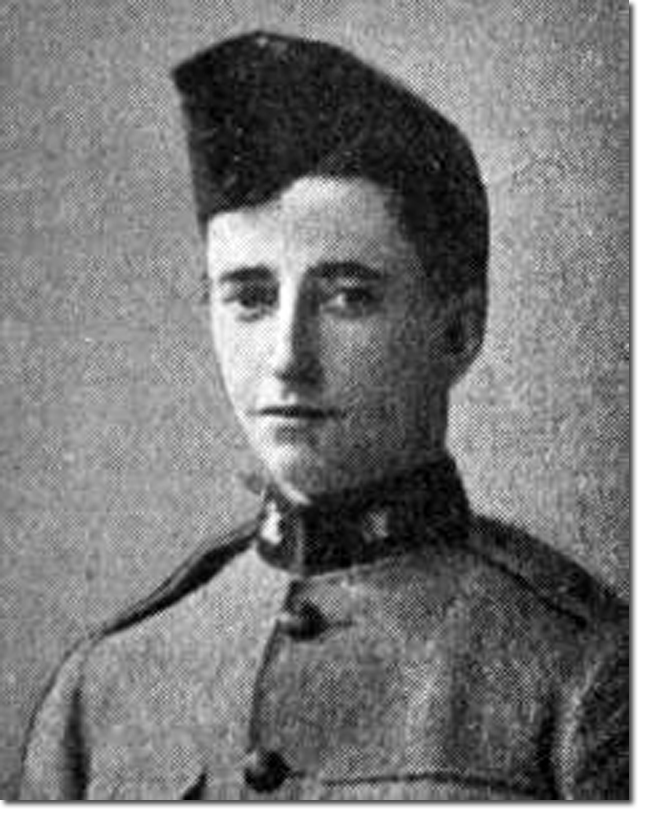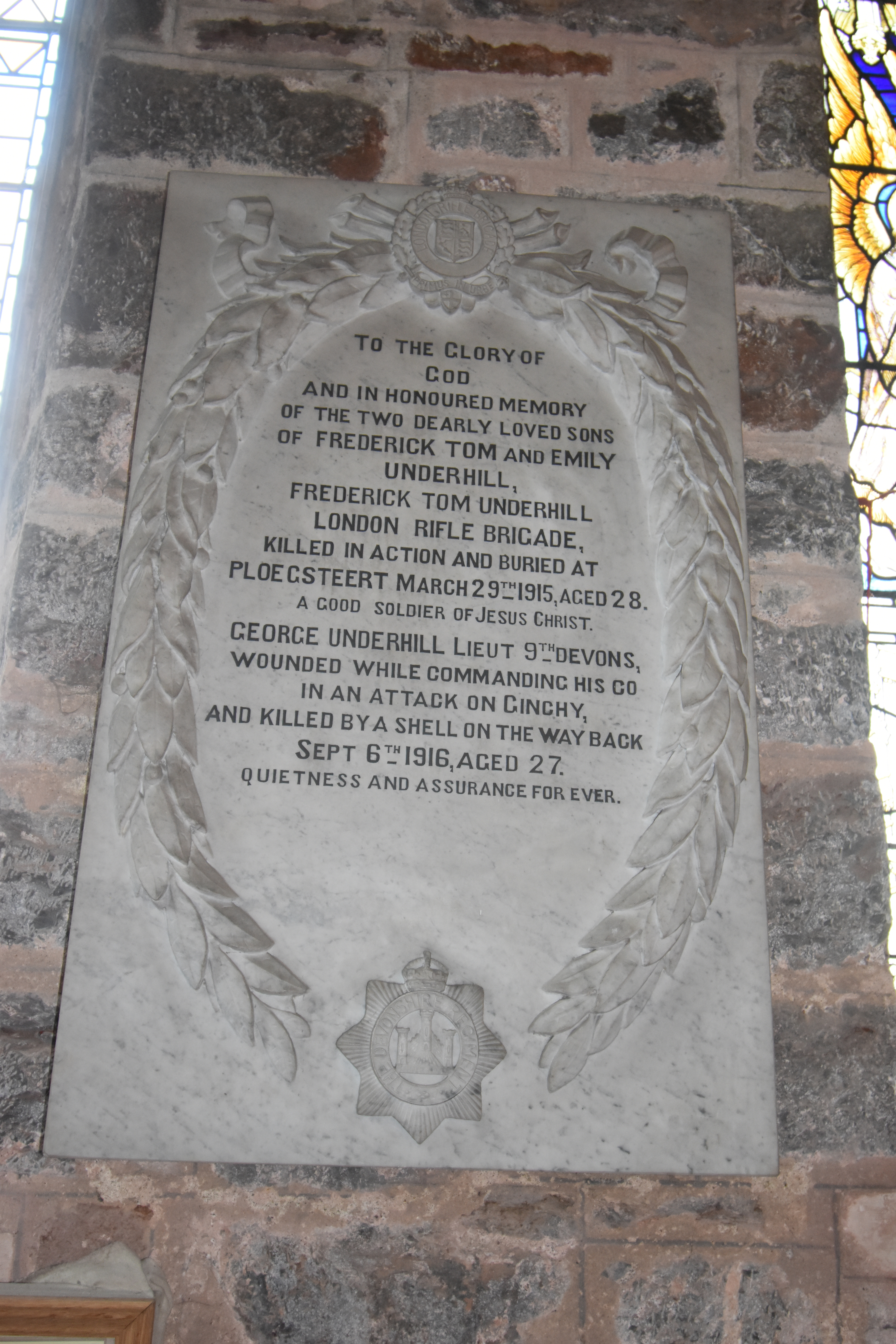
The story of the Underhill brothers is one of the quiet tragedies behind the memorials of the Great War, and in Marldon it is felt with particular sharpness. When the church finally became a parish in its own right in 1912, one of its earliest duties was the sombre task of commemorating the village’s dead. Among the names on the official plaque, a private memorial to Frederick Thomas “Bunny” Underhill and his younger brother George stands apart, a reminder that for some families the war did not merely take sons but extinguished entire households.
The Underhills had already endured loss long before Europe descended into conflict. The boys’ father, Frederick Tom Underhill, a prosperous farmer at Aptor Marldon Farm near Aveton Gifford, died in 1897 within days of his young daughter Zoë. The farm lease was surrendered, and Emily Underhill was left with two sons and a life abruptly reshaped by grief. Freddie, then ten, was sent to Bancroft’s School as a boarder, while George — born on 27 September 1888 and baptised in Marldon the following summer — went to Lewisham Lodge School in Weston-super-Mare, where the 1901 census records him as a boarding pupil aged twelve. At Bancroft’s, Freddie — soon universally known as “Bunny” — thrived. He was a gifted sportsman, playing in both the cricket and football elevens, remembered as “a splendid sportsman, incapable of anything that was not cricket,” a centre-forward quick to seize any opening and lethal with either foot.
After leaving school in 1902 he joined the Old Bancroftians, lived with his mother and brother in Balham, and worked for a tea and spice merchant, first in Plymouth and later in the City. His life in London revolved around sport and the Old Bancroftian community: he became vice-captain of the OB Football Club, represented the Essex Amateur Football Association, and was a hard-hitting batsman for the OB Cricket Club. He was also a driving force in the newly founded Old Bancroftians’ Association, attending dinners, serving on committees, and helping to shape an organisation that would soon find itself supporting members scattered across the battlefields of France and Flanders.
George’s early adult life took a different path. By 1911 he was living with his widowed mother at 19a Emmanuel Road, Balham, working as a lace and trimmings sales traveller. His civilian life was settled enough for him to accumulate modest savings, later reflected in his probate records, but like his brother he volunteered for service. He enlisted as a young officer in the 9th (Service) Battalion, Devonshire Regiment, rising to lieutenant (his Medal Index Card also noting the rank of captain). The same card records that he first landed in France on 2 October 1915, joining the battalion as it prepared for the long campaigns ahead.
When war broke out in 1914, Bunny enlisted at once in the West Kent Yeomanry. The cavalry, however, had little place in the new industrial warfare, and by October he had transferred to the 5th Battalion, London Regiment (Rifle Brigade). He arrived in the Ypres sector on 6 November 1914, stepping into a world of mud, filth, and exhaustion that bore no resemblance to the patriotic imaginings of the previous summer. A veteran later captured the shock of arrival: “We had been brought up on histories of the Boer War and patriotism and heroics… Well in about half a minute I wondered what the devil I had gotten myself into because it was nothing but mud and filth.”
Bunny’s own letters home strike the same note of stoic understatement. He wrote of bullets “whizzing about,” of flooded trenches, of the cold and the rain, but always ended with reassurance: he was fit, he was cheerful, he was managing. He longed for a game of football. He fought alongside fellow Old Bancroftians John Gray and William Henry Peppiatt, both of whom would also fall. In late March 1915, during a major attack at Ploegsteert, Freddie “Bunny” Underhill was killed in action. He was twenty-eight. He lies today in Rifle House Cemetery, Ypres.
George Underhill followed his brother to the Western Front in October 1915 as a lieutenant in the 9th Battalion, Devonshire Regiment. He fought through the Somme campaign, and at the Battle of Ginchy in September 1916 he commanded an attack that formed part of one of the few British successes of that terrible summer. As his men withdrew, George was killed by a shell on 6 September 1916. He was twenty-five. His body was never recovered, and he is commemorated on the Thiepval Memorial to the Missing of the Somme. His name also appears on the Bigbury war memorial and in the Baptist church at Marldon. He was awarded the 1915 Star and the British War and Victory Medals, which his mother applied for on 27 January 1919 from her address at Knowle, Aveton Gifford. Probate records show that he left an estate valued at £1,041 4s 9d, and his personal effects — £0 9s 4d initially, followed by £84 16s 4d — were paid to Emily in late 1916 and early 1917, with a war gratuity of £6 issued in November 1919.
For their mother, Emily, the loss was absolute. Having already buried her husband and daughter, she now lost both her sons within eighteen months of each other. By 1919 she had returned to Devon, carrying with her the remnants of a family broken by disease and war.