

Thomas Rogers Kitsell, architect, was born at Ticknall, Derbyshire, in 1864, the elder son of Thomas Kitsell, an Inland Revenue Excise Officer, and his wife Emma. He was christened on 10 April 1864 at the Church of St George, Ticknall. His early education was at George Watson’s College, Edinburgh, followed by Fine Art classes at Edinburgh University. In 1878 he was articled to Sir Robert Rowand Anderson, one of Scotland’s foremost architects, and remained in his office until 1888. Over the next two years he gained further experience as chief assistant to Francis Grinham Howell, assistant to John Alfred Gotch of Kettering, and chief assistant to Charles Edwin Ponting in London. Considered a highly promising pupil, he won both the Welby Pugin scholarship and the Tite prize. In 1891 he passed the qualifying examination and was elected ARIBA on 8 June, proposed by J. A. Gotch, J. A. Morris, and C. H. Howell. He later exhibited at the Royal Academy Summer Exhibition in 1907 and 1910.
Kitsell commenced independent practice in January 1891 when he succeeded to the practice of A. W. Cross at 9 West Street, Weston‑Super‑Mare. Early in his career he accepted a government appointment and was engaged by the Royal Engineers, who maintained drawing offices around the country for the design of military installations for the Board of Ordnance in Pall Mall. These offices were often staffed partly by civilians, and in this capacity he was sent to Plymouth to work on the construction of the barracks at Crownhill. He remained with the Royal Engineers for eight years before re‑establishing an independent practice in Plymouth in 1900.
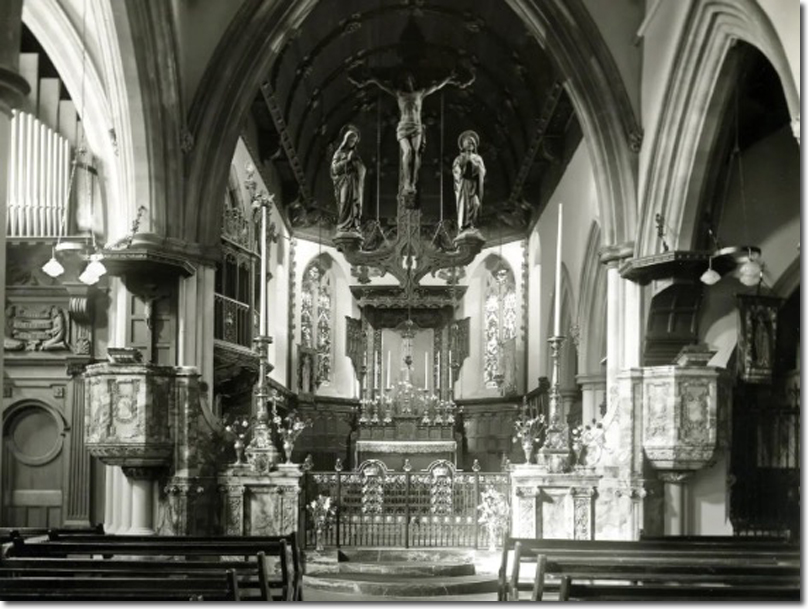
In the West Country he undertook a considerable amount of ecclesiastical work. He was employed by Athelstan Riley on work at Petherick near Padstow, and carried out improvements at Egg Buckland Parish Church. He was architect of the new church of St Mary, Laira, built as part of the Three Towns’ Church Extension scheme, and his design for the church was exhibited at the Royal Academy in 1910. He executed elaborate work at St James‑the‑Less (shown above), Plymouth, including marble pulpits and a chancel screen. In 1903 he designed the Drake Institute for Soldiers and Sailors on Devonport Hill beyond the Halfpenny Gate, and Crownhill Board School at Honicknowle.
After 1905 his promising career was severely checked by two misfortunes: increasing physical disability and an arbitration case that resulted in bankruptcy. From 1905, if not earlier, he suffered from neuritis, a painful condition that gradually incapacitated his legs. By 1908 he was housebound and thereafter had to be wheeled about in a bath‑chair. His bankruptcy arose from an arbitration case concerning a house he had superintended on the Vinstone estate at Hartley for Mrs Haydon. Dissatisfied with the work, she alleged professional negligence and claimed £1000. The arbitrator awarded her £45 and £25 towards her costs. Kitsell accepted the award, apparently unaware that this acceptance made him liable for the arbitrator’s fees, his own costs, and damages, amounting to about £350. His difficulties were compounded when, on 1 January 1910, he entered into partnership with Mr Barker, who paid £300 to join him. Under the terms of the deed the partnership dissolved automatically on bankruptcy, and the £300 became repayable. At his examination the chaotic state of his finances became clear: he had kept no books of account, explaining that he handled only three or four works per year and could easily compute his commission, and that he kept no record of expenditure.
On 30 June 1896, at the Parish Church of Ballingham near Ross, Herefordshire, he married Ann Kitsell, the youngest daughter of Alfred William Kitsell of Kilforge House, Ballingham. They had three children: Mary Pitt Kitsell, born 1901; Cecil Rogers Pitt Kitsell, born 1903; and Gordon Thomas Kitsell, born 1910.
Thomas Rogers Kitsell died on 18 May 1918 at Plymouth. He was buried in the Plymouth Corporation Cemetery at Egg Buckland, where his father had been interred the previous year.
His residences included Edinburgh (1878–1888); London (1890); 9 West Street, Weston‑Super‑Mare (1891); 2 Devon Terrace, Mutley (1897); 17 George Street, Plymouth (1907); The Parapet, Egg Buckland (1910); 46 Tavistock Place (1912); and 27 Portland Square, Plymouth (1914–1918).

