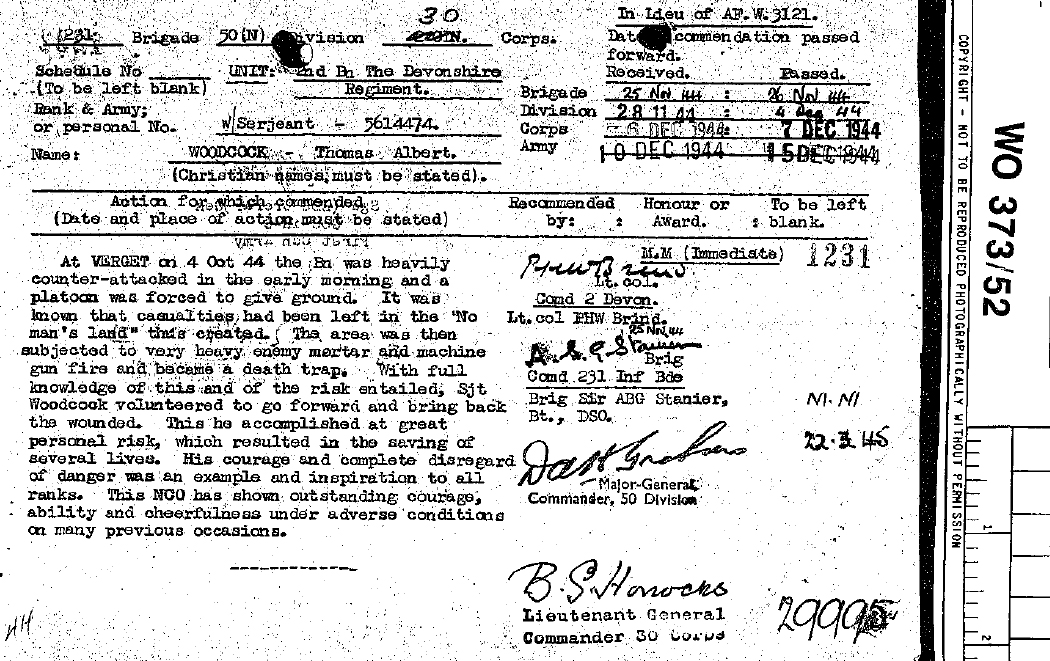
Sergeant Thomas Albert Woodcock served with ‘C’ Company, 2nd Battalion, The Devonshire Regiment, part of 231 Brigade, 50th (Northumbrian) Division. He appears in the battalion’s casualty lists as wounded on 28 September 1944 during the fighting on “The Island” north of Nijmegen as part of the Arnhem campaign. Less than a week later, on 4 October, he carried out the action for which he was awarded the Military Medal. The fact that he had only recently been wounded makes the citation all the more striking.
The Devons had moved into the Bemmel–Haalderen sector on 2 October, taking over from the exhausted battalions of 69 Brigade. ‘C’ Company was placed forward in the orchards at Vergert, an exposed position described in the battalion’s own records as “a most unhealthy spot”. The ground was waterlogged, visibility was limited by orchards and ditches, and German forces of Kampfgruppe Bruhn were operating in strength in the same area. Contact was close and movement in daylight was almost impossible.
On 4 October the battalion was heavily counter-attacked in the early morning. One of the forward platoons was forced to give ground, leaving several wounded men in the strip of no-man’s land created by the withdrawal. The area was then subjected to intense mortar and machine-gun fire. According to the official recommendation, Woodcock volunteered to go forward alone to bring back the wounded, fully aware that the ground was being swept by fire and that the position was effectively a death trap. He succeeded in recovering several men, an action described by his commanding officer as an example and inspiration to the rest of the battalion.
The Military Medal was recommended by Lieutenant-Colonel F. H. W. Britten, commanding 2nd Devons, and endorsed at brigade, divisional and corps level between 25 November and 10 December 1944. It was approved on 15 December. The citation notes that Woodcock had already shown “outstanding courage, ability and cheerfulness under adverse conditions on many previous occasions”.
The fighting on 4 October was part of the wider British counterattack to stabilise the Nijmegen bridgehead after the failure of Operation Market Garden. Horrocks ordered 50th Division to push the Germans back behind the Linge–Wetering Canal and to secure the orchards east of Bemmel. The Devons, Dorsets and Hampshires of 231 Brigade were heavily engaged throughout the first week of October. Several men of the Devons were killed on 4 October, and it is likely that Woodcock’s rescue attempts were made under the same fire that caused those casualties.
Woodcock survived the war and died in 1971. His grave in the churchyard of St Mary’s, Clyst St Mary, carries the badge of the Devonshire Regiment. The presence of his headstone among the older parish memorials is a reminder that the battalion’s history did not end in Normandy, and that the fighting on The Island in the autumn of 1944 was as costly and demanding as anything the Devons had faced earlier in the campaign.