

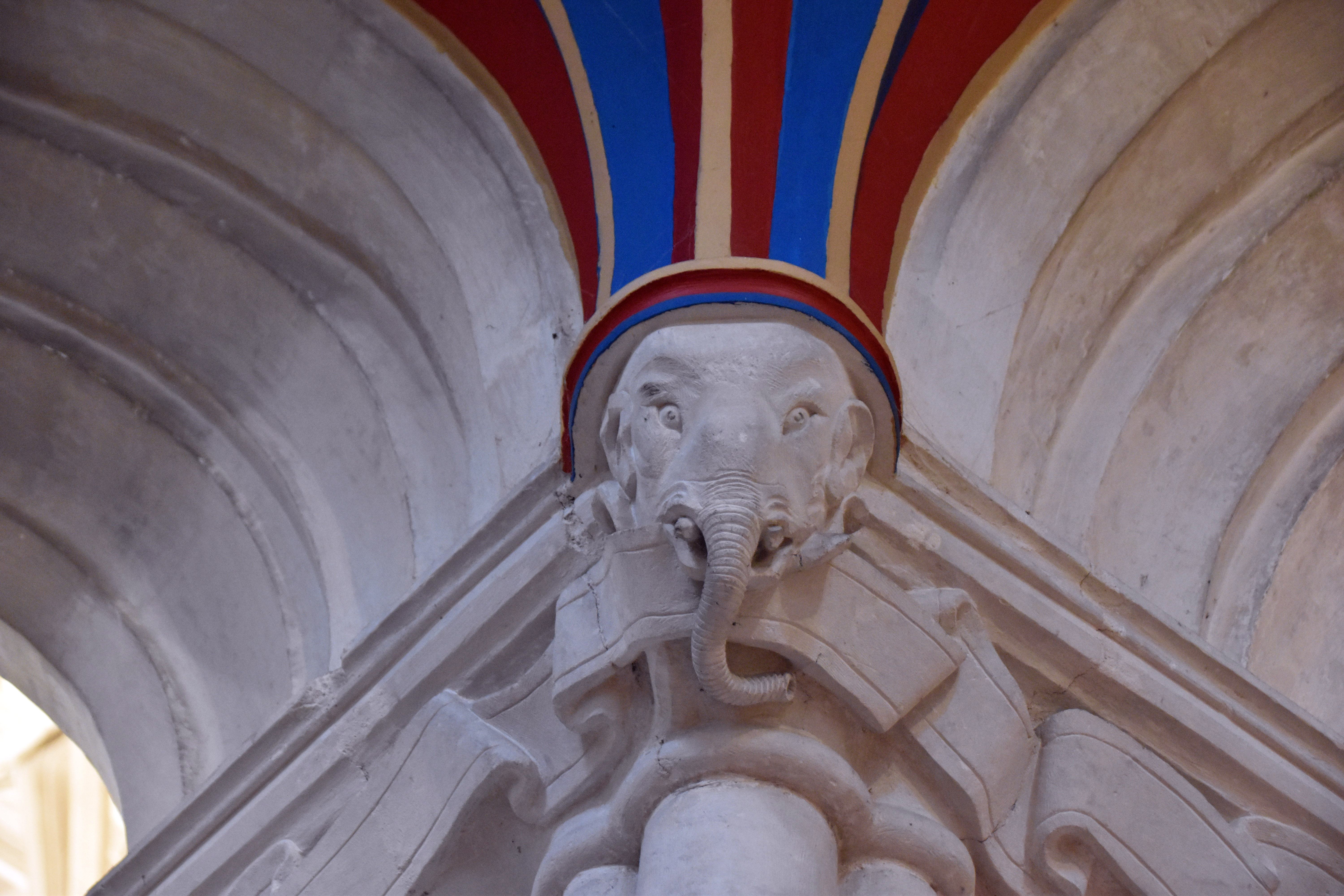
One of the most curious details in St Mary’s is the small medieval carving of an elephant, tucked away where you might miss it if you were not looking. It is immediately obvious that the sculptor had never seen an elephant in his life. The creature has the general bulk one might expect, but the ears are the giveaway: they sit high and round on the head like shields, nothing like the thin, fanned ears of the real animal. The legs are thick and column‑like, and the whole body has the compact, barrelled look of something imagined rather than observed. It is the work of a craftsman doing his best with a description, a traveller’s tale, or perhaps a sketch copied from a manuscript that was itself copied many times before.
This kind of guesswork is not unusual in medieval art. Elephants were known in Europe only through stories, bestiaries, and the occasional imported ivory, and the results were often inventive. In some manuscripts the elephant looks like a horse with a castle on its back; in others it resembles a bear with an improbably long nose. Romanesque capitals sometimes show elephants with hooves, or with ears like fish fins, or with faces that are almost human. Even in later centuries, when artists had slightly better information, the animal often appears with the wrong proportions, the wrong skin, or ears that belong to an entirely different species. The Ottery carving sits comfortably in this tradition: confident, sincere, and entirely inaccurate.
What makes the Ottery example particularly engaging is that it appears in a church otherwise full of precise and deliberate work. The misericords, the vaulting, the bosses and the tombs all show the hand of craftsmen who knew exactly what they were doing. The elephant, by contrast, is a moment of imaginative reach — a medieval mind trying to picture a creature that existed only in words. Its rounded ears and compact body tell us more about the limits of local knowledge than about the animal itself, and that is precisely what gives it its charm. It is a reminder that even in a building of great ambition and learning, there were still corners where the world beyond Devon was understood only in fragments.

