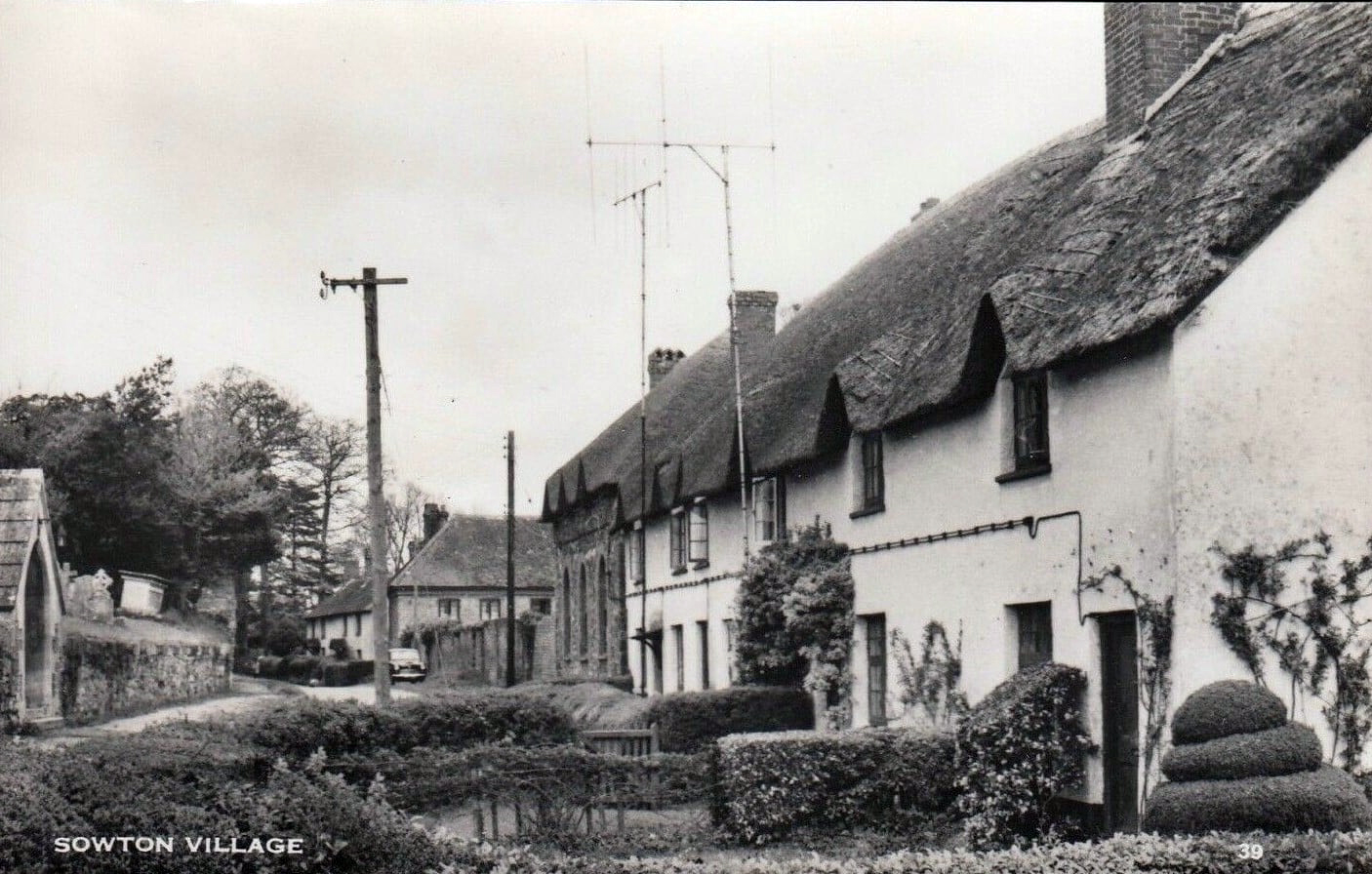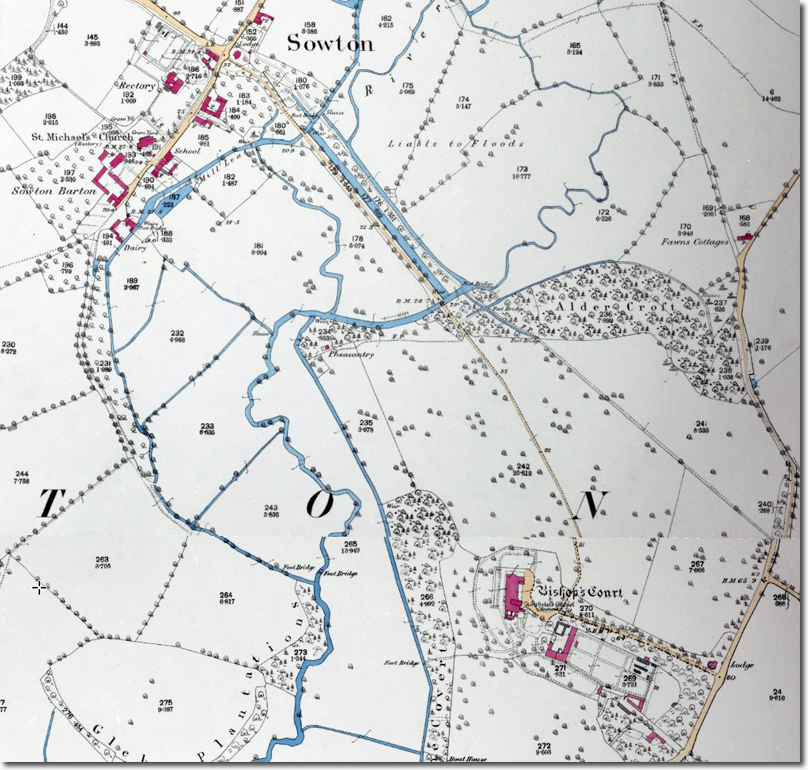
The parish of Sowton lies in south‑eastern Devon, about three miles east of Exeter. Once a wholly separate village, it is now divided from the expanding city only by the M5, which acts as a temporary limit to further development. The village is small and compact, set just south of the A30 in dead‑end lanes on the banks of the River Clyst. The parish has long been devoted to pastoral farming on the Clyst floodplain. Sowton itself stands on a slight rise at about ten metres above sea level, five above the river, which flows south to join the Exe at Topsham. Like most eastern Devon parishes it is small—under 1100 acres—but historically supported nearly 400 inhabitants. In Domesday the land was held by Bishop Geoffrey of Coutances and contained five ploughs, meadows, pastures and livestock.
Sowton is an ancient parish. Other places within it include Clist Satchfield. The parish has also been known as Clyst Fomison and Clyst St Michael, reflecting earlier arrangements among the “Clyst” settlements east of Exeter. Of the other Clysts which have not survived as separate parishes, Clyst Fomison is now the parish of Sowton.
In the early nineteenth century Sowton was described as a small village and parish in the valley of the Clyst, containing 1360 acres and 382 inhabitants. Of these, 215 lived in the village and in the tithing of Clist Sachville, with a further 71 in Farringdon parish on the opposite side of the valley. Clist Sachville was sometimes called Bishop’s Clist, from its having been for some time the property and one of the seats of the bishops of Exeter.
Much of the parish was owned by John Garratt Esq., who held the manors of Clist Sachville (or Bishop’s Clist) and Sowton, also known historically as Clyst Fomison. Clist Sachville had been held by the Sachville family until the reign of Edward I, when it was mortgaged to Bishop Bronscombe. He built a mansion here and later annexed the manor to the See of Exeter. In the reign of Edward VI the estate passed to the Earl of Bedford, and the house became known as Bedford House. During the Civil War it was fortified by Sir Thomas Fairfax during the blockade of Exeter. It is now Bishop’s Court, the seat of the Garratt family.
Bishop’s Court stands on a rise above the Clyst, in a well‑wooded park on the east bank of the river. In the eighteenth century it was the seat of Lord Graves, who purchased the manor in 1802 from the executors of Miss Beavis. The manor of Sowton itself had long been held by the Fomeson and Ash families before being sold to Lord Graves in 1800 by the heirs of Miss Salter. The pattern is typical of east Devon: small parishes, compact manors and a close relationship between village, church and estate.
The parish church of St Michael is a Perpendicular building with a tower and eight bells. It was entirely rebuilt on the old site in 1844–45 at a cost of about £4700, replacing the earlier medieval structure. The interior includes an elaborately carved stone pulpit with figures of St Michael, St Paul and the four evangelists, and an east window enriched with stained glass. In 1831 the living was valued at £245. The Bishop of Exeter is patron, and the Rev. Henry Sanders M.A. was then incumbent, with about 18 acres of glebe and a neat residence.
A mid‑nineteenth‑century description placed Sowton in the union of St Thomas, partly in the hundred of East Budleigh but chiefly in that of Wonford. It lay on the London–Exeter road and on the small stream Clyst or Clist, and comprised by admeasurement 1094 acres. The living was a rectory, valued in the king’s books at £11 16s 3d, in the gift of the Bishop of Exeter. The tithes were commuted for £264, and there was a glebe‑house with about 15 acres of glebe. The rebuilt church, funded by J. Garratt Esq., was consecrated in September 1845 and noted for its later English style, stained glass and elaborate fittings.
Education in the parish was provided by a small National School at Sowton and another at Clist Sachville (also known as Satchfield), the latter connected with the parish of Clyst St Mary. Sowton received £3 15s a year from Weare’s Charity for the schooling of four children, a modest but typical provision for a rural Devon parish.
Parish registers begin in 1560, with Bishop’s Transcripts from 1608. Adjacent parishes include Heavitree, Clyst Honiton, Farringdon, Clyst St Mary and Pinhoe. Although now close to the modern expansion of Exeter, Sowton retains the core of its historic landscape: the church, the manor, the lanes leading towards Bishop’s Court and the Clyst valley, and the pattern of fields on the floodplain. The old parish of Clyst Fomison survives in the modern parish of Sowton, a small settlement holding its ground on the city’s eastern fringe.