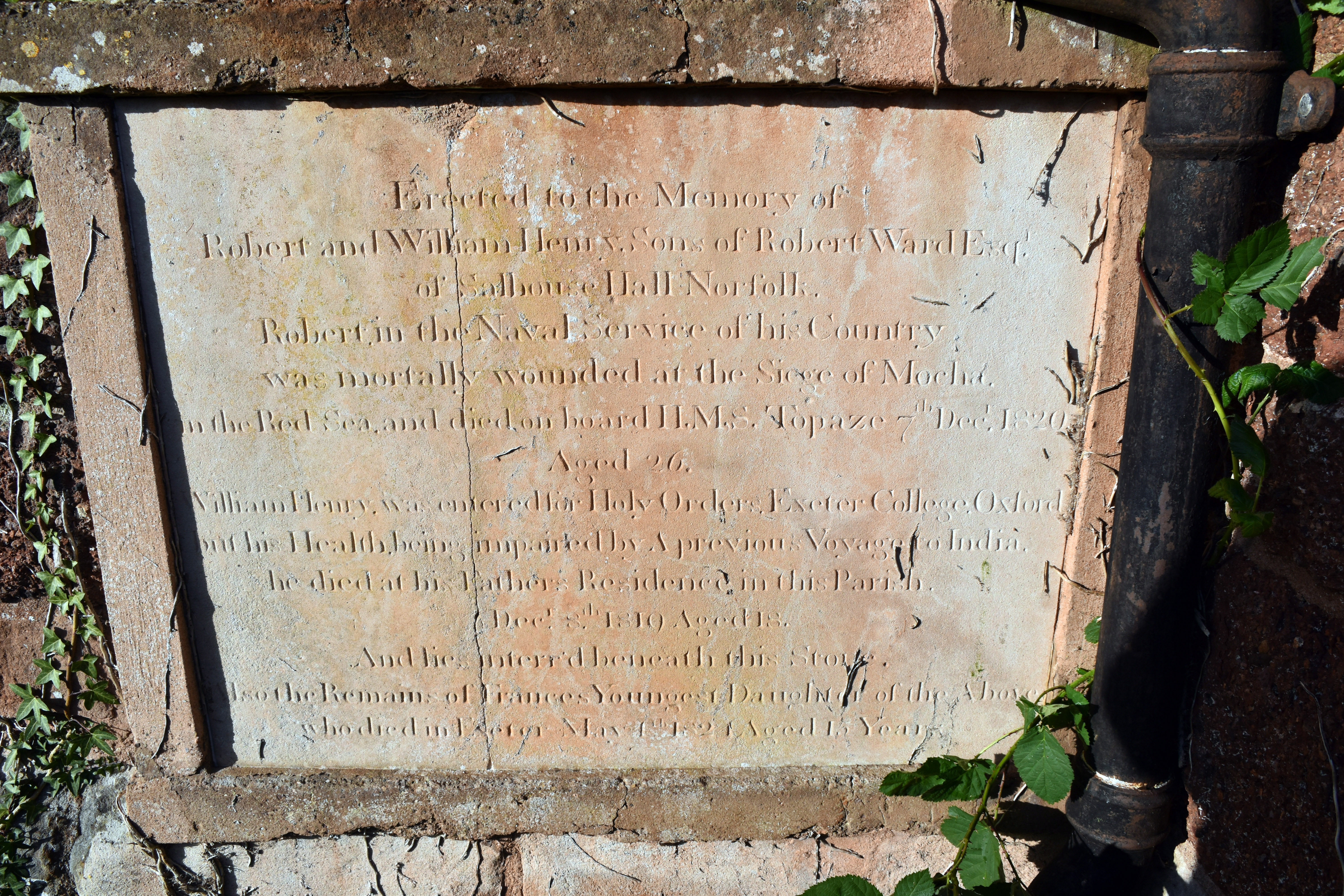
On the exterior wall of All Saints Church, Kenton, a weathered stone plaque commemorates Midshipman Robert Ward, who died of wounds sustained during the British expedition against Mocha in Yemen in December 1820. He was just twenty‑six years old, and his memorial, set into the very fabric of the parish church, anchors a global story of empire and conflict back into the quiet lanes of Devon.
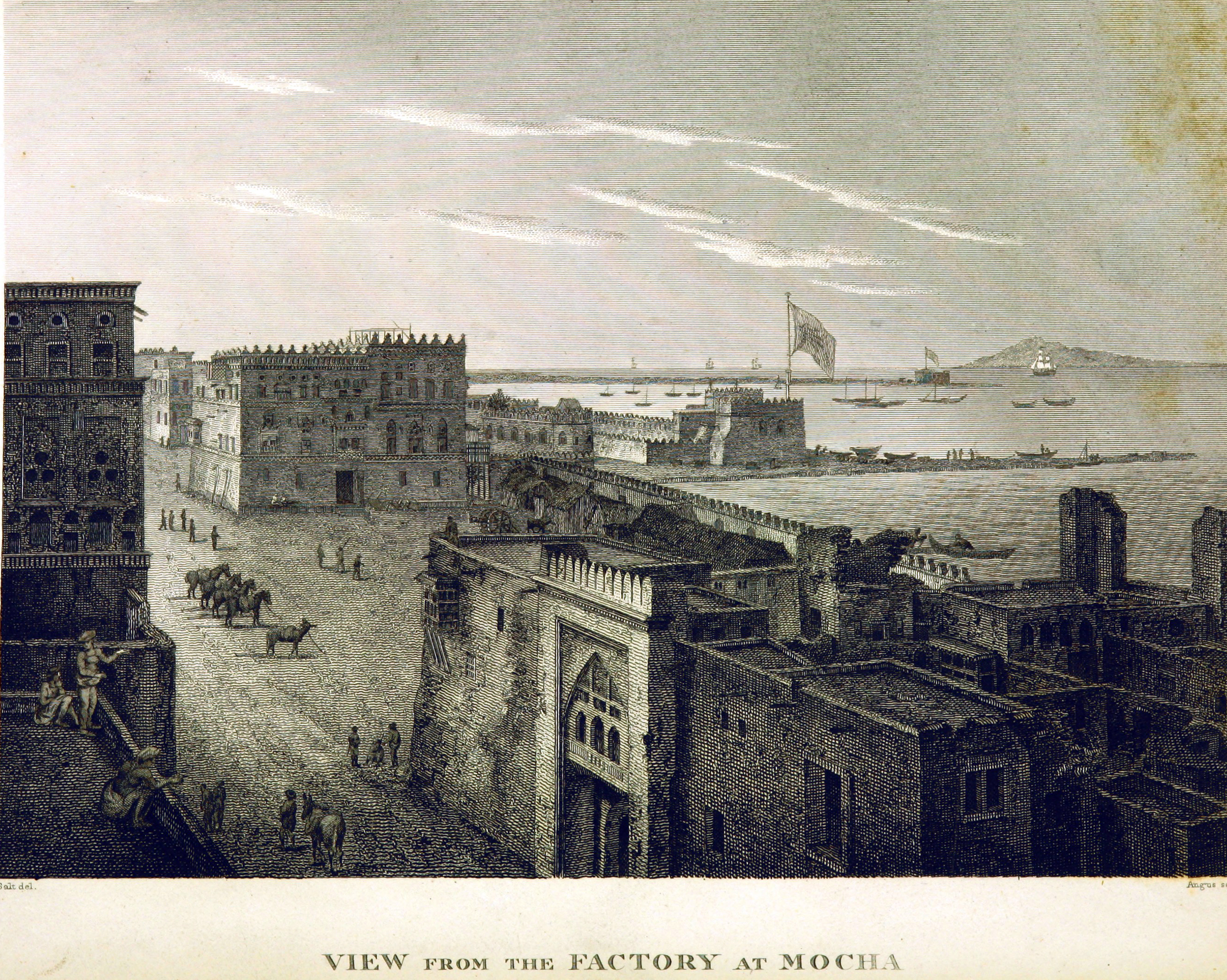
Mocha, on the Red Sea coast of Yemen, was famed as the principal port for the export of coffee beans and had been a regular port of call for East India Company ships since the 1610s. Relations with the local authorities were often uneasy. In 1817, after the death of the Company’s resident David Ramsey, disputes flared between Lieutenant Dominicetti of the EIC cruiser Prince of Wales and the governor of Mocha. By 1820, tensions had escalated into outright hostility, with British officials demanding redress for “insults and cruelties” inflicted on their subjects. Rear‑Admiral Sir Richard King, commanding the East India station, ordered an expedition to enforce British demands.
The force comprised HMS Topaze (46 guns, Captain John Richard Lumley), several East India Company cruisers, and a bomb vessel. They arrived off Mocha on 3 December 1820. The following morning, believing the north fort abandoned, Captain Lumley attempted to seize it. Instead, the landing party was repulsed with heavy loss. Negotiations followed on the 5th, but the local Dolah (governor) presumed too much on British patience.
At 8 a.m. on the 4th, the flagship opened fire, joined by the cruisers. The enemy’s five batteries replied, but within an hour the north battery was silenced. Arab defenders retreated across the isthmus towards the Mecca Gate. British fire, including 13‑inch shells, struck houses and magazines, forcing further withdrawals. Contemporary reports describe houses shattered, defenders fleeing, and the psychological shock of the bombardment on the town. By noon, British troops occupied the north side of the isthmus under cover of the ships.
When negotiations failed, the squadron opened fire again on the north fort. At 2 p.m., the Topaze, two cruisers, and the mortar boat bombarded the fort and town. Under cover of this fire, boats carrying Royal Marines, seamen, and artillery landed half a mile from the fort. Led by Captain Pym and Lieutenants Mordey, Wright, Pasco, Lediard, White, and Macdonald, they stormed the fort. Lieutenant Pasco burst through the barricade, the men rushed in through embrasures, and after fierce resistance the defenders fled. Fifty were killed or wounded, thirty taken prisoner, including several officers. British losses were three killed and eleven wounded, among them Pasco (shot in the neck) and Lieutenant Hill of the Buffs (shot through the thigh). The fort, containing fifteen cannon and much ammunition, exploded after being set alight.
Still no agreement was reached. On the 30th, the south fort was bombarded, breached, and destroyed. The town endured heavy shelling, with reports of shells penetrating houses where families sheltered. Casualties among the defenders were severe. British officers and medical men later tended Turkish wounded in the governor’s residence, even as negotiations continued.
On 21 March reports noted truces for burial of the dead and removal of wounded. The Turkish commander, one of the kings of Senna, met British officers to arrange the truce, which was respected. Eventually, on 15 January 1821, a treaty was signed and returned to Captain Lumley, restoring relations on terms favourable to the East India Company. The British had achieved their objectives, but at significant cost.
The Topaze alone fired over 3,500 shot. Among her dead were Lieutenant Robert Gordon Atkinson, Master’s Mate C. P. Gill, Midshipman Francis S. Burnett, and several seamen and marines. Midshipman Robert Ward was mortally wounded and died aboard Topaze on 7 December 1820; his memorial survives at All Saints Church, Kenton. Captain Lumley himself died in July 1821, “in a great measure owing to excessive exertion and exposure during operations at Mocha,” and was buried at Penang. Other officers succumbed to fatigue and climate in the months that followed, including Lieutenant Robson (August 1821) and Lieutenant Faithful (April 1823).
Because of the difficulty of communication up the Red Sea and through Egypt, news of the expedition did not reach London until April 1821. The Hampshire Chronicle of 30 April carried the first reports, based on dispatches written at Mocha in January and forwarded via Bombay. These described the bombardments, the storming of the forts, the truce for burial of the dead, and the eventual treaty. Later gazette reports praised the gallantry of officers such as Captain Pym and Lieutenant Pasco, and noted the “tremendous explosion” when the north fort blew up.
The bombardment of Mocha was one of those small but telling episodes of Britain’s maritime empire: a clash born of trade disputes, diplomacy, and imperial assertion. It demonstrated the reach of British naval power, but also the human cost — borne by officers like Robert Ward and by the Yemeni defenders whose town was shelled into submission. Today, the memorials in English parish churches, like that at Kenton, preserve the memory of those who died far from home.