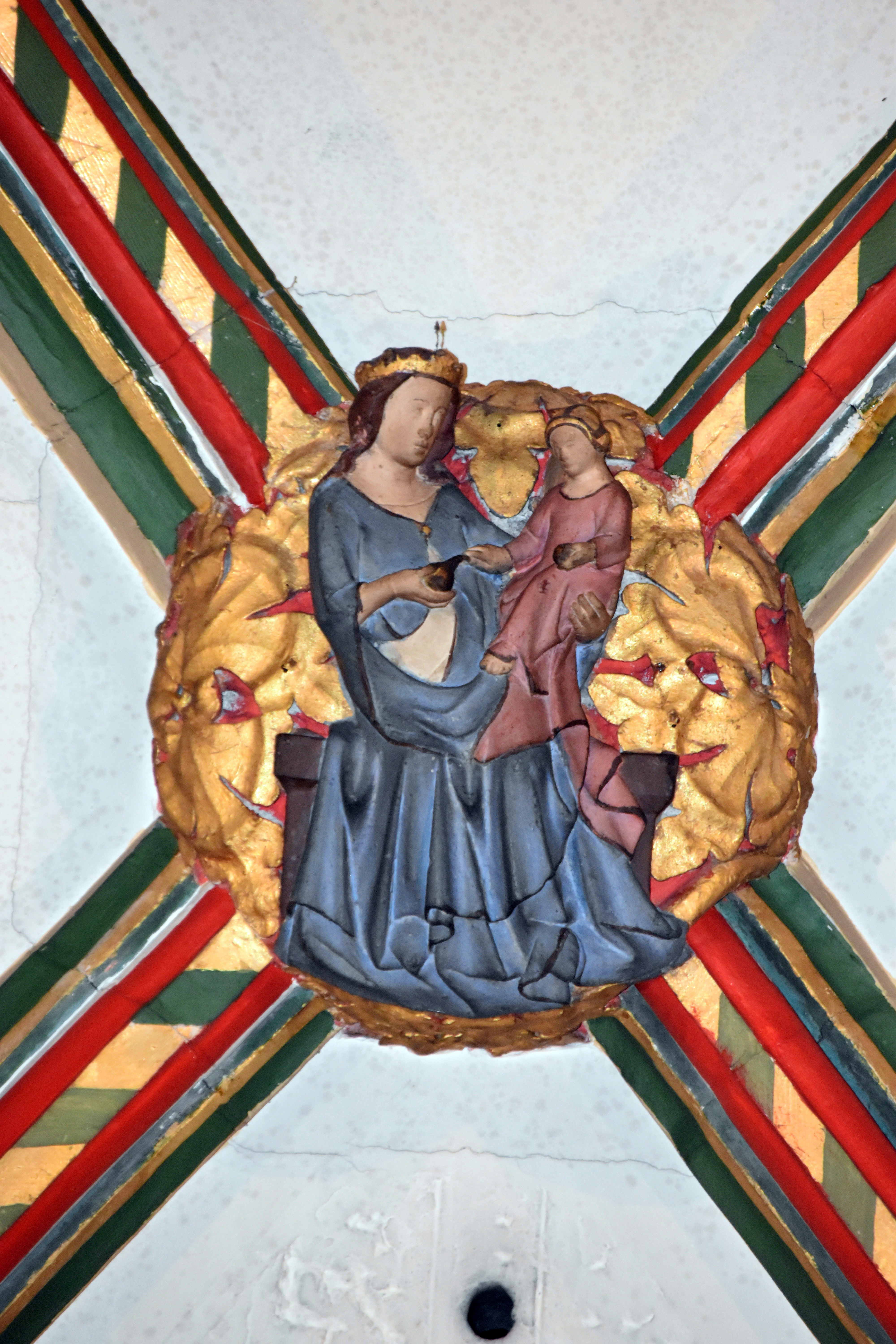
The roof bosses of St Mary’s are among the church’s most distinctive features. They belong to the fourteenth‑century rebuilding under Bishop Grandisson and form a sequence of carved and painted figures that run the length of the nave and chancel. Many show familiar subjects — the Virgin and Child, saints, angels, foliage and heraldry — but what makes them striking is the survival of their medieval colour. The reds, greens and golds, though restored over the centuries, still give a good sense of how vivid the interior would have been when the church was new.
One of these bosses, the Virgin and Child, became unexpectedly well known in 1974 when the Post Office chose it as the model for the 8p Christmas stamp. The designers were looking for images that reflected the theme of “Church Roof Bosses”, and Ottery’s example, dating from around 1350, was selected alongside carvings from York Minster, St Helen’s Norwich and Worcester Cathedral. The Postal Museum’s account of the issue notes that the Ottery boss was reproduced from a photograph and adapted only slightly to fit the stamp format. The result is a small but faithful rendering of the original carving, complete with its striped background and the distinctive blue and red of the Virgin’s robe.
The choice of a roof boss for a national Christmas stamp was unusual but fitting. Bosses were designed to be seen from below, often at a distance, and their bold outlines and strong colours translate well into the small scale of a stamp. The Ottery example works particularly well because the figures are compact and self‑contained, and the medieval painter’s use of contrasting colours gives the design clarity even when reduced to a few centimetres.
The 1974 stamp also sits within a longer tradition of medieval imagery being reused or reinterpreted in modern contexts. Roof bosses, like misericords and capitals, were often carved by craftsmen who worked from established patterns but added their own variations. The Ottery bosses show this clearly: some are formal and symmetrical, others more expressive, and a few have the slightly naïve charm that comes from a carver working from memory rather than direct observation. The Virgin and Child boss chosen for the stamp is one of the more refined examples, and its selection helped draw attention to a part of the church that visitors often overlook.
Today the boss remains in place high above the nave, and the 1974 stamp has become a small footnote in its history. But the connection is a useful reminder of how medieval art continues to surface in unexpected ways, and how a carving made in Ottery nearly seven hundred years ago briefly found itself on millions of Christmas cards and letters across the country.