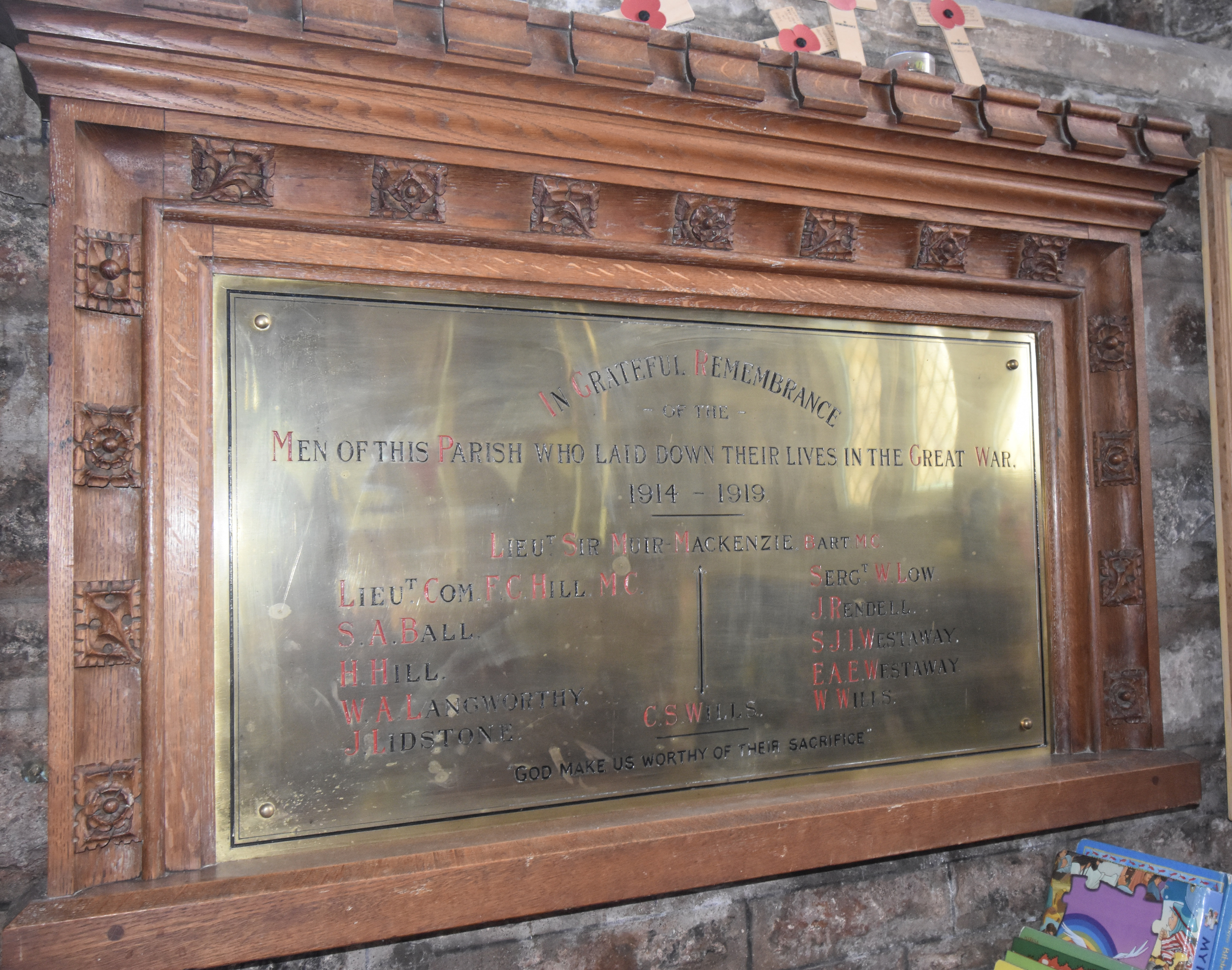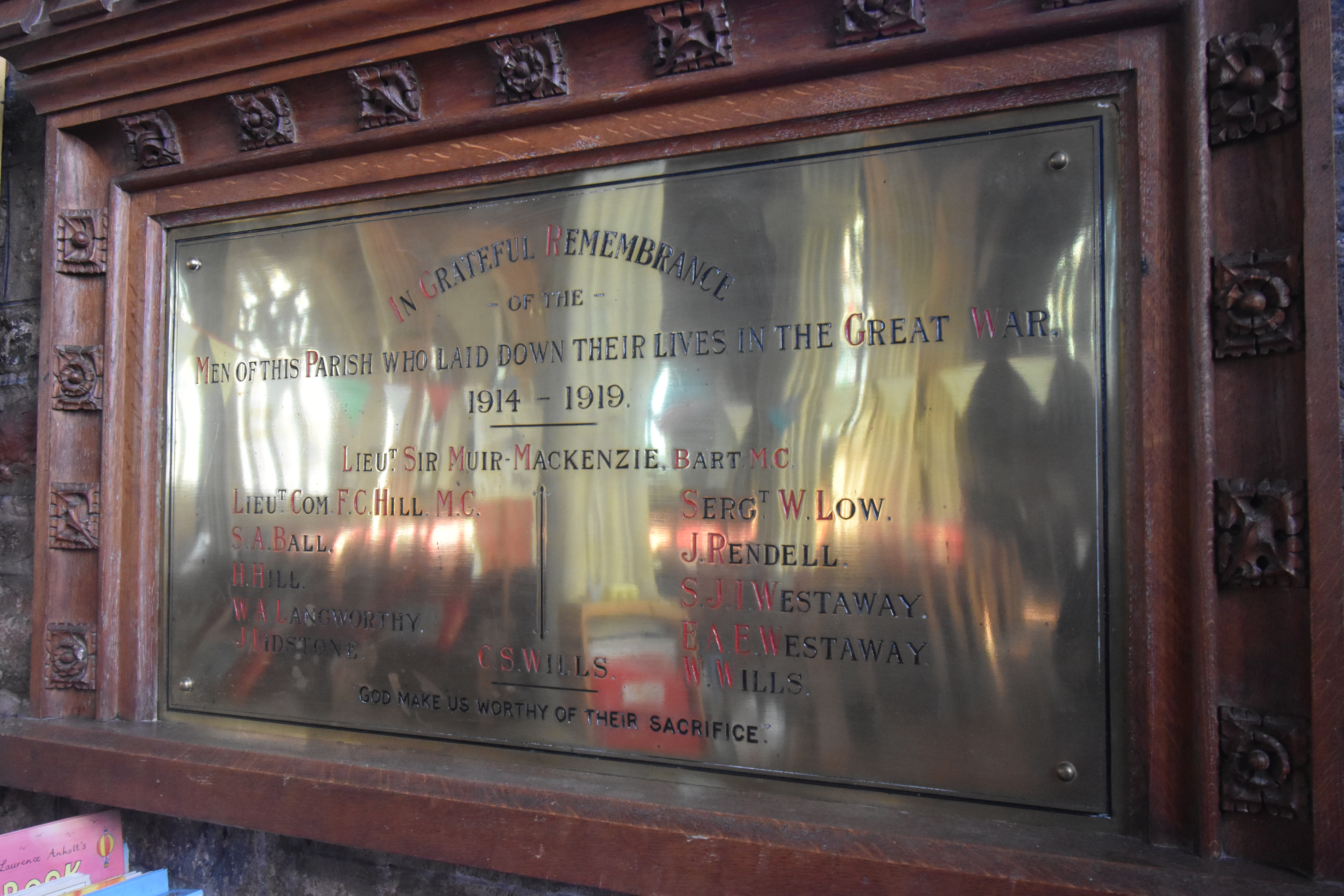
The names carved on Marldon’s war memorial form a small roll of honour, yet behind each one lies a life shaped by the rhythms of the parish and ended by the upheavals of the early twentieth century. They represent farm labourers, stokers, gunners, sailors, and officers; men who left the lanes and fields of the village for distant fronts and never returned. Their stories, pieced together from service records, parish registers, and local memory, give a sense of the breadth of experience contained within a single rural community.
Frederick Charles Hill, born in Marldon in 1882, rose to become a Lieutenant‑Commander in the Royal Naval Volunteer Reserve. Serving at HMS Excellent, the Navy’s gunnery school at Portsmouth, he was awarded the Military Cross for his wartime service. Hill survived the fighting but died of illness in August 1919 at the age of thirty‑seven, and was brought home to be buried in Marldon churchyard.
Samuel Albert Ball, a private in the Wiltshire Regiment, was born in Ashcombe in 1885 and grew up in Marldon. He married before the war and settled in Torquay. Ball died on 21 March 1918 during the German Spring Offensive, aged thirty‑three, one of the many casualties of that sudden and devastating attack.
Herbert William Elkanah Hill, a sergeant in the Devonshire Regiment, was born in Dartington in 1894. He died on 27 September 1918 during the final Allied advance, aged twenty‑four. His battalion was heavily engaged in the Hundred Days Offensive, a period of relentless fighting that brought the war to its close.
Walter Ashford Langworthy, born in Marldon in 1893, served with the Royal Marine Light Infantry aboard HMS Snaefell, a requisitioned steamship used for troop transport and patrol work. He died on 5 June 1918 at the age of twenty‑five.
John Lidstone, Chief Stoker of HMS Warrior, was born in Marldon in 1875. He died at the Battle of Jutland on 31 May 1916, aged forty‑one, when Warrior was heavily damaged and later sank while under tow. His death links the parish directly to the largest naval battle of the war.
William Low, a sergeant in the Royal Garrison Artillery, was born in Compton, Marldon, in 1872. He died at home on 21 February 1916 at the age of forty‑three and is buried in Marldon churchyard. His service reflects the physically demanding work of the artillery, the dominant arm of the conflict.
James Rendell, a private in the Devonshire Regiment, was born in Stonehouse in 1894 and raised in Marldon by his grandparents. He died in the UK on 6 August 1916, aged twenty‑two, possibly from wounds or illness contracted during training or early service.
Stanley James Isaiah Westaway, a Stoker 1st Class with HMS Vivid, was born in Marldon in 1898. He died on 8 April 1918 at the age of nineteen and is buried in the churchyard. His brother Ernest Albert Edward Westaway, born in 1887, served with the Machine Gun Corps after earlier service in the Devonshire Regiment. Ernest died on 8 October 1918, aged thirty‑one. The brothers’ names appear together on the memorial.
Charles Stanley Wills, born in Marldon in 1898, died on 26 October 1917 at the age of nineteen while serving as a private. His surviving records are sparse, but his age places him among the many young men who joined late in the war and were sent quickly to the front.
William Wills, a Stoker 1st Class born in Marldon in 1871, served with HMS Vivid and died on 31 January 1921. Although his death came after the Armistice, his inclusion on the memorial suggests a recognised connection to wartime service. A discrepancy in his recorded age — his death certificate giving thirty‑six rather than forty‑nine — remains unexplained.
Sir Robert Cecil Muir Mackenzie, born in 1891, was the son of Lieutenant‑Colonel R.S.M. Mackenzie of Marldon House. Serving with the Durham Light Infantry, he was killed on 12 April 1918 during the German Spring Offensive, aged twenty‑six.