

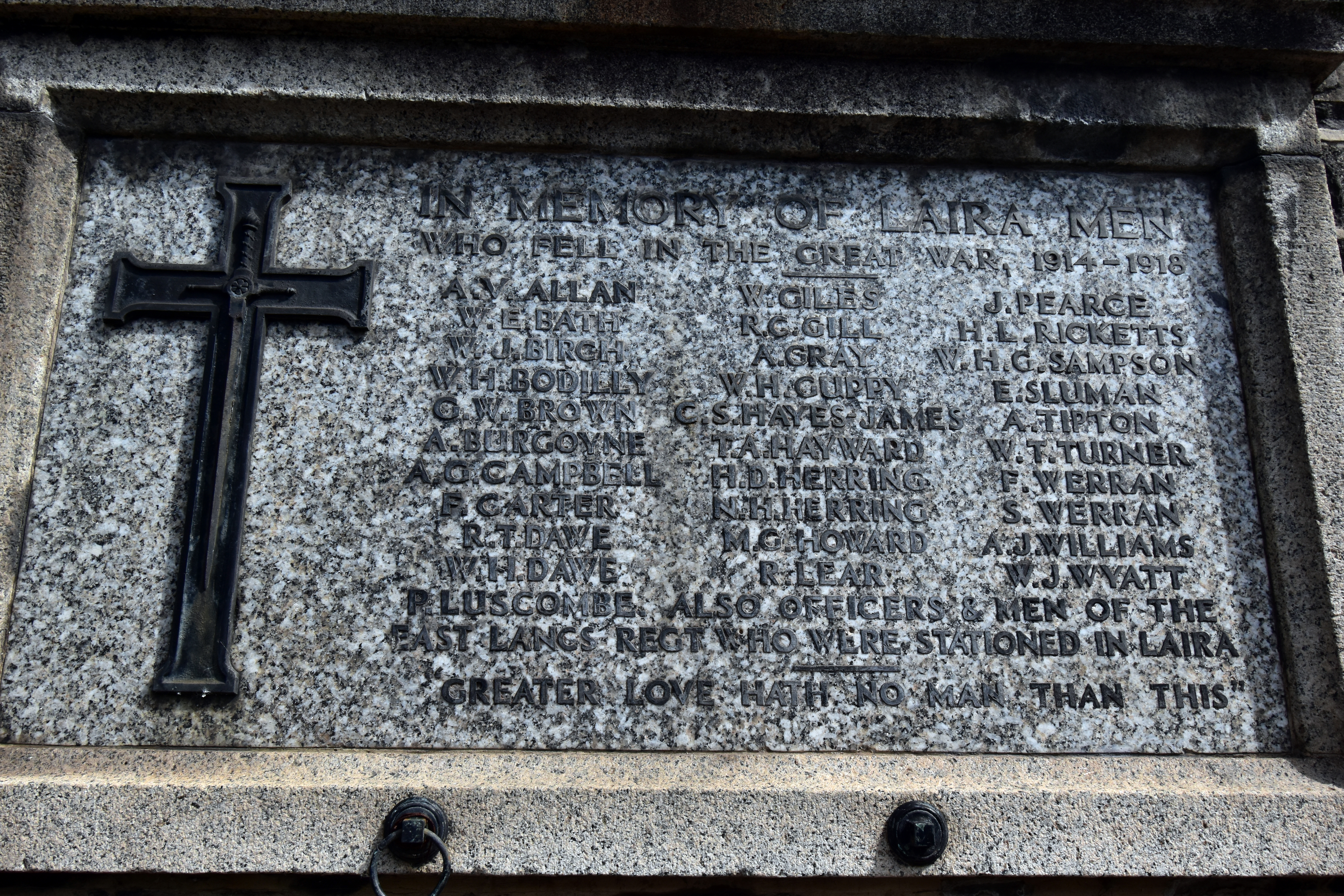
At the close of the First World War, the district of Laira lay beyond the administrative boundaries of the Borough of Plymouth. Though geographically close, it remained distinct in civic terms, and this separation had lasting implications for how its war dead were commemorated. When the city’s principal memorial was planned, the names of Laira’s fallen were not included. Instead, the community resolved to honour its own with a dedicated memorial on Old Laira Road — a decision that speaks to both local pride and the desire for distinct remembrance. That memorial still stands today, quietly bearing witness to the cost of war and the character of a neighbourhood that chose to remember its own.
The Laira War Memorial commemorates thirty-one men who died in the First World War. No names of survivors are listed; this is a roll of sacrifice, not of service. The names are inscribed by surname only, in alphabetical order, a stark and egalitarian register of loss. Among them are multiple members of the same families — four Ellis men, three Daveys, three Vernans — suggesting the depth of grief borne by individual households and the close-knit nature of the community.
The memorial itself is composed of three elements: a bronze cross, a granite tablet, and a sandstone frame. The frame measures 850mm in height, 110mm in width, and 60mm in depth, enclosing the tablet and cross in a simple but dignified architectural form. The materials — bronze, granite, and sandstone — were chosen for durability and solemnity, resisting weather and time while preserving the clarity of the names. The inscription concludes with the biblical phrase, “Greater love hath no man than this,” anchoring the memorial in Christian tradition and echoing the sacrificial theme that runs through so many postwar commemorations.
In addition to the named individuals, the tablet also honours the officers and men of the 5th Battalion Devon Regiment who were stationed in Laira during the war. Their presence, though less individually recorded, forms part of the district’s wartime history and reinforces the sense of Laira as a place both of residence and of military significance.
Today, the Laira War Memorial remains a focal point for remembrance. Its survival into the present is not merely a matter of preservation but of continued relevance. It reminds passers-by that Laira, though once outside the borough, bore its share of the war’s burden. It offers a local counterpoint to the city’s larger memorials, and in doing so, it affirms the value of community memory — precise, personal, and enduring.

