

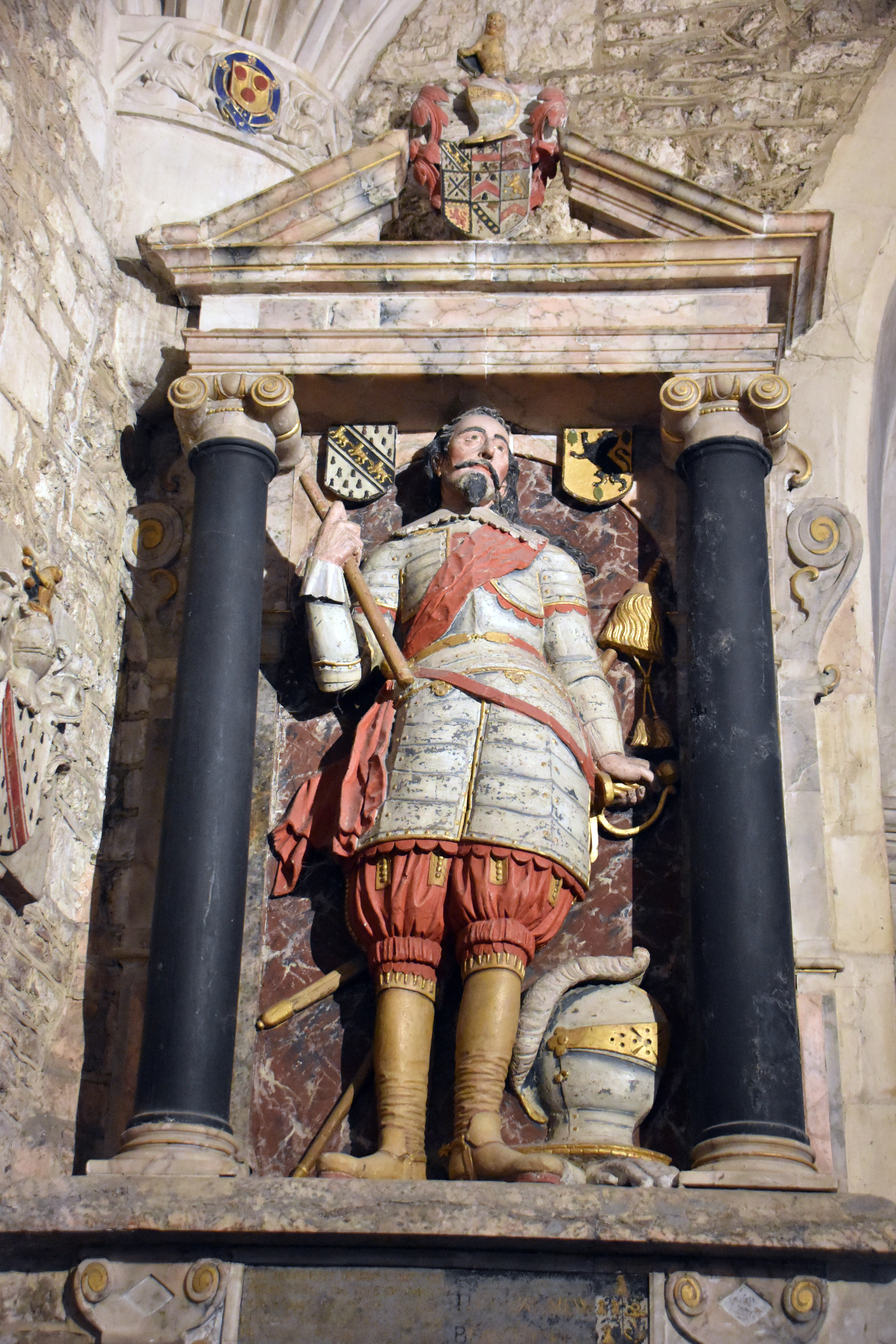
The monument to John Coke of Thorne stands in the Dorset Aisle and is one of the most striking early‑seventeenth‑century memorials in the church. The inscription records him plainly: the son of Christopher Coke and Joan Coplestone, husband of Margaret Sherman, father of Richard, John, William, Jane and Joan, and aged forty‑two years and seven months when he died on 28 March 1632. The tablet gives the genealogy; the effigy supplies the character. Coke is shown in armour, upright and alert, with an enormous helm at his feet and a baton held in his right hand. The baton is not decorative. It almost certainly represents his appointment in 1622 as a Master of the Court of Requests, a post that carried judicial and administrative authority. The style of the monument, and the baton itself, can be compared with the contemporary effigy of John Northcote (d.1632) at Newton St Cyres, which shows a similar mixture of martial pose and civilian office.
Coke belonged to the long‑established Cooke family of Thorne in the parish of Ottery St Mary. Their arms — Ermine, on a bend cotised gules three cats‑a‑mountain passant guardant or — appear on the monument, as recorded in Vivian’s Visitations of Devon. The other shield, for Sherman, displays Or, a lion rampant sable between three holly leaves vert, marking the marriage alliance with Margaret Sherman. Above the monument, on the column to the left, two carved angels support a shield of the Courtenay Earls of Devon, circumscribed by the Garter. It is the same device seen in Tiverton Church and reflects the long association between the Courtenays and this part of Devon.
The effigy itself is unusually forceful for a parish church. Coke’s armour is rendered with a confidence that feels almost anachronistic, more suited to a knight of the previous century than to a seventeenth‑century gentleman. In reality he was a peacetime soldier and, more significantly for Ottery, one of the governors of the church. When Henry VIII dissolved the collegiate foundation he appointed four governors to oversee the church’s affairs, with “succession forever”. Edward VI added eight assistants. The body still exists today, a small committee whose origins lie in the upheavals of the mid‑sixteenth century. Coke’s presence among them explains why his monument occupies such a prominent position.
Local tradition adds a final layer. It is said — though no one seems able to say by whom — that Coke was murdered by his younger brother, and that his spirit steps down from the niche and walks the church at night. The story has persisted for generations, helped no doubt by the commanding posture of the effigy and the slightly theatrical setting of the Dorset Aisle. Whether believed or not, it has become part of the church’s folklore, a reminder that monuments can acquire afterlives of their own quite separate from the histories they were meant to record.

