

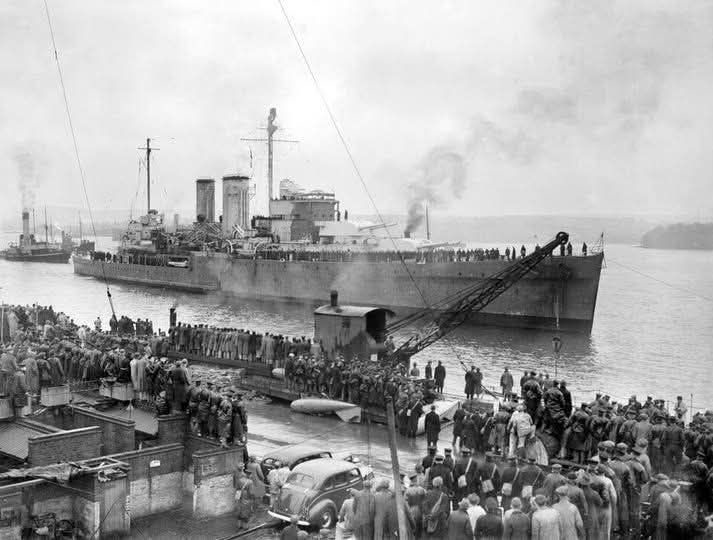
HMS Exeter was a heavy cruiser of the York class, built at Devonport and commissioned in 1931, and by the outbreak of the Second World War she was serving with the 8th Cruiser Squadron on the South American station. Her role in the opening months of the war was defined by the hunt for the German pocket battleship Admiral Graf Spee, whose attacks on merchant shipping threatened the Atlantic trade routes. On 13 December 1939, off the River Plate estuary, Exeter found herself at the centre of the first major naval action of the war. Commodore Henry Harwood’s squadron — Ajax, Achilles and Exeter — intercepted the German raider at dawn. Mistaking the enemy’s smoke for a merchant ship, Exeter was initially detached to investigate, but the error was quickly realised and the British ships engaged. Graf Spee opened fire at 06:15, and Exeter, the only heavy cruiser present, bore the brunt of the early exchanges.
The ship’s captain, F. S. Bell, manoeuvred to close the range, knowing that her 8‑inch guns were the only weapons capable of seriously damaging the German ship. In doing so, Exeter drew much of the enemy fire. She was hit repeatedly: her bridge was wrecked, her forward turrets were put out of action, and casualties were heavy. Despite this, she continued to fight, firing her remaining aft turret and launching smoke to shield the lighter cruisers. Her damage was severe enough that she had to withdraw temporarily, but her early attack had forced Graf Spee to divide her fire and had contributed directly to the tactical situation that later drove the German ship into Montevideo. The battle ended with Graf Spee scuttled by her captain to avoid a renewed engagement. Exeter’s conduct — battered, burning, but still fighting — became one of the defining naval images of the early war.
Her return to Britain on 14 February 1940 was treated as a public event. She came into Plymouth to large crowds, her battle damage still visible despite temporary repairs made in the South Atlantic. Newsreel footage shows the ship coming alongside, the crew lining the decks, and Captain Bell addressing those gathered to welcome them home. Winston Churchill, then First Lord of the Admiralty, visited the ship, accompanied by senior naval officers. The reception was not theatrical; it reflected the fact that Exeter had been the first British warship to face a major surface engagement of the war and had done so under conditions that would have broken a less well-handled ship.
The connection to Feniton lies in the presence of one of Exeter’s pennants in St Andrew’s Church. It stands as a reminder that the ship was built at Devonport, crewed in part by West Country sailors, and welcomed home in Plymouth before returning to service. The pennant is not a decorative curiosity; it is a fragment of a ship that had already become part of wartime memory by the time it reached the church. Its presence in Feniton links a rural parish to a global conflict in a way that is neither forced nor sentimental: a local object with a very large story behind it.
After repairs, Exeter returned to duty, first in the Atlantic and then in the Far East. Her final action came in 1942 during the Java Sea campaign, where she fought in two engagements against overwhelming Japanese forces. On 1 March 1942 she was sunk in the Second Battle of the Java Sea after a prolonged chase and heavy shellfire. Many of her crew became prisoners of war, and the wreck was later illegally salvaged. Her end was far removed from the cold February morning when she steamed into Plymouth, but the reputation she earned at the River Plate remained the defining episode of her career.
The pennant in St Andrew’s is therefore more than a naval relic. It marks the moment when a Devon-built cruiser, damaged in the first major surface battle of the war, returned to the county that had launched her. For a parish whose history ranges from medieval screens to Melanesian missions, the presence of Exeter’s colours adds another thread: a reminder that even a small village can find itself connected to events far beyond its boundaries.

