

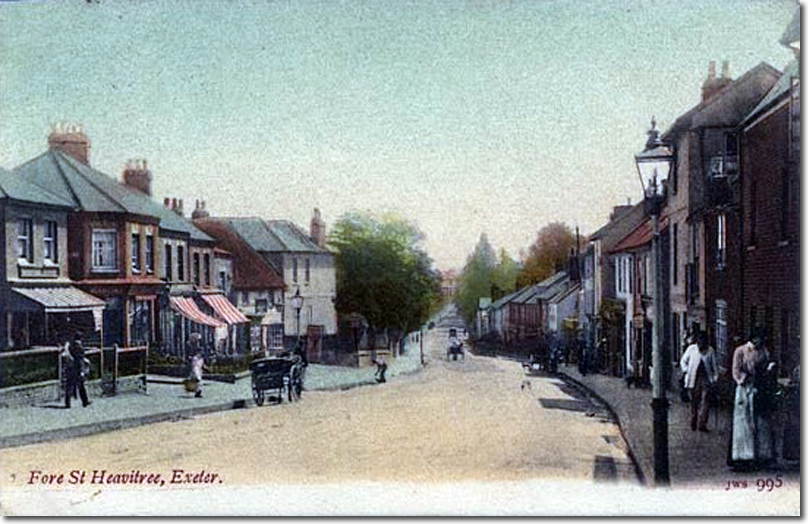
Heavitree began as a separate settlement to the east of Exeter, positioned on the main route towards Honiton and London. Its name appears in medieval records in a variety of spellings, including Hevetrowe, Hevetre and Hevetrewe. The most widely accepted explanation links it to the Old English heafod-treow, meaning “head tree”, a reference to a boundary tree or possibly to a site associated with executions. Whatever the precise origin, Heavitree was clearly established as a distinct community long before the expansion of Exeter reached its boundaries.
The village developed around a central cluster of dwellings, fields and smallholdings, with St Michael and All Angels Church forming its principal landmark. The church has medieval origins, although the present building is largely Victorian following extensive nineteenth‑century rebuilding. The surrounding manor houses and farms indicate that Heavitree supported a mixture of agricultural activity and gentry residences. Its position on the main eastern road ensured a steady flow of travellers, traders and livestock through the settlement.
By the early modern period Heavitree had acquired a number of functions that distinguished it from neighbouring communities. It served as the site for county executions at Livery Dole and later at Ringswell, reflecting its position just outside the city boundary. Inns, smithies and workshops grew up along Fore Street to serve both local residents and those passing through. The village also became associated with several charitable foundations, including the Duckes Almshouses, originally established in the Elizabethan period and rebuilt in the nineteenth century.
Throughout the eighteenth and early nineteenth centuries Heavitree remained a separate village, although its proximity to Exeter meant that the two were increasingly connected. Wealthy families built houses in the area to enjoy a semi‑rural setting while remaining close to the city. The growth of Exeter’s population and the development of new roads gradually reduced the open land between the two settlements. By the mid‑nineteenth century Heavitree was effectively a suburb in all but name, with new terraces, villas and public buildings altering the character of the old village centre.
The formal incorporation of Heavitree into the city of Exeter took place in 1913, when the parish was absorbed into the municipal boundary. By this time the village had been transformed by housing developments, schools, churches and public amenities. Heavitree Park, opened in 1906, reflected the Edwardian concern to preserve green spaces as urban expansion continued. The area’s earlier history remained visible in the layout of Fore Street, the position of the church, and the survival of older buildings among later additions.
Modern Heavitree retains elements of its village origins despite being fully integrated into the city. The pattern of streets, the presence of long‑established shops and public houses, and the survival of historic sites such as Livery Dole and the Duckes Almshouses all reflect its earlier identity. The area’s layered history—from medieval settlement to rural village, from suburban expansion to urban incorporation—illustrates the gradual process by which Exeter extended its influence eastwards over several centuries.


