

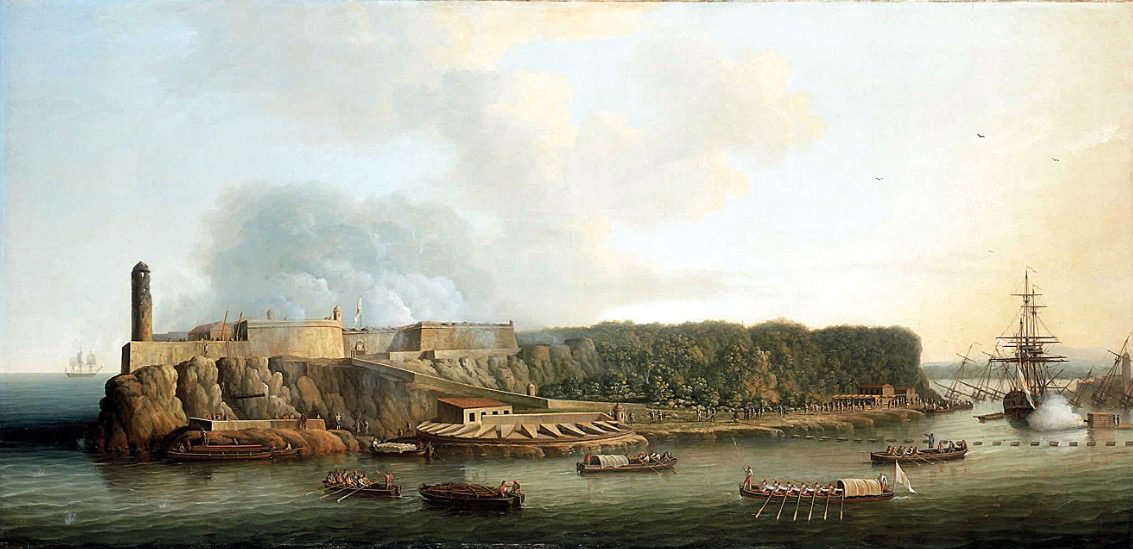
In June 1762, during the final phase of the Seven Years War, Britain launched one of the most ambitious amphibious operations of the eighteenth century: the assault on Havana. Spain had entered the conflict late, in support of France, and the British government responded by striking directly at the most valuable of Spain’s overseas possessions. Havana was the key: the gathering point of the Spanish silver fleet, the gateway to the Gulf of Mexico, and the strongest fortified harbour in the Americas. Its capture would reshape the balance of power in the Atlantic.
The expedition that sailed under Admiral Sir George Pocock and General the Earl of Albemarle was immense. Nearly 13,000 soldiers, 17,000 sailors and marines, 23 ships of the line, 19 auxiliary warships and around 160 transports converged on Cuba. Pocock took this vast fleet through the treacherous Old Bahama Channel to achieve surprise. On 7 June 1762 the British landed without opposition at Cojímar Bay, six miles east of Morro Castle. Dominic Serres, later Marine Painter to George III, depicted the scene in a series of canvases commissioned by the Keppel family, three of whom served in the campaign. His paintings show the long rows of tents, the constant movement of boats between transports and shore, and the blue squadron colours flying from Pocock’s ships.
The siege that followed was brutal. The heat was punishing, the terrain difficult, and disease relentless. On 1 July the ships Cambridge, Marlborough and Dragon attempted to bombard Morro Castle but were driven off with heavy losses. The decisive moment came on 30 July, when British engineers detonated a mine beneath the walls of the Morro. The breach was stormed under the direction of Colonel William Keppel, and the fall of the fort made the collapse of Havana inevitable. The city capitulated on 11 August and was occupied on the 14th. Nine Spanish ships of the line were captured, along with immense stores and valuables.
The jubilation in Britain and British America was immediate. One New York preacher compared the victory to the defeat of the Spanish Armada in 1588. The scale of the triumph was not merely military but strategic and economic. As Professor Elena Schneider has shown, Cuba was far from the “stagnant” colony once imagined by historians. It was the third most populous city in Spain’s New World empire, a vital node in Atlantic commerce, and a major market for British goods. Nearly half of Cuba’s exports left the island through contraband channels dominated by British merchants. Havana’s demand for slaves, flour, cloth and luxury goods, and its supply of silver, tobacco, hides and livestock, made it central to eighteenth‑century Atlantic trade networks. The British occupation did not create these patterns; it intensified them.
For Spain, the loss of Havana was catastrophic. In the 1763 Treaty of Paris, Spain ceded Florida to Britain in exchange for the return of Cuba — a stark measure of Havana’s importance. The shock of the occupation triggered sweeping reforms in Spanish colonial administration, taxation and defence, reshaping Cuba’s place in the empire for decades to come.
The scale and global significance of the Havana expedition make its quiet echo in Feniton all the more striking. In St Andrew’s Church lies a graveslab which remembers John Moore, a soldier, sailor or possibly a marine who served in the 1762 campaign. His presence in this rural Devon churchyard is an unusually direct link to one of the largest amphibious operations of the eighteenth century. Few English parishes can claim any connection to the siege of Havana, let alone one preserved in stone. Moore’s memorial anchors the vast events of 1762 — the great fleet threading the Old Bahama Channel, the storming of Morro Castle, the fall of Havana — to the life of a man who returned to East Devon and was buried within sight of the medieval church.
For a walk centred on Feniton, Fenny Bridges and Alfington, the Havana expedition may seem remote, yet it forms part of the same wider historical web that links this landscape to global events. The graveslab mentioning John Moore is a reminder that the great wars of the eighteenth century reached far beyond the Admiralty, the Caribbean and the imperial capitals, leaving their traces even in the churchyard of a small Devon parish.

