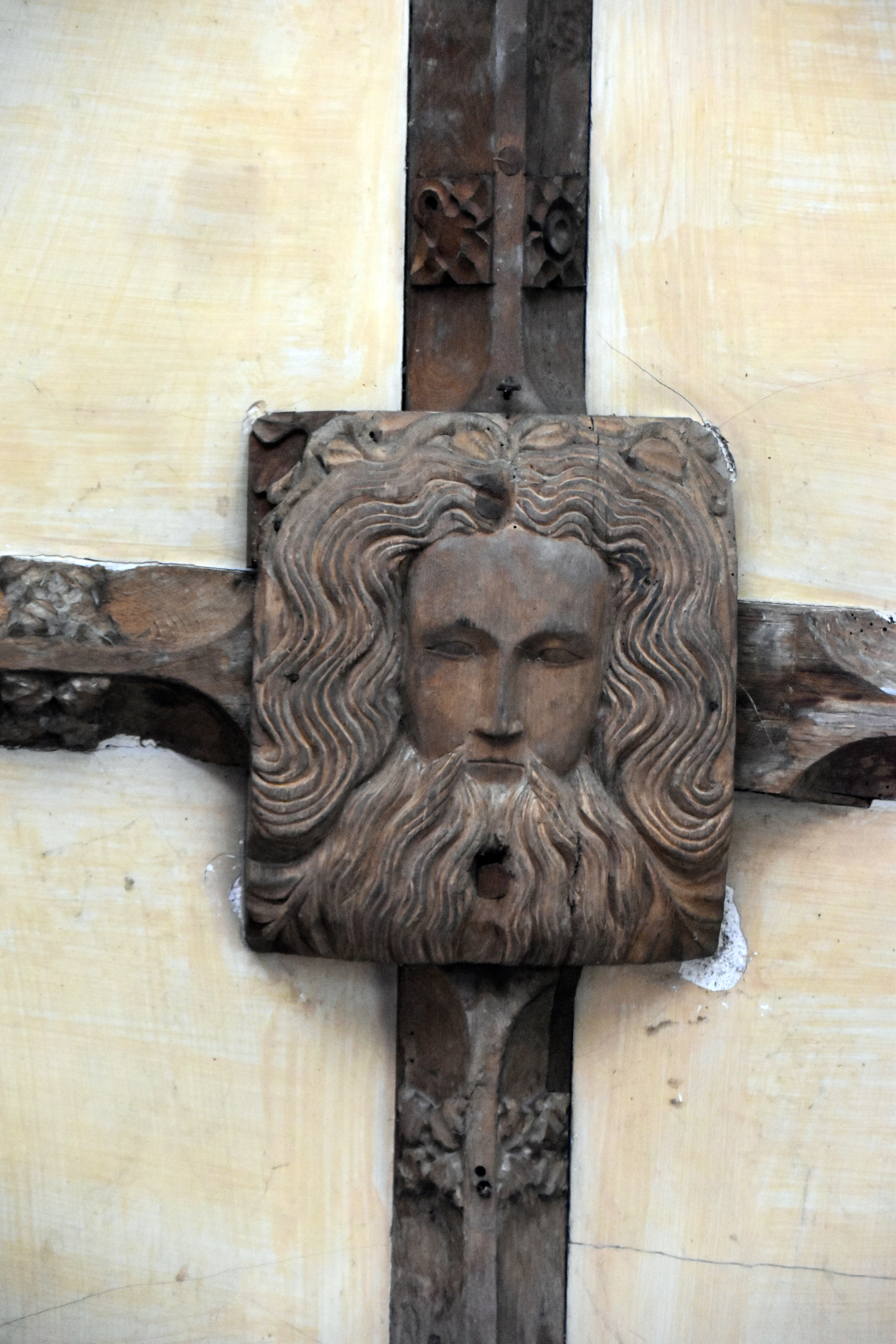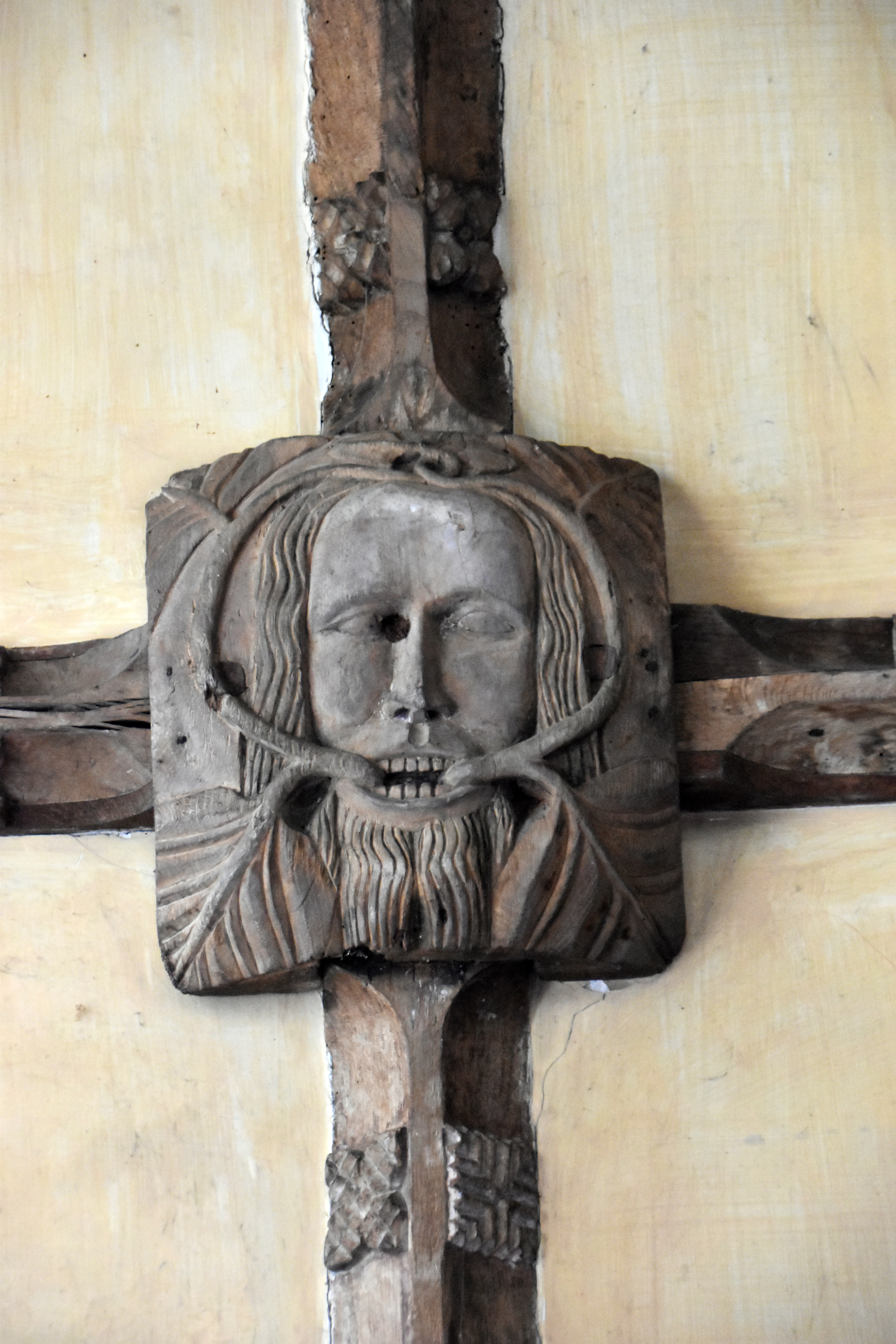
St Andrew’s has more Green Men than most Devon churches manage, and they are not tucked away apologetically either. The bosses sit confidently in the medieval wagon roof, part of the same fifteenth‑century decorative programme that produced the Three Hares, the sow and piglets, and the Courtenay shield. Whoever carved them was clearly enjoying themselves, and the results still hold their own six centuries later.
The Green Men here are not identical copies of a workshop pattern. One is the classic foliate head, leaves curling from the mouth in that familiar medieval way. Another is more restrained, the foliage emerging more subtly from the corners of the mouth. A third has a distinctly human expression, as if the carver was working from a real face and only added the leaves afterwards. They are variations on a theme rather than repetitions, which suggests a carver with a bit of freedom rather than someone following a rigid template.
It is tempting to read too much symbolism into Green Men, but in a church like this they sit comfortably alongside the rest of the roof’s iconography. Medieval craftsmen were not shy about mixing the sacred with the secular, the moral with the mischievous. The Green Men at Sampford Courtenay feel like part of that broader visual vocabulary — decorative, skilful, and probably intended to keep the eye occupied during long sermons rather than to convey a grand theological message.
Their survival is helped by the quality of the roof itself. St Andrew’s wagon roof is one of the better rural examples in the county, and P. J. Cave thought highly enough of it to include several bosses from this church in his 1948 study — an honour usually reserved for cathedrals. The Green Men sit among good company: a bearded head, a queen, a king, the Three Hares, and the Courtenay arms. It is a surprisingly rich collection for a parish church, and it gives the interior a level of visual interest that rewards anyone willing to look up for more than a moment.
What is striking is how unselfconscious the Green Men are. They are not presented as curiosities or as relics of some lost pagan tradition; they are simply part of the fabric of a late‑medieval church built by people who enjoyed lively carving. In a building that has seen rebellion, Victorian rebuilding, and the usual churn of parish life, the Green Men have quietly outlasted everything around them. They are not mystical, but they are very good examples of what medieval craftsmen could do when given a roof and a bit of freedom.