Frederick Charles Hill was born on 13 June 1882 in the village of Marldon, one of seven children of William and Elizabeth Hill. His father worked as a carpenter, and the 1891 census places the family living or boarding at the Royal Oak Inn, a reminder of the fluid and often informal housing arrangements of rural tradesmen in late‑Victorian Devon. When his schooling ended, Frederick found work as a gardener, but the pull of a wider world proved stronger. On 21 April 1897, still below the legal age for enlistment, he joined the Royal Navy, giving a falsified birth year of 1881. He entered as Boy 2nd Class and was sent to HMS Impregnable at Devonport, where he spent eighteen months learning the routines, drills, and seamanship that would shape the rest of his life.
Promoted to Boy 1st Class in early 1898, he received his first posting later that year aboard HMS Agincourt, before being transferred in the autumn to the cruiser HMS Leander. By the following summer he had “come of age” according to the date of birth he had supplied, and was formally inducted into the Navy as an Ordinary Seaman. His service record describes him as 5 feet 2 inches tall, with red hair, grey eyes, a fresh complexion, and a scar on his forehead. He remained on Leander for more than two years, earning promotion to Able Seaman in May 1900. In January 1901 he returned to HMS Vivid, the Plymouth depot that would serve as his base whenever he was not at sea.
His twelve‑year contract took him through four ships and a steady progression of responsibility. He became Leading Seaman in 1904, Petty Officer 2nd Class in 1906, and Petty Officer 1st Class in 1911. When his term expired, he re‑enlisted immediately. His annual assessments consistently praised his “very good” character and “superior” ability, and in 1914 he reached the senior rating of Chief Petty Officer. By then he was an experienced, capable man in his early thirties, with nearly two decades of naval service behind him.
The outbreak of war in August 1914 brought an unexpected turn. The Navy found itself with a surplus of trained reservists—men who had completed their sea service but were still liable for recall. There were far more of them than there were ships to place them on. The Admiralty’s solution was unconventional: it created a land‑fighting formation composed of sailors who would serve as infantry. This became the Royal Naval Division, a force whose very existence sits slightly askew from the usual categories of the First World War. Sailors drilled as soldiers, marched as soldiers, and fought as soldiers, yet retained naval ranks, naval terminology, and naval administration. Their battalions bore names such as Drake, Hawke, Nelson, and Howe, and their officers wore naval uniforms in the trenches. It was an anomaly born of necessity, and one that would carry men like Hill into some of the most demanding theatres of the war.
Hill was sent to Antwerp with the Royal Naval Division in September 1914, part of the hurried and ill‑equipped attempt to support the Belgian defence of the city. The operation was improvised to the point of absurdity: many men lacked packs, mess tins, or water bottles; khaki uniforms were unavailable; and the rifles issued were obsolete charger‑loading models. Yet the Division fought with determination, and although the defence collapsed, the experience forged the unit’s identity. Hill survived the withdrawal and continued to serve with the Division as it regrouped and trained.
In 1916 he was sent to the Dardanelles, where the Royal Naval Division took part in the later stages of the Gallipoli campaign. It was here that Hill earned his commission for bravery, rising from the senior enlisted ranks into the officer corps—a transition that, in the rigid hierarchies of the early twentieth‑century Navy, speaks to exceptional conduct. After the evacuation of Gallipoli, the Division was retained in the eastern Mediterranean before being transferred to the Western Front. In July 1916 it was redesignated the 63rd (Royal Naval) Division and placed under War Office control, though it retained its naval character. Hill served with it through the Battle of the Ancre in November 1916, where he won the Military Cross for gallantry during the fighting.
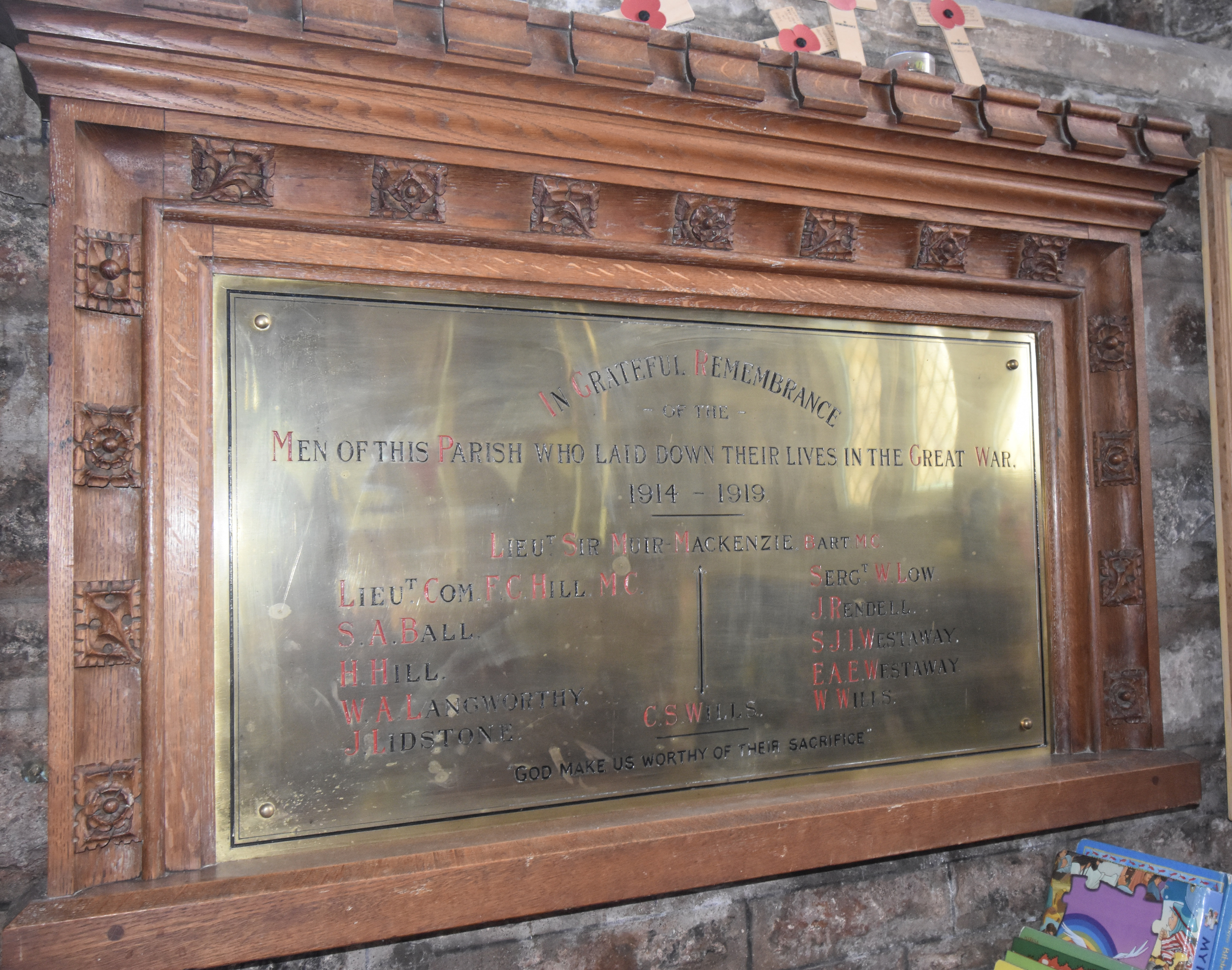
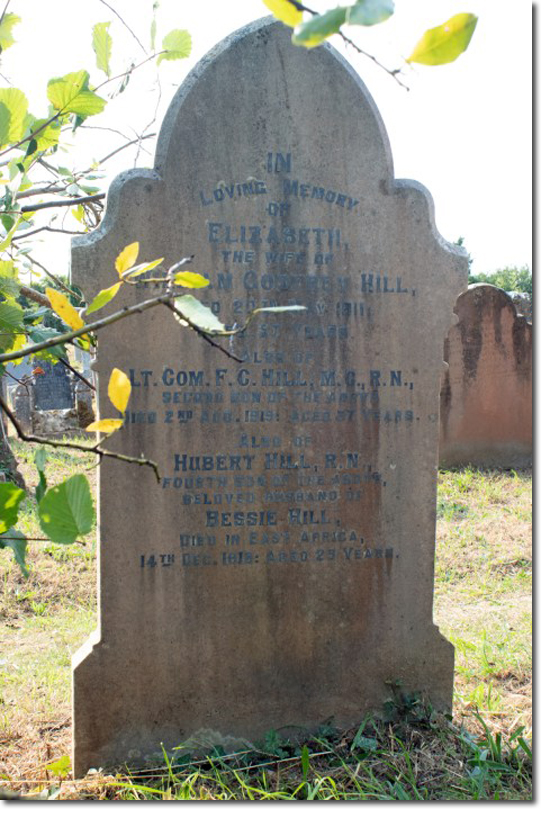
By February 1918 Hill was exhausted and was sent to England for six months’ rest. He returned to France voluntarily in November, a decision that speaks to a sense of duty shaped by more than twenty years of service. It was during this final period that he contracted the heart disease that would end his life. He returned to England in June 1919 and, while on sick leave, was admitted to Paignton Hospital, where he died on 2 August 1919 at the age of thirty‑seven. He was buried in the family plot at St John the Baptist’s Church in Marldon. His headstone and the village war memorial record him as a Lieutenant Commander, though Commonwealth War Graves Commission documents list him as a Lieutenant, a discrepancy not uncommon in the administrative tangle of wartime promotions and post‑war record‑keeping.
Hill’s career traces an unusual arc: a Devon gardener’s son who lied about his age to join the Navy; a sailor who became an infantry officer; a man who fought at Antwerp, Gallipoli, and on the Somme; and one of the few from Marldon to receive the Military Cross. His service in the Royal Naval Division places him within a formation that defies easy categorisation—a division of sailors who fought as soldiers, whose battalions carried the names of admirals, and whose history runs from the Scheldt to the Dardanelles to the mud of the Western Front.