

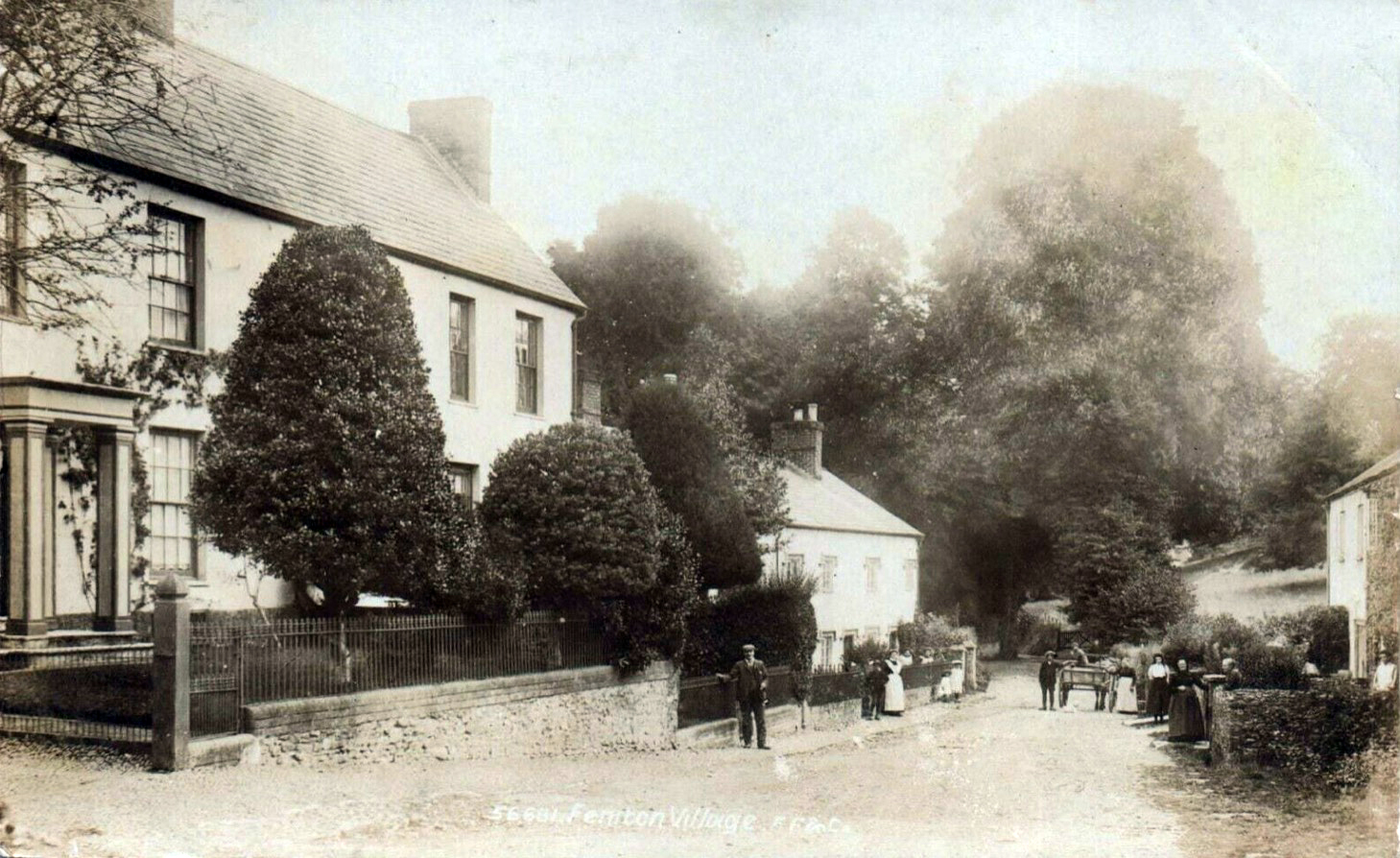
Feniton lies a few miles west of Honiton, just north of the old Roman road between Exeter and the east of the county. It has always been a dispersed parish, made up of the village around St Andrew’s Church and the manor of Feniton Court, together with the hamlets of Colestocks, Colesworthy, Cheriton, Curscombe and Fenny Bridges. The landscape of lanes, orchards and enclosed fields is long‑established, and the parish formed part of the historic Hayridge Hundred.
Feniton is first securely mentioned in a charter of 1061 defining the boundary with Ottery St Mary, and it appears in the Domesday Book of 1086 along with Curscombe. The Domesday entries record Etmar and Ineguar, Robert Count of Mortain and Drogo de Montacute as holders of the manor. By the mid‑12th century the Malherbe family had become the dominant manorial line, holding Feniton for more than four centuries until 1556. The manor often passed through female heirs, and the last of the line, Lady Jane Kirkham, is associated with the burning of the manor house by Royalist forces after the 1549 Western Rebellion, in retaliation for her care of wounded rebels.
Several of Feniton’s outlying settlements have early documentary histories. Curscombe was a Domesday manor. Colesworthy is recorded in 1219 and is likely of 12th‑century origin. Hoskins noted the long continuity of these small farmsteads and the parish’s essentially agricultural character, shaped by high‑quality land and long‑established holdings.
St Andrew’s Church is largely 15th‑century work, with a north transept of earlier date. Its rood screen, of the Kentisbeare type, is one of the finest in East Devon, with rich vaulting and an elaborate cornice. The parclose screen is of similar quality. In the chancel lies a cadaver tomb, probably commemorating a member of the Malherbe family. The parish registers begin in 1549 and record a typical rural congregation, including dissenting families. Eighteenth‑century clergy left notes on the size and character of the parish: in 1744 the rector counted forty‑four families, one of them Presbyterian; in 1799 the rector lived at Kew and relied on a licensed curate in residence.
Fenny Bridges has long been a significant crossing point on the River Otter. In Fenny Meadow, just north of the bridge, Lord Russell’s mercenaries defeated the Western rebels on 29 July 1549. The hamlet later developed a Methodist presence: the Centenary Chapel was built in 1839 on land given by Edward Coombe, owner of the mill. It later fell out of use and became part of the farm before its recent conversion to a dwelling.
The arrival of the railway in 1860 altered the shape of the parish. Sidmouth Junction (later Feniton Station) became a small settlement in its own right, with railway cottages, a hotel, coal merchants and associated trades. A mission chapel was built in 1865 to serve the railway workforce and the growing community around the station. The station closed in 1967 but was reopened in 1971 after local pressure.
Education in the parish developed gradually. By the mid‑19th century there were three schools: a small school at Fenny Bridges run by John and Mary Webber; a private school in Thorne and Court Barton run by the Murray sisters; and a one‑room school established in 1844 by Miss Patteson near Curscombe. The Pattesons gave this building to the village in 1863. A new school was built in 1966–67 to accommodate the expanding population and the shift of settlement towards the station.
Feniton Court, a Georgian house, was the birthplace of John Coleridge Patteson (1827–71), first missionary bishop of Melanesia, who was killed in the Solomon Islands. His father, Sir John Patteson, a judge, died at Feniton in 1861. The estate later passed to the Rashleigh family of Menabilly, who rented the house to tenants and sold much of the village property at auction in 1921. The Acland family purchased the remaining home farm and manor house in 1925 and remained until 2004.
The 20th century brought major changes. Electricity arrived in 1952, piped water in 1957 and mains gas in the 1980s. The late 1960s saw the construction of a large housing estate north of the old village, creating the modern distinction between the historic core and the newer settlement around the station. Further developments in the 1990s and 2010s expanded the village and intensified long‑standing flooding problems as building encroached on land known to lie wet in winter.


