

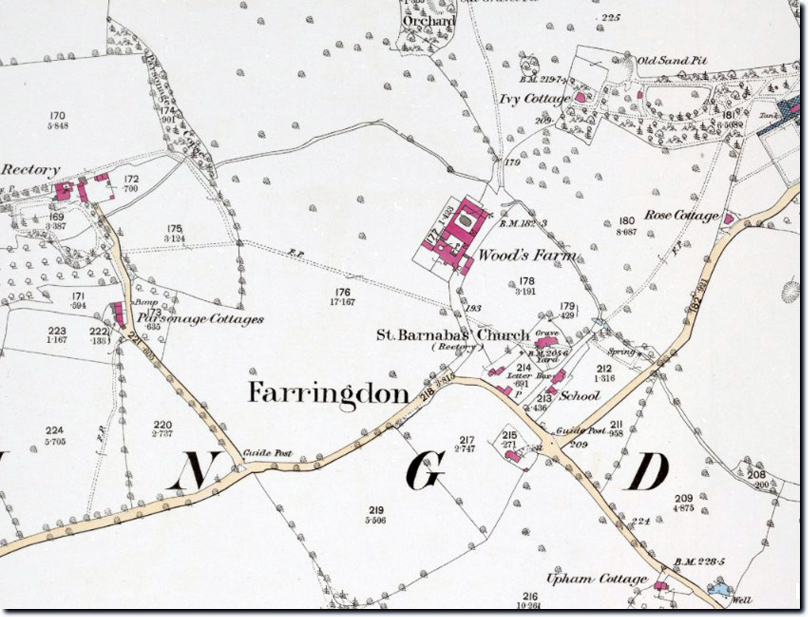
Farringdon is a small parish in east Devon, bordered by Clyst Honiton, Aylesbeare, Colaton Raleigh, Woodbury, Clyst St Mary and Sowton. Its position on the low ground east of Exeter has shaped its history for thousands of years. The parish is known for its unusually pure springs, which rise in several places and have supported settlement since prehistory. Flint scatters across the fields show continuous activity from the Neolithic, and earlier finds point to occupation in the Old Stone Age. Bronze Age tools, Iron Age traces and Saxon sites all fall within the parish boundary, forming a long sequence of habitation that predates the formation of the medieval manor.
Roman presence is well established, with several sites identified and evidence of a Romano‑British farm. A lamp found at Denbow suggests a villa in the vicinity. After the Norman Conquest the land was held by the chief bowman to William the Conqueror, and the distribution of ancient oaks indicates that much of the parish formed part of a deer park. Nineteenth‑century field names such as The Park and Deer Park Copse preserve this earlier landscape. The name Farringdon is thought to derive from “fern down,” reflecting the character of the higher ground.
The medieval parish centred on its church, now dedicated to St Petrock and St Barnabas. The present building is a complete Victorian rebuild of 1870, but the site itself is older and retains its Norman font. Among its earlier clergy was John Travers, brother of the puritan Walter Travers and connected by marriage to Richard Hooker. The manor was long held by the de Farringdon family, whose pedigree is recorded from the thirteenth century. The last male heir died in 1598 and the estate passed to his sisters, dividing the property between the Drakes of Peter Tavy and the Coopers. Other long‑established estates within the parish include Crealy, Denbow and Upham, each with their own sequence of owners and architectural survivals.
Farringdon House has a complicated history. The present structure is unlikely to be earlier than the seventeenth century, and conflicting accounts of sixteenth‑century ownership probably refer to different manor houses. In the nineteenth century the estate was owned by Bishop’s Court and let to tenants. An auction of its contents in 1918, held shortly before the arrival of the Putnam family, gives a clear picture of the house at the end of the landed‑gentry period. Across the parish, marl pits and clay workings show that Farringdon clay was widely used for brick and tile making, while orchards supplied the cider trade typical of east Devon.
By the early twentieth century the parish remained largely agricultural. Memories recorded by residents born in the 1930s describe a community centred on its farms, with children walking long distances to school and learning in a single room heated only by a stove beside the teacher’s chair. Outside toilets, buckets emptied by hand and newspaper for paper were part of daily life. Children earned money by catching rabbits or helping with harvest work, and the stream behind the rectory was still clean enough to drink from.
The Second World War brought abrupt changes. Troops camped in orchards and fields, anti‑aircraft guns were positioned close to farmhouses and aircraft crashed in nearby fields. American forces marched through the parish on their way to training grounds on Woodbury Common. The glow of Exeter burning during the Blitz was visible from Farringdon. Sentries sometimes stopped even local residents, though children quickly learned the paths that avoided them. Despite the disruption, the farms continued to operate, with farmers classed as a reserved occupation. Soldiers were generally friendly to the children, and the Garrison Cinema provided a rare diversion.
After the war the parish returned to its usual pattern. Some residents later worked at Farringdon House when it became an approved school, recalling the fire that destroyed part of the building and the loss of a wall painting of two pilots and a Spitfire. Others remembered the severe winters, the long walks to school and the resourcefulness required during rationing. The local policeman was a familiar figure, and poaching remained a serious offence. National Service took some of the young men abroad, while others entered apprenticeships in the building trades.
The structure of the landscape still reflects its earlier history. A survey of ancient trees revealed a ring of large oaks consistent with the outline of the medieval deer park. The largest, known as Anne’s Great Oak, measures seven metres in circumference and is estimated to be between six and seven centuries old. Other ancient trees, now recorded on local and national registers, reinforce the impression of a long‑established parkland environment.
Farringdon today retains the essential elements of its past: a parish shaped by springs, early settlement, medieval estates and the lived experience of the twentieth century. Its farms, lanes and scattered houses preserve a pattern that has altered little over time, while the church, the manor and the great oaks continue to define a small Devon parish with a long and well‑documented history.

