Satow’s diplomatic career began in 1861 when he entered the British Consular Service as a student interpreter. After a brief period in China, he was transferred to Japan in 1862, arriving at Yokohama at the age of nineteen. Within days of his arrival the Namamugi Incident occurred, and Satow found himself at the edge of the political crises that marked the final years of the Tokugawa shogunate. He took part in the British expedition to Kagoshima in 1863 and the allied attack on Shimonoseki in 1864, gaining first-hand experience of the military and diplomatic pressures that shaped Anglo–Japanese relations.
His rise in the service was rapid. On 1 April 1865 he was promoted to Interpreter of the Japanese Language, his salary doubling from £200 to £400 per year. On 31 December 1867 he was appointed Japanese Secretary with a salary of £700. Satow pressed for a consular posting at £800 per year, arguing that he did not wish to be overtaken by juniors, but the vacancy at Hyogo was not given to him. He accepted the rank of Japanese Secretary and remained in that position throughout the turbulent years of the Meiji Restoration. In 1876 he was granted the local rank of Second Secretary in recognition of his achievements, though this was not a promotion into the Diplomatic Service and applied only while he remained Japanese Secretary.
Satow’s linguistic ability was central to his influence. He learned Japanese initially from the Reverend Samuel Robbins Brown and Dr James Hepburn, using Brown’s sheets of colloquial Japanese. Later he studied the epistolary style under Takaoka Kaname of Wakayama, and after 1868 he learned Chinese-style writing from Takasai Tanzan, one of the best teachers in Tokyo. Satow never claimed to have good handwriting, noting that eight years spent translating official documents into English was not conducive to elegant Japanese prose, but his command of the language made him indispensable in negotiations with the shogunate and the powerful Satsuma and Chōshū domains.
He returned to England on leave in 1869 and came back to Japan in 1870. In 1872 he was a founding member of the Asiatic Society of Japan, contributing several papers on Japanese history, literature, and society. His 1874 article on Japan for the New American Cyclopædia was one of the earliest authoritative surveys of the country written in a European language. During this period he also studied Chinese calligraphy under Kōsai Tanzan, who gave him the artist’s name Seizan. Examples of his calligraphy survive in the British Library.
After more than twenty years in Japan, Satow left the country at the beginning of 1883 to take up a higher appointment. In 1884 he was posted to Siam as Consul-General in Bangkok. His work there was highly regarded, and in 1885 he received the rare honour of promotion from the Consular to the Diplomatic Service, becoming Minister Resident. Such advancement was exceptional, as the two services were normally segregated and the Diplomatic Service was largely reserved for men of aristocratic background. Satow’s promotion was therefore a recognition of his long experience, linguistic skill, and proven judgement in East Asian affairs.
In 1887 he left Siam and in 1889 was appointed Minister Resident in Uruguay, a post he held until 1893. His time in Montevideo broadened his diplomatic experience beyond Asia and brought him into contact with the political complexities of South America. From Uruguay he was transferred to Morocco, serving as Minister Resident from 1893 to 1895. These two postings, though far removed from his earlier work in Japan, strengthened his reputation as a capable and adaptable diplomat.
Satow returned to Japan in July 1895 as Envoy Extraordinary and Minister Plenipotentiary. He arrived only months after the Treaty of Shimonoseki and witnessed the rapid expansion of the Japanese army and navy following the Triple Intervention. During his five years in Tokyo he oversaw the transition to the ending of extraterritoriality, which came into effect in 1899 under the Anglo–Japanese Treaty of Commerce and Navigation. He also played a role in judicial appointments, recommending Hiram Shaw Wilkinson as Judge of the British Court for Japan in 1897 and later as Chief Justice of the British Supreme Court for China and Corea. Satow built a house at Lake Chūzenji in 1896 and used it as a retreat from the pressures of diplomatic life in the capital.
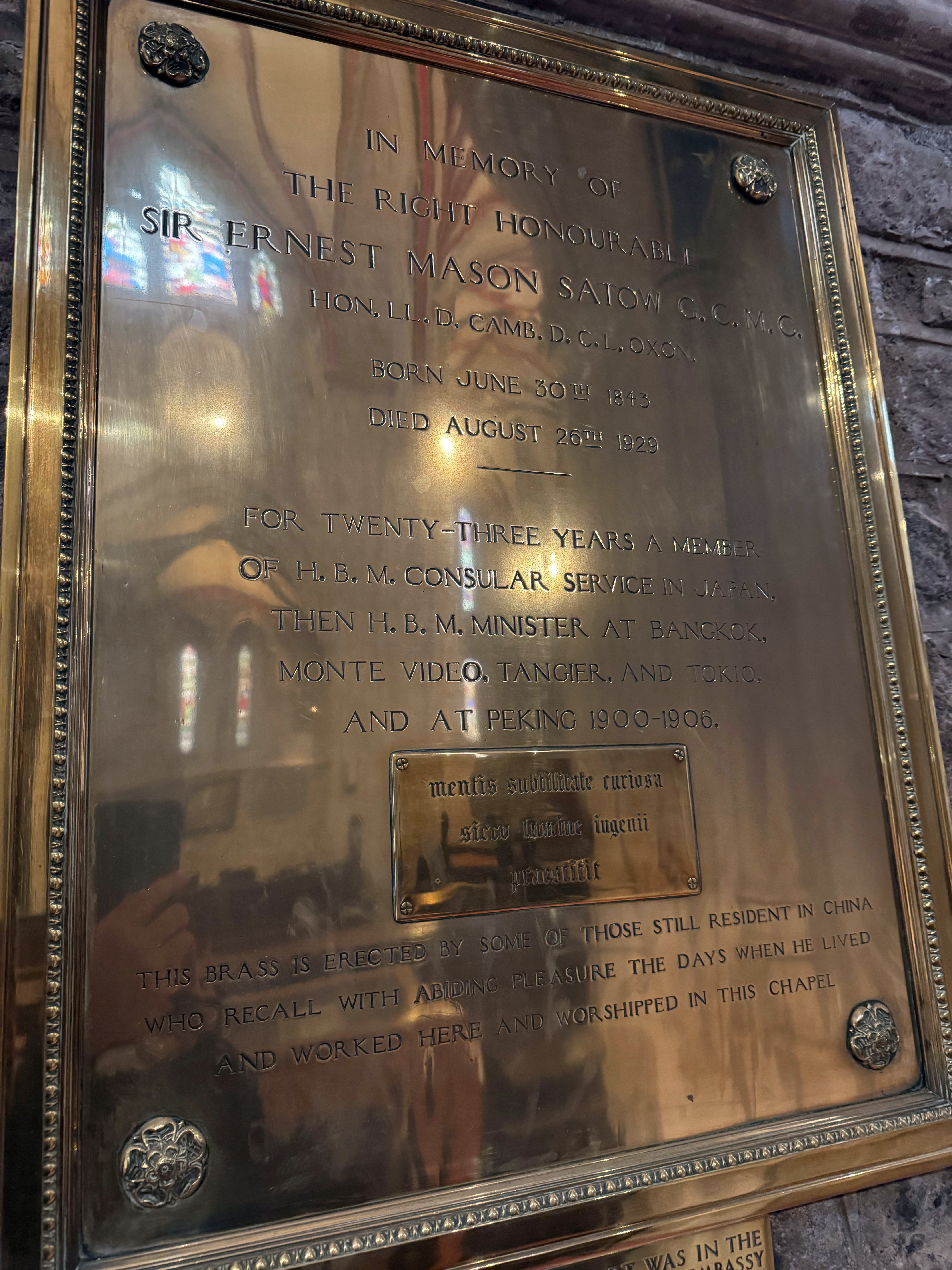
In 1900 Satow was transferred to China, arriving in Peking during the aftermath of the Boxer Uprising. Because the Imperial Court had fled and the allied powers were still at war with the Qing government, he could not present his credentials and served instead as British High Commissioner from September 1900 to January 1902. He was one of the plenipotentiaries who negotiated the Boxer Protocol, which he signed for Britain on 7 September 1901. After the settlement he was formally received as Minister and remained in China until 1906. China was considered a more prestigious post than Japan, with a salary of £5,000 per year compared with £4,000 in Tokyo. Satow received the GCMG in 1902 and was made a Privy Councillor in 1906.
In retirement at Ottery St Mary from 1906 to 1929, Satow continued to serve the government. In 1907 he was appointed Britain’s second plenipotentiary delegate at the Second Hague Peace Conference. He devoted much of his time to writing on diplomacy and international law, producing A Guide to Diplomatic Practice, which became a standard reference work for the Foreign Office and remains in use today. His diaries and correspondence from this period show a life centred on scholarship, gardening, and the organisation of his extensive library. He cultivated Japanese plants in his Devon garden, many grown from seeds sent by friends in Tokyo, and maintained close contact with former colleagues from his East Asian postings.
Satow’s personal life was closely connected with Japan. He formed a long-standing relationship with Takeda Kane (1853–1932), whom he could not legally marry while serving as a diplomat. They had a daughter who died in infancy in 1872, and two sons: Eitaro (1880–c.1925), who died in the United States after suffering from tuberculosis, and Hisayoshi (1883–1972), who became a noted botanist. Hisayoshi studied at Kew Gardens and Birmingham University, founded the Japan Natural History Society, and later served as President of the Japan Alpine Club. The Takeda family letters, including many of Satow’s, are preserved at the Yokohama Archives of History.
Satow died on 26 August 1929 at Ottery St Mary and is buried in the churchyard of St Mary’s. His papers, diaries, and travel journals, covering the years 1856–1927, are held at the National Archives and remain a major source for the study of British diplomacy in East Asia. His reputation in Japan is considerable, and he is remembered as one of the most important foreign observers of the Bakumatsu and Meiji periods.
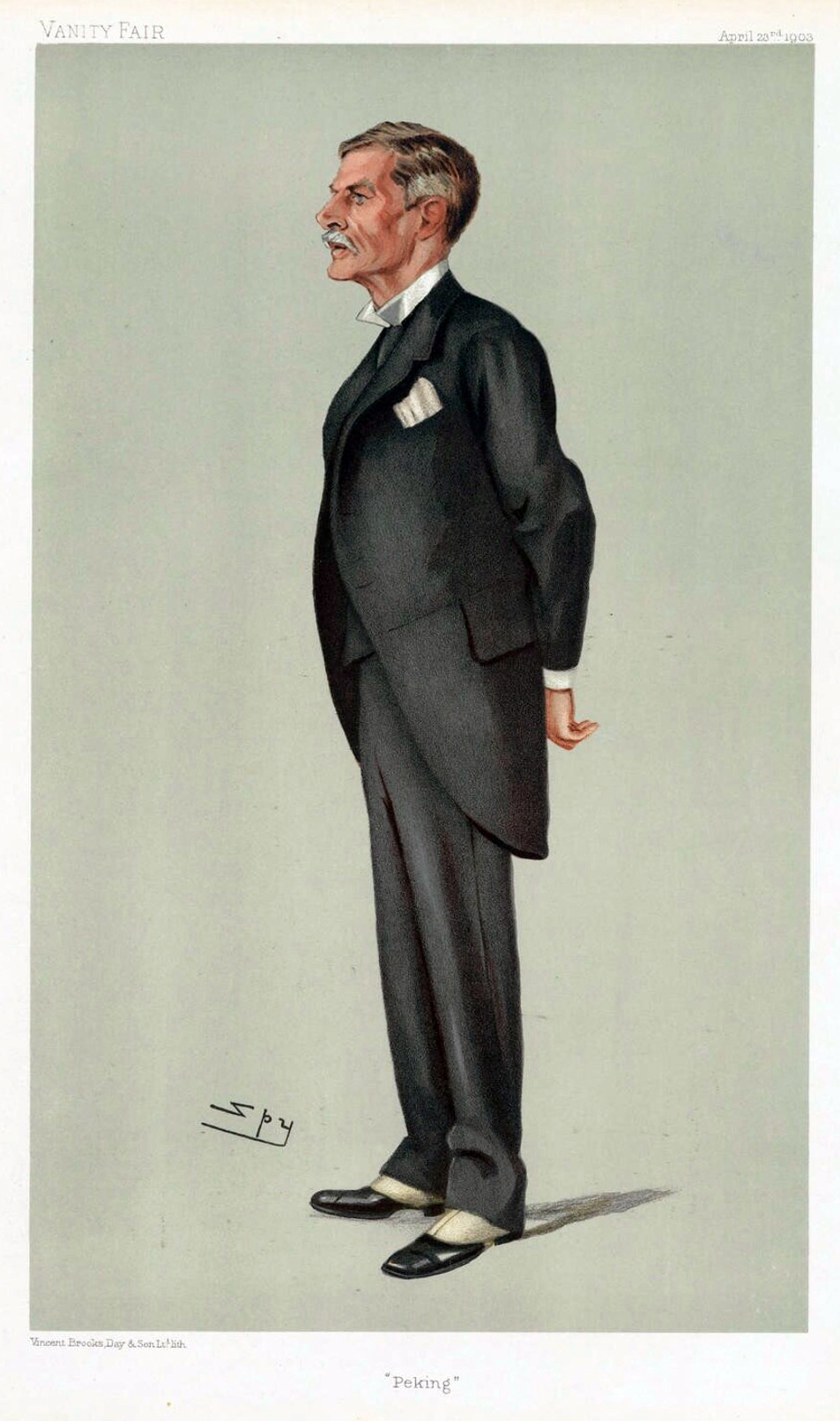
Image above courtesy of National Portrait Gallery