

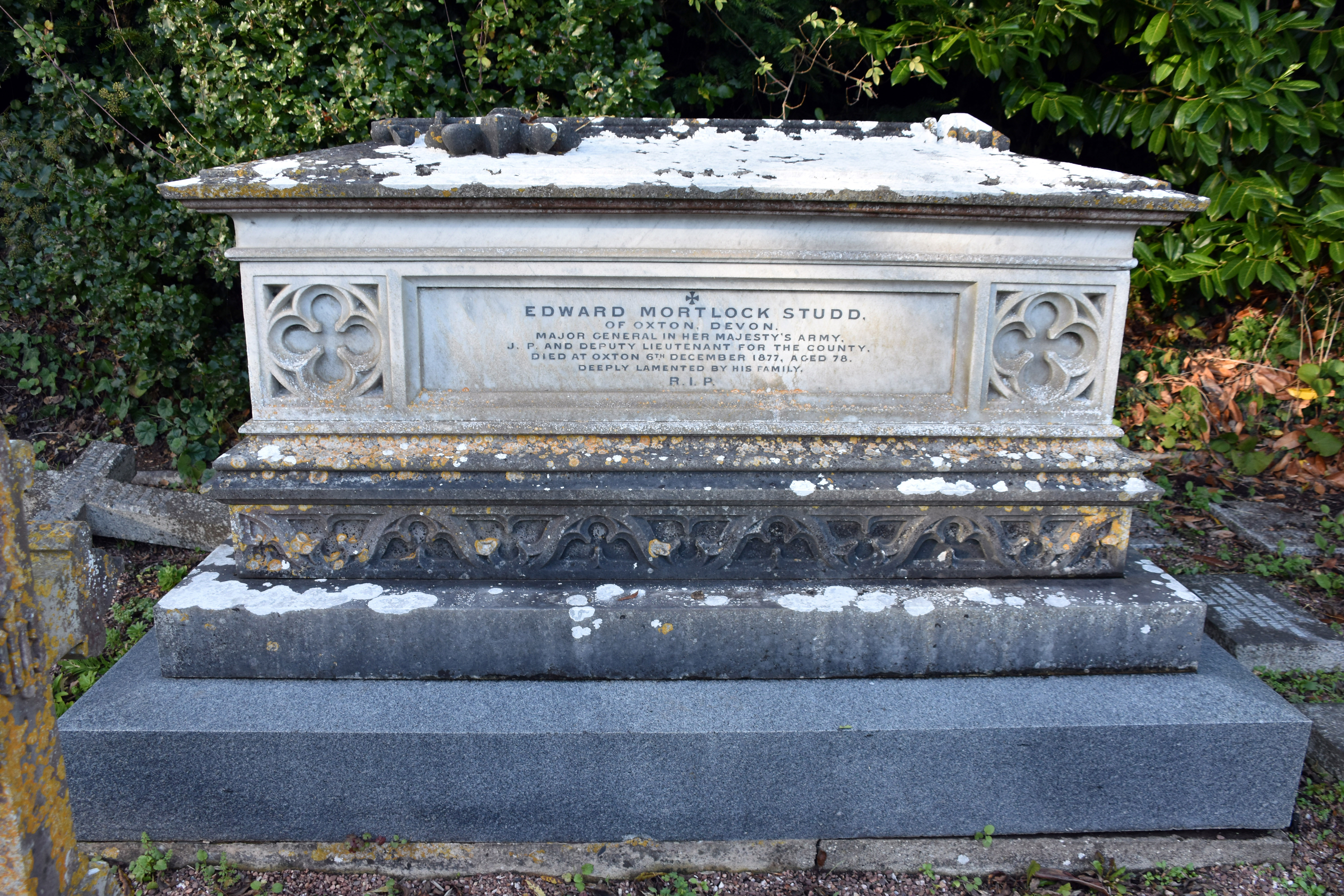
Major‑General Edward Mortlock Studd (1799–1877), soldier, landowner, and later Fellow of the Royal Numismatic Society, is commemorated in a striking late nineteenth‑century chest tomb. Carved in marble and granite, the monument stands high on a polished granite base, its ends decorated with quatrefoils and its plinth enriched with blind tracery. The coped lid is adorned with a foliated cross, a symbol of faith and remembrance. The inscription records his death in 1877 and identifies him as “Major‑General Studd of Oxton.”
Studd had purchased Oxton in 1848, succeeding the Swete family as lord of the estate, and his memorial reflects both his military distinction and his deep attachment to the place. According to tradition, he willed that he should be buried in Oxton soil, and earth from the estate was placed in his grave to fulfil that wish. This detail, recorded by Griffiths in The Book of Dawlish (1984), underlines the symbolic bond between the man and the land he had made his home.
The tomb thus serves as more than a personal memorial: it is a statement of continuity, linking the imperial soldier who had served abroad with the Devon estate he cherished. In its Gothic tracery and dignified form, the monument reflects the Victorian taste for medieval revival, while its inscription and the story of the Oxton soil root Major‑General Studd firmly in the local landscape. It stands today as a reminder that even those whose lives were shaped by empire sought, in death, to be bound again to the soil of Devon.


