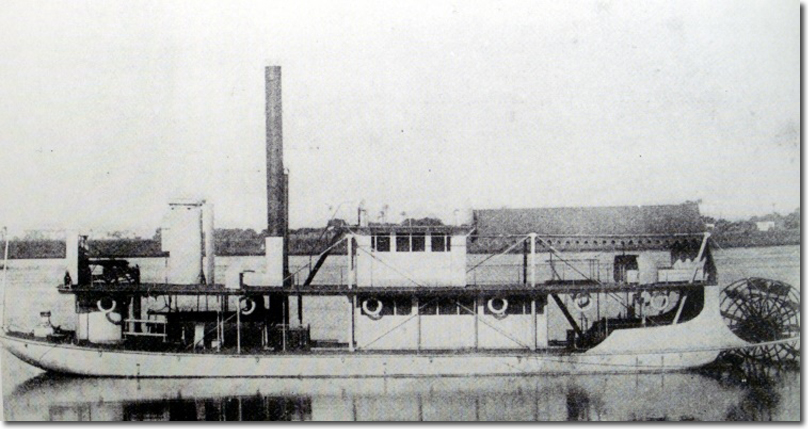
Edward Osborne Armstrong Newcombe was born on 30 August 1874 and educated at Bath College before entering the Royal Military Academy, Woolwich. Commissioned into the Royal Engineers in 1893, he was soon posted to the Egyptian Army during the Sudanese campaigns of 1896–98. It was here that he was given command of the gunboat Abu Klea, one of the paddle steamers that made up the Nile Gunboat Flotilla under Commander C. Keppel, R.N. These ungainly but formidable vessels were the lifeline of Kitchener’s army, carrying supplies and heavy guns upriver through treacherous waters. Newcombe’s task was to keep the Abu Klea moving, ensuring that food, ammunition, and reinforcements reached the front. When the climactic Battle of Omdurman was fought on 2 September 1898, the gunboats’ bombardment was decisive, and Newcombe himself was Mentioned in Despatches for his part in the victory.
The experience on the Nile set the tone for a career that combined engineering skill with logistical command. After Sudan, Newcombe served on the Staff in South Africa during the Boer War, present at operations in the Orange Free State, the Transvaal—including the actions at Diamond Hill and Belfast—and in the Cape and Orange River Colonies. Once again his service was recognised in despatches, and he received the Queen’s and King’s South Africa Medals with multiple clasps. In 1906 he returned to Sudan as Traffic Manager of the Government Railways, a post he held for two decades. His ability to keep men, supplies, and machinery moving across difficult terrain became his hallmark.
At the outbreak of the Great War he was a Major on retired pay, but he rejoined the colours in October 1914. The efficiency with which he ran the Sudanese railways proved vital to Britain’s ability to rush troops to threatened fronts in East Africa and along the Suez Canal. Twice more he was Mentioned in Despatches, awarded the Egyptian Order of the Nile, 3rd Class, and created a Companion of the Distinguished Service Order. His career illustrates the often-overlooked importance of engineers and logisticians in sustaining imperial campaigns across vast distances.
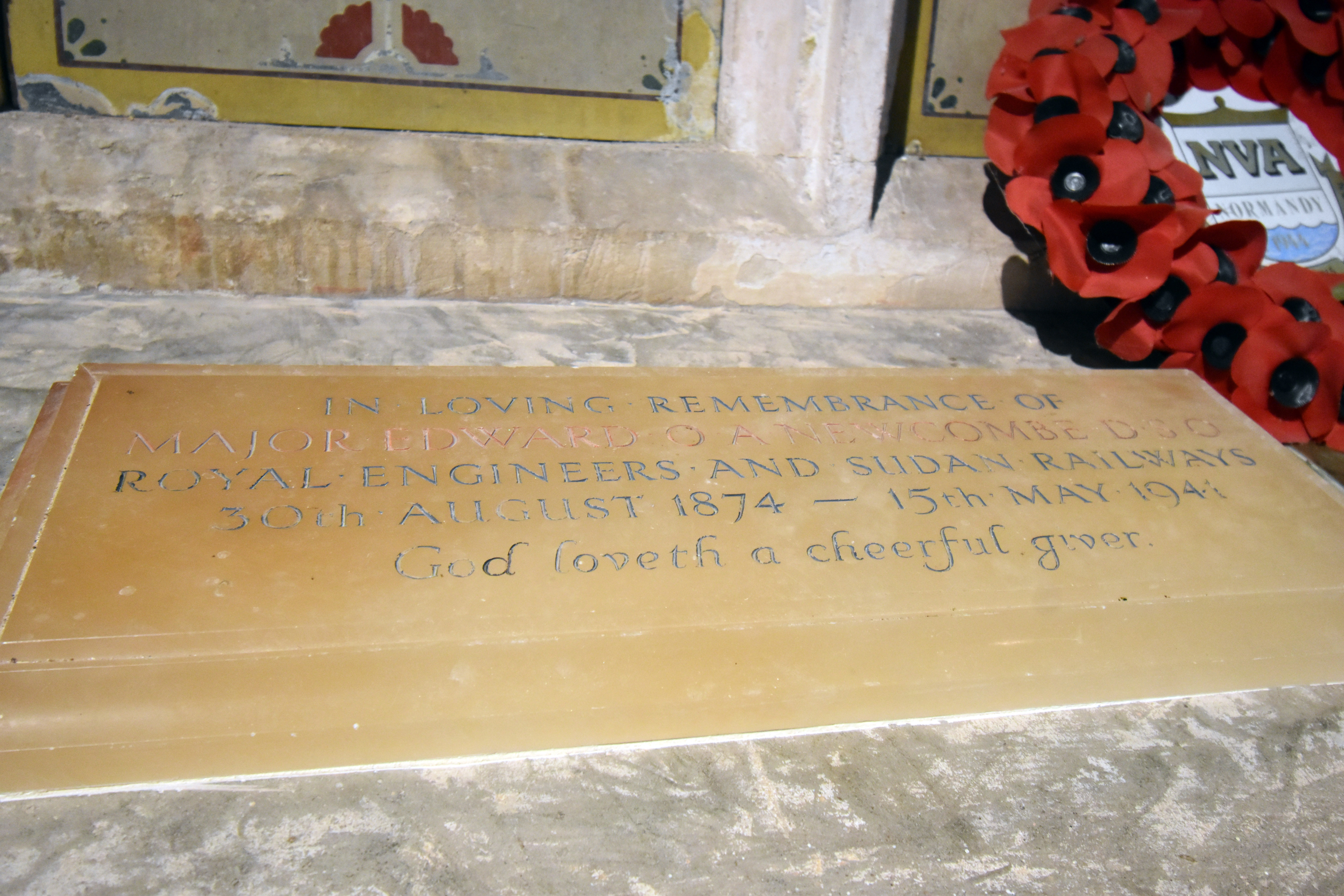
Major Newcombe is remembered today on a plaque in St Clement’s Church, Powderham. After his early years on the Nile gunboats, much of his career was spent not in battle but in the steady, essential work of keeping men and supplies moving. As Traffic Manager of the Sudan Government Railways from 1906, and again during the First World War, he oversaw the lines that carried troops to the Suez Canal and East Africa. His skill in running the railways was as vital to Britain’s campaigns as any battlefield success, and it was for this quiet but decisive contribution that he was repeatedly commended. His memorial in Powderham is a reminder that service can be measured not only in moments of combat, but also in the less visible labour that sustained armies across continents.