

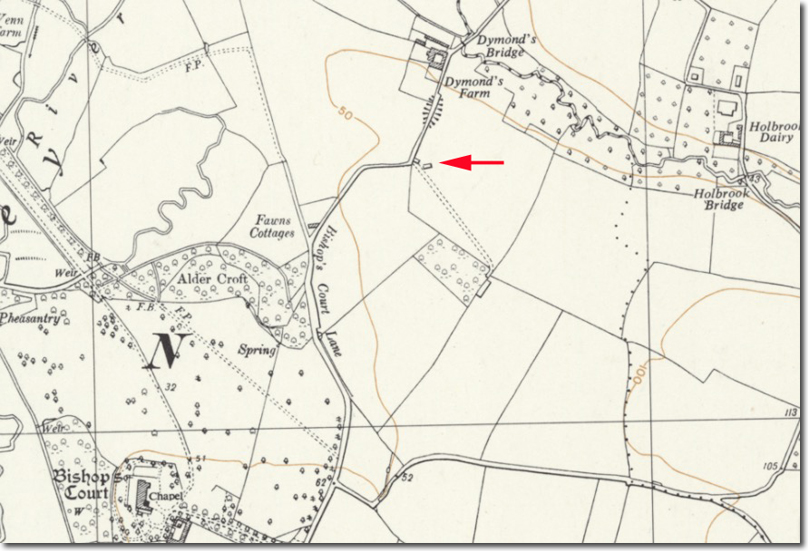
A little over two kilometres east of Exeter, Bishop’s Court Lane passes fields that give no hint of the activity once concentrated here. Before the war this was simply farmland, but from 1944 the aerial photographs show a new geometry imposed upon it: a tight block of Nissen huts arranged in a rectangular pattern, with further huts scattered to the west and north and all of them linked by a web of trackways. The camp covered just over 2.6 hectares and was entered from the lane to the north. It had begun as additional accommodation for bomber crews operating from RAF Exeter during the D‑Day period, but it soon took on a different role as German prisoners of war arrived during the Normandy campaign.
The 1947 photographs show the camp still intact, its wartime layout sharply defined. By 1957 much of it had been cleared and a plantation had taken root across part of the site, though three Nissen huts still stood. Two of these survive today at the former entrance, now absorbed into the grounds of Oakview House. A third, once lying to the southeast of the plantation, has since been demolished and replaced by a modern agricultural building. The rest of the land has slipped back into its earlier agricultural rhythm.
The camp’s internal life was shaped by the shifting population of 1946, when large numbers of prisoners arrived from the United States. Many had been led to believe they were being repatriated and found themselves instead in working camps across the West Country. Others had served in the Channel Islands. Morale was low, and the camp’s politics were unsettled. Oversight of re‑education and English teaching fell to the Political Intelligence Department of the Foreign Office and the Control Office for Germany and Austria. Their visitors concerned themselves almost exclusively with re‑education and paid little attention to welfare, sport or the ordinary occupations of the men.
A report of early July 1946 recorded a strength of one officer and 1,360 other ranks across the headquarters and ten hostels. Major A. E. Machin, the Commandant, was considered co‑operative but not active in re‑education. The interpreter, S/Sgt Kessler, was Polish; his parents had been murdered by the Germans, yet he was regarded as capable, energetic and fluent. The camp leader, August Drinkow, aged 38 and formerly of the SPD, was judged unable or unwilling to recognise the deterioration in morale. His deputy, Fritz Christiani, aged 27 and previously in the Hitler Youth and SA, had been held in the United States; his removal was recommended. Other figures caused concern, including the chairman of the political committee and the prisoner responsible for re‑education, who was diagnosed with a mental disorder and recommended for medical repatriation.
Political screening at this time showed a broad spread from A+ to C+, with 180 men unscreened. Hostel leaders had been elected by secret ballot, but this had proved open to manipulation. A “Camp Parliament” at headquarters directed activities and had already engineered the removal of a previous leader. Rumours circulated that former Nazis and officers were already home and back in their jobs while anti‑Nazis and other ranks remained in captivity. One spokesman for these grievances was Oscar Fass, who had lived in France, served in the French Army, spent two years in Buchenwald and later served in the German forces. It was believed that others were deliberately fostering unrest.
Re‑education was widely regarded as pointless. The camp received copies of Wochenpost and Ausblick, a small supply of German newspapers, and had a library of only 350 books. Lectures were held, though discussion groups were limited. Films were shown fortnightly at headquarters, Torquay and Teignmouth, with YMCA films at other hostels. Wireless sets were unreliable. A camp magazine had begun three months earlier, and English classes were attended by more than a hundred men across beginner and advanced groups. Entertainment included small orchestras and theatre groups at headquarters, Sidford, Froyle House and Chudleigh. Religious provision was irregular, with Protestant and Catholic services conducted by local clergy and priests from Buckfast Abbey.
Between late 1946 and the summer of 1947 the headquarters moved to Nissen Creek, leaving Dymond’s Farm as a hostel. By November 1947 the headquarters had returned. A re‑education check recorded one officer and 325 other ranks. The new Commandant, Major Munns, RA, was thought to have little understanding of re‑education but was popular with the prisoners. The interpreter, S/Sgt Tomaschoff, was regarded as extremely efficient. Political screening now showed one A‑grade prisoner and the remainder B‑grade. More than 800 men had been repatriated from the combined camps. Morale was described as changeable but improving, helped by repatriation, the approach of Christmas, good relations with the local population and the Commandant’s popularity. Camp activities had declined. English newspapers were supplied satisfactorily, and German papers were received privately. Lectures suffered from poor attendance, and there were no discussion groups, press reviews or information rooms. Films were infrequent. Education was limited to English classes. Religious services were held weekly in a local church, with Bible classes and access to Catholic services in Exeter. A camp band and theatre group continued to perform.
A routine check in early January 1948 recorded one officer and 284 other ranks. The temporary Commandant, Captain H. Humphreys, RTR, was considered a very good influence. Morale remained good, though employment had ceased shortly before Christmas, leaving the men without pay. Many had been invited to local homes over the holiday. Older prisoners with families complained that they should be repatriated before younger men. By this time nearly 900 prisoners had been repatriated. Most camp activities had ceased, with only football and table tennis continuing. Closure was expected soon.
By early 1948 Dymond’s Farm had become a hostel for Bampton Road Camp 92. In March only seven prisoners remained, and the camp closed shortly afterwards. The land returned to agricultural use, the plantation grew over much of the former camp, and only a few Nissen huts survived into the modern era. Today the fields along Bishop’s Court Lane give little away, but the aerial photographs and scattered remnants still mark the years when Dymond’s Farm formed part of the wider wartime and post‑war network of Prisoner of War camps across Devon.

