

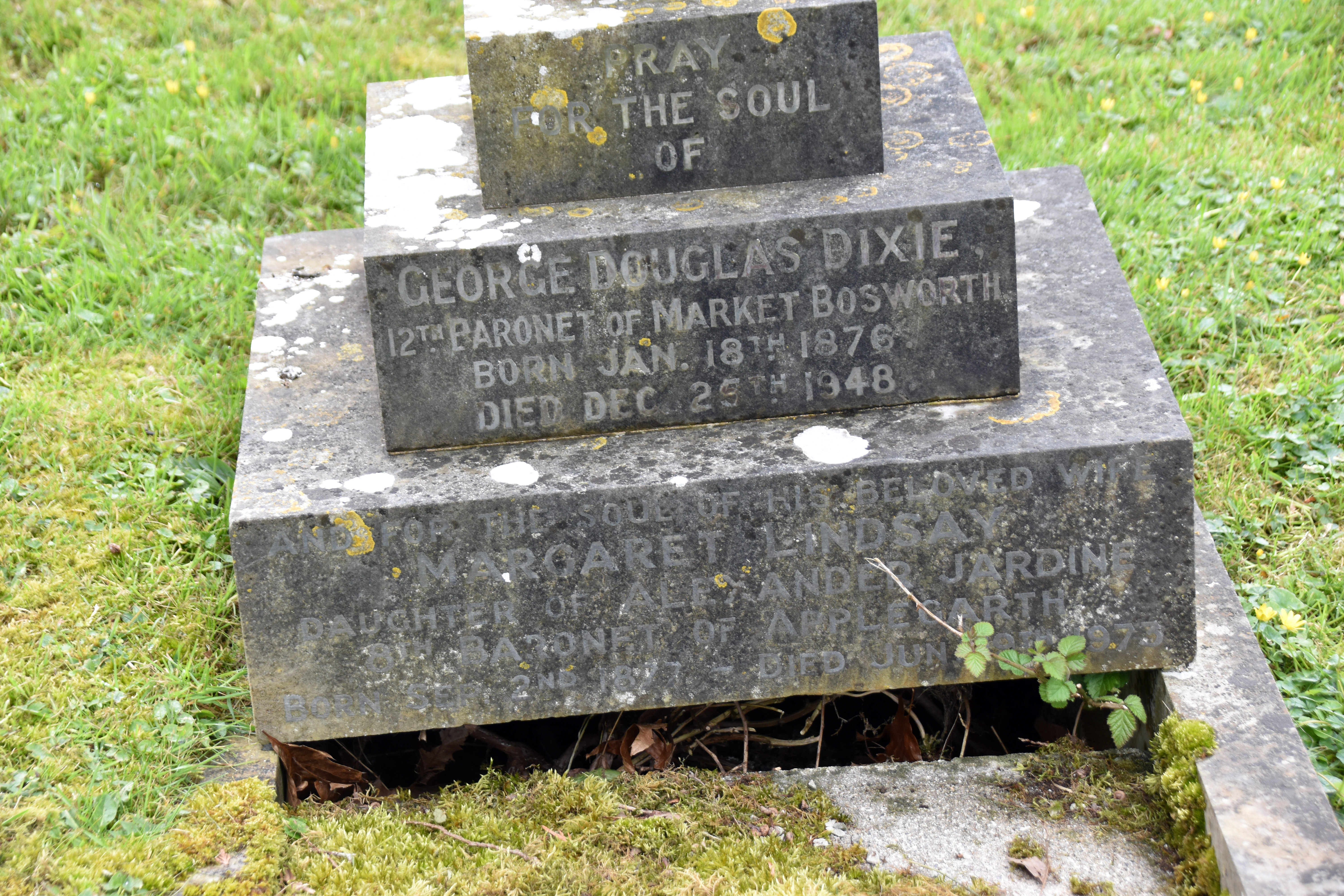
Sir George Douglas Dixie (1876–1948), known as Sir Douglas Dixie, was the 12th Baronet of Market Bosworth, Leicestershire. Market Bosworth lies west of Leicester in the English Midlands and is best known as the site of the Battle of Bosworth (1485). The Dixie family were established there from the seventeenth century, holding the baronetcy created in 1660 and occupying Bosworth Hall until its sale in 1885.
Douglas Dixie was the elder son of Sir Alexander Beaumont Churchill Dixie, 11th Baronet, and Lady Florence Caroline Dixie. His mother was a well-known traveller, writer and early feminist, noted for her reporting on the Anglo-Zulu War and for books such as Across Patagonia (1880). Through her he was connected to the Douglas and Queensberry families. His uncle, John Sholto Douglas, 9th Marquess of Queensberry, gave his name to the Queensberry Rules of boxing and was involved in the 1895 prosecution of Oscar Wilde. The middle name “Douglas” reflected this maternal lineage.
The Dixies’ ancestral seat, Bosworth Hall, had been sold in 1885 during the lifetime of the 11th Baronet as a result of financial pressures, including gambling debts. Although Douglas Dixie inherited the title in 1924, he did so without the estate that had defined the family’s position in Leicestershire for more than two centuries. The family’s earlier prominence included the foundation of Dixie Grammar School in 1601 by Sir Wolstan Dixie, an Elizabethan merchant and Lord Mayor of London.
Douglas Dixie began his career in the Royal Navy, serving as a midshipman. In 1895 he transferred to the British Army and was commissioned into the 3rd (Militia) Battalion, King’s Own Scottish Borderers (KOSB). He was promoted lieutenant in 1898 and resigned his commission in 1900, returning to the regiment in 1906. During the First World War he served as a temporary captain in the 5th Battalion, KOSB, from November 1914. His military service followed the pattern typical of late-Victorian and Edwardian aristocratic families, combining naval training with militia and Territorial Force appointments.
In 1902 he married Margaret Lindsay Jardine, daughter of Sir Alexander Jardine, 8th Baronet of Applegirth. They had three children: Marie Margaret Florence Hyacinthe Dixie (1907–1968), Frances Dorothy Madeleine Barbara de la Motte Dixie (born 1912), and their son Alexander Archibald Douglas Wolstan Dixie (1910–1975), who succeeded as the 13th Baronet.
Douglas Dixie succeeded to the baronetcy in 1924 on the death of his father. By this time the family’s former estates had long passed out of their hands, and his later life appears to have been largely private, with no significant public appointments recorded. He died in 1948 and was succeeded by his son, Sir Wolstan Dixie.
Sir Wolstan Dixie, the 13th Baronet, served in the Royal Navy during the Second World War and later wrote an autobiography, Is It True What They Say About Dixie? (1972). He married twice and had two daughters but no male heirs. On his death in 1975 the Dixie baronetcy became extinct, ending the line that had begun in 1660.
The Dixie arms are Azure, a lion rampant or, a chief or. The family motto, “Quod dixi dixi” (“What I have said, I have said”), is a long-standing pun on the family name and appears throughout the heraldic material associated with the baronetcy.

