

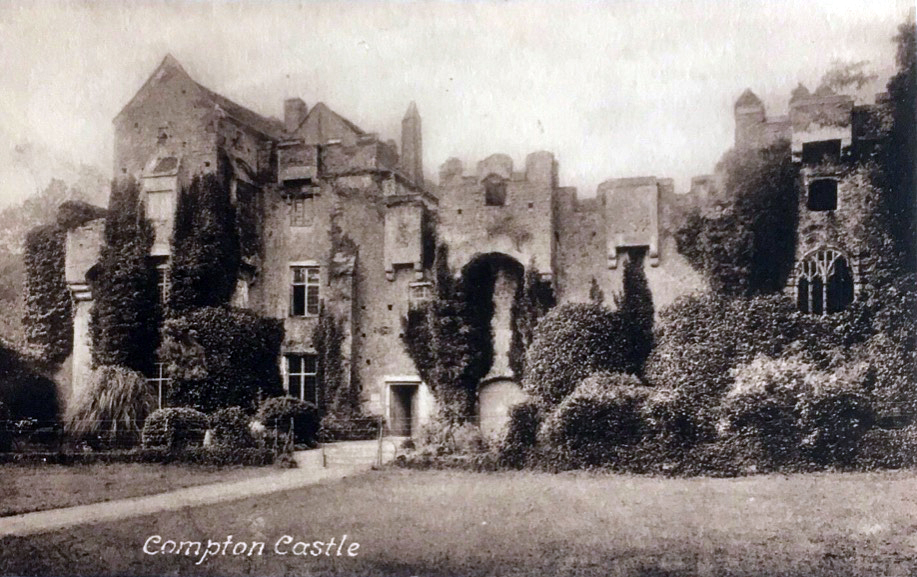
Compton Castle sits tucked into its fold of Devon countryside, a compact but unmistakably self‑assured survivor of the medieval world. Approaching it today, you see at once that this was never a great baronial fortress but a fortified manor house, built as much to impress as to defend. Most of what stands dates from the 14th and 15th centuries, with the Gilberts adding their own flourishes in the 16th. The battlements, the twin portcullis entrances and the stout curtain wall all speak of a family eager to project status in stone. Beneath the lawns lie the remains of an earlier medieval hall, and the surrounding fields still hint at the old estate: fishponds, orchards, and perhaps even a small deer park where the family could watch or hunt from levelled viewpoints cut into the hillside.
Long before the Gilberts arrived, the manor belonged to the de Pole family. In the 15th century Alice de Pole, Duchess of Suffolk and daughter of Geoffrey Chaucer, passed the estate to a relative, Peter de Pole, who promptly adopted the surname Compton in honour of the property. The Comptons held the manor for seven generations until Joan Compton married Geoffrey Gilbert of Totnes in the early 14th century. Geoffrey, already the owner of Greenway on the Dart, built a Great Hall at Compton, and it was around this hall that the later castle grew. The Gilberts were already a seafaring family, owning ships and trading with Iberia. Geoffrey’s grandson William organised voyages to Spain, and his great‑grandson Otho provided ships for the Crown during the long wars with France. Otho’s loyalty was rewarded in 1475 when he was appointed Sheriff of Devon.
It was Otho’s son John who gave Compton its fortified silhouette. He transformed the old manor into the courtyard castle we see today, adding battlements, defensive gateways and a surrounding wall. By the 16th century the Gilberts were well connected at court and increasingly involved in England’s overseas ambitions. Their story becomes entangled with the great Elizabethan push into the Atlantic world, and Compton Castle, despite its quiet setting, found itself linked to voyages, privateering and the earliest English attempts at colonisation.
The most famous of the family, Sir Humphrey Gilbert, embodied the restless energy of the age. Soldier, navigator, writer and Member of Parliament, he was driven by a conviction that England’s future lay across the ocean. In 1578 he secured Letters Patent from Elizabeth I granting him the right to claim lands not already held by a “Christian prince or people”. Five years later he sailed from Plymouth with a small fleet and 260 colonists, hoping to establish England’s first overseas settlement. When he reached Newfoundland he found a harbour already frequented by European fishing vessels and an Indigenous population whose presence the English chose to overlook. Undeterred, he claimed the land for the Queen in a ceremony that was more symbolic than practical. His expedition soon unravelled, and on the return voyage his tiny ship, the Squirrel, was lost in a storm near the Azores. His death was later romanticised, but the gesture helped ignite the English imagination and paved the way for his half‑brother Sir Walter Raleigh and later ventures.
The Gilberts were part of a wider network of West Country adventurers — the so‑called “West Country Men” — whose names still echo through Elizabethan history: Raleigh, Grenville, Drake, Hawkins. They were explorers, privateers and colonisers, and their activities knitted Devon into the early modern Atlantic world. Among those who crossed the ocean was John Provost, an Indigenous man from Trinidad who lived for years with Sir John Gilbert and travelled repeatedly between England and the Americas. His presence, and that of others like him, is a reminder that Compton Castle was never as isolated as its rural setting suggests.
The fortunes of the Gilberts rose and fell with the tides of history. Long‑distance voyages and military service were expensive, and by the early 18th century the family had left Compton. The Great Hall roof collapsed around 1750, and by 1775 parts of the building were being dismantled. In the 19th century the castle became a working farm, its forecourt flanked by large agricultural barns. By the end of the century only fragments of the eastern service wing remained habitable; the rest was a romantic ruin, smothered in ivy and slowly returning to the landscape.
Compton’s revival began in 1931 when Commander Walter Raleigh Gilbert, a descendant of the family, bought the derelict castle and six acres of land. He and his wife Joan undertook a meticulous restoration, working with skilled craftsmen to rebuild the Great Hall and stabilise the surviving structures. They reused original stone and salvaged window fragments, ensuring that the revived castle retained its medieval character. In 1951 the family gifted the property and 300 acres of farmland to the National Trust, though they continued — and still continue — to live in part of the house. Today the castle stands as a rare fortified manor, its story woven from medieval ambition, Elizabethan adventure and 20th‑century dedication to preservation.

