

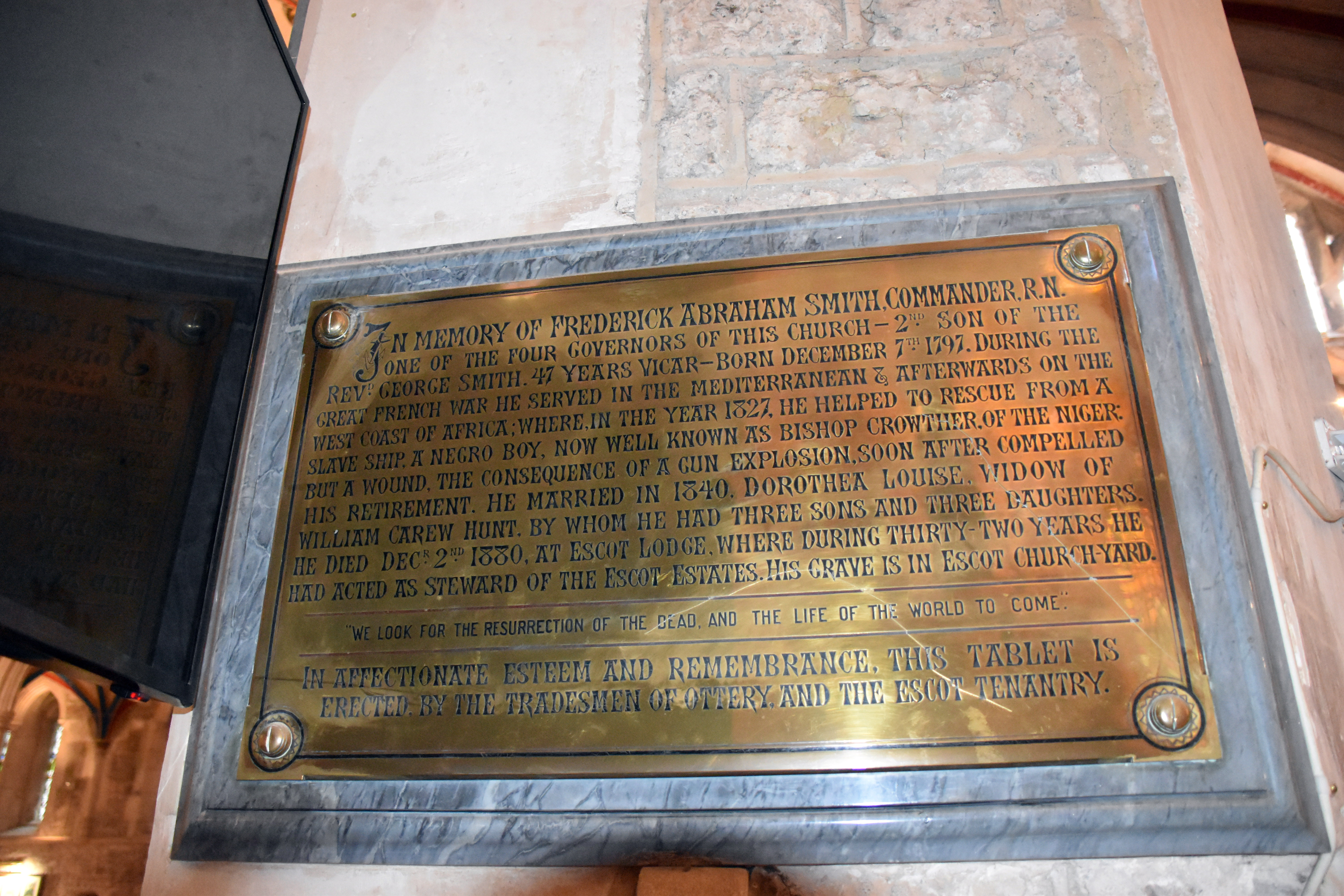
Frederick Abraham Smith was born on 7 December 1797, the second son of the Revd George Smith, Vicar of Ottery St Mary and a magistrate for the county. He entered the Royal Navy on 8 February 1811 as a first-class volunteer in the Edinburgh 74 under Captain Robert Rolles, serving in the Mediterranean during the later stages of the Napoleonic Wars. He later followed Rolles into the Union 98, rising to midshipman, and in 1814 transferred to the Valiant 74 under Captain Zachary Mudge. His early service included cutting out vessels near Toulon, taking part in the siege of Tarragona, and witnessing the fall of Genoa.
On his return from a voyage to the coast of Brazil in the Valiant, Smith joined the Albion 74 in July 1815, and then successively the St George 98, Impregnable 104, Berwick 74 and the Impregnable again, flagships of Sir John Thomas Duckworth and Lord Exmouth at Plymouth. For a time he was employed in the revenue tender Quail. His career then shifted to the West Africa station, where he served for nearly eighteen months as Master’s Mate in the Tartar 42, flagship of Sir George Ralph Collier, engaged in the suppression of the transatlantic slave trade.
In the Tartar Smith assisted in the capture of several slave vessels. On 18 January 1820 he was appointed Acting-Lieutenant of the Myrmidon 20 under Captain Henry John Leeke, and his rank was confirmed on 10 April that year. While in command of the tender Augusta, attached to the Myrmidon, he made further captures on the African coast including the interception of the slave ship that carried the 12 year old slave boy Adjai, later Bishop Samuel Ajayi Crowther.. During an attack on slave-trading settlements on the Rio Pongo on 20 May 1820 he was severely wounded and lost the sight of an eye, an injury that forced him to invalid home in February 1821.
Later appointments, in 1827 and 1829, took him to the Britannia 120, flagship of the Earl of Northesk, and the Kent 78 under Captain John Ferris Devonshire, both on the Plymouth station. Recurrent and severe inflammation of the injured eye obliged him to retire again in 1830, and he did not serve afloat thereafter. On 5 January 1831 he was granted a naval pension of £91 5s. per annum.

