

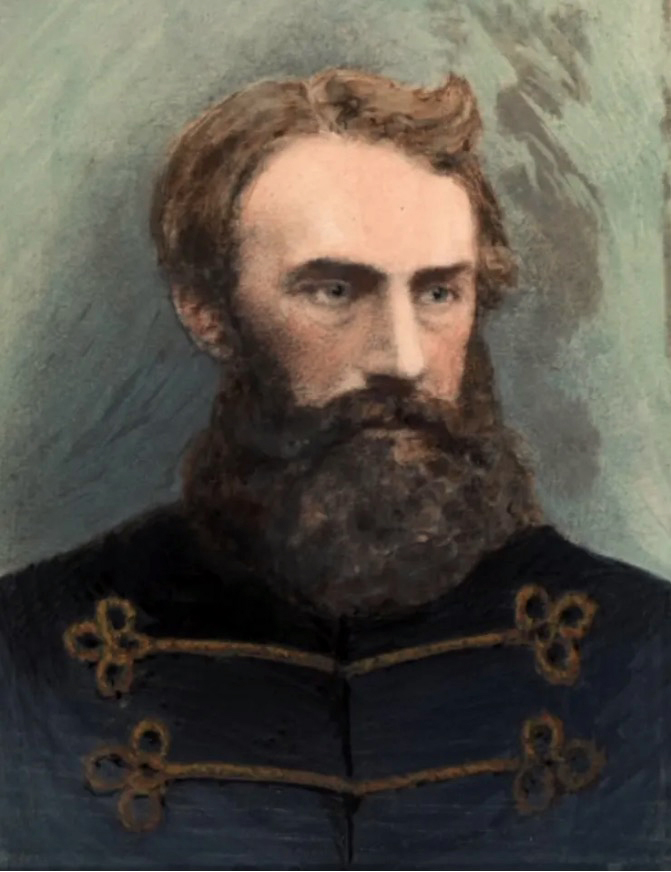
Charles James Buchanan Riddell (1817–1903) was a Royal Artillery officer whose career combined scientific work, Arctic involvement, and active service in the Indian Mutiny. He was born at Lilliesleaf, south-east of Selkirk, on 19 November 1817, the third son of Sir John Buchanan Riddell, 9th Baronet. He entered the Royal Military Academy, Woolwich, in 1832 and was commissioned into the Royal Artillery in 1834. Promotion followed in steady sequence: First Lieutenant in 1837, Second Captain in 1845, Captain in 1850, Lieutenant-Colonel in 1855, Brevet Colonel in 1858, Colonel in 1865, and Major General on retirement later that year.
Riddell’s early career was shaped by his association with Edward Sabine and the international programme of magnetic and meteorological observation. In 1839 he joined Sabine’s work and was sent to Canada to select the site of the new colonial Magnetical and Meteorological Observatory in Toronto. He oversaw its construction and served as Superintendent until illness forced his return to Britain in 1841. Once recovered, he became Assistant Superintendent of Ordnance and Magnetic Observations at the Royal Military Repository, Woolwich.
Riddell played a significant role in preparing the scientific equipment for Sir John Franklin’s 1845 expedition. The surviving letter book (TNA BJ3/47) contains copies of the detailed instrument lists for Erebus and Terror, all written in his hand. His 1844 publication, Magnetical Instructions for the Use of Portable Instruments, set out the procedures for establishing observatories and conducting observations ashore and afloat. It is likely that he trained several of Franklin’s officers, including James Fitzjames, in the use of the magnetic instruments. Fitzjames later sent greetings to Riddell from the Whale Fish Islands, indicating a direct working relationship.
During the Indian Mutiny Riddell commanded the siege artillery of Outram’s force on the left bank of the Goomtee during the siege and capture of Lucknow in March 1858. He later commanded the artillery of Lugard’s column at Tigree, the relief of Azimghur, operations in the jungle, and the capture of Jugdespore. He was three times mentioned in despatches, received the brevet of colonel, was appointed Companion of the Bath (CB), and received the Indian Mutiny Medal with clasp “Lucknow”.
His CB insignia was a refurbished Georgian badge, re-issued by Garrard in the late 1850s. His medal group, commissions, and extensive documentation survive, including his CB warrant signed by Queen Victoria and nine commission documents covering his promotions from 1834 to 1865.
After India, Riddell served in the West Indies and later held a staff appointment at Woolwich. He married Mary, second daughter of Field Marshal Sir Dalrymple Ross GCB, in 1847. They had one daughter, Mary Frances, who died in 1900. Riddell retired as a major general in 1865 and spent his later years in South Devon. He died at Chudleigh on 25 January 1903, aged 85, and is buried in the parish.
Riddell’s career reflects the breadth of mid-Victorian military service: scientific work, Arctic involvement, colonial observatories, and active campaigning. His surviving memorial on Beechey Island and his long record of service place him among the more distinctive Royal Artillery officers of his generation.

