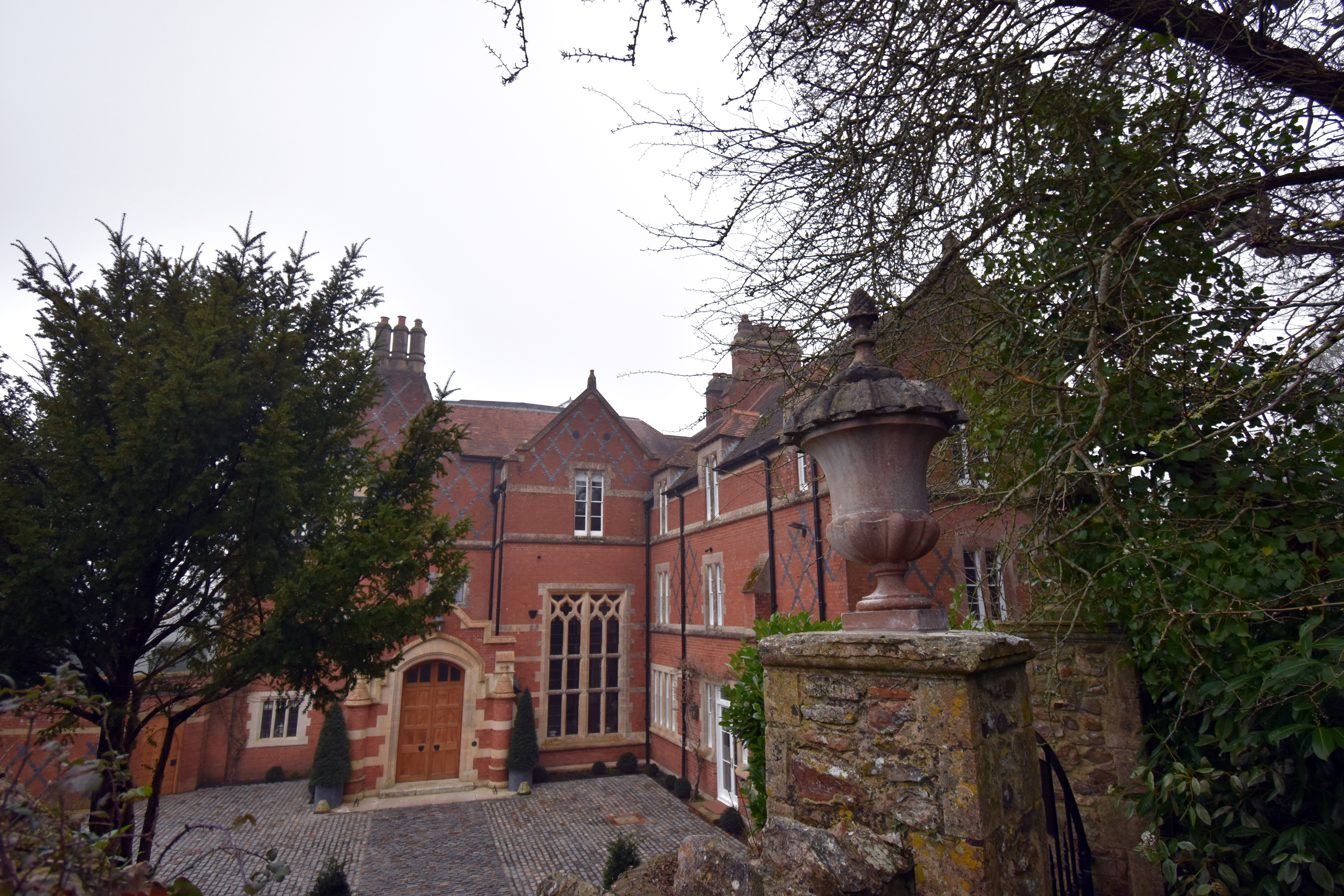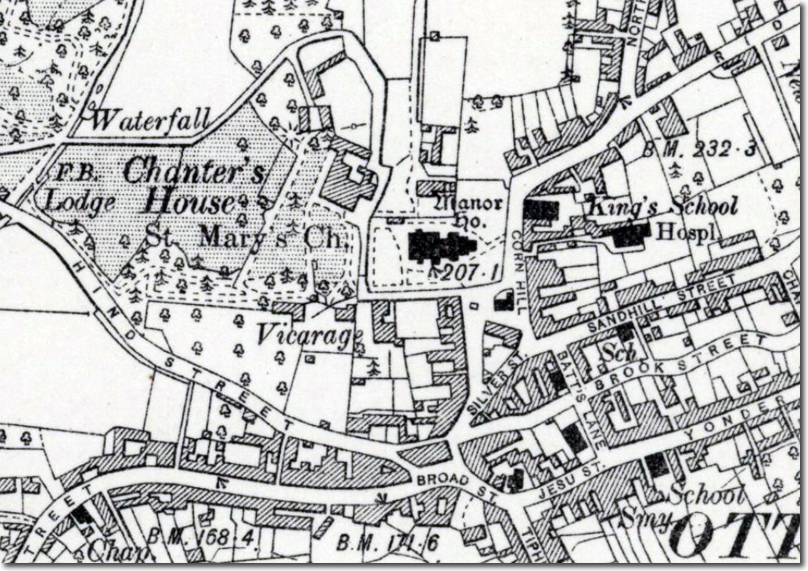
Chanters House stands beside the churchyard of St Mary’s on the site once occupied by the medieval College of Priests. The Precentor’s House and associated collegiate buildings formed part of the great ecclesiastical complex that surrounded the church. Although the present structure is largely the result of later rebuilding, fragments of the medieval fabric survive within the house, including sections of walling and painted beams. The name “Chanters” preserves the memory of its collegiate origins.
At the beginning of the 17th century Ottery St Mary was a prosperous market town on the main London road from the west. Its people were overwhelmingly Royalist: the town provided 500 men for the King’s service and only eight for Parliament. In July 1643 Ottery helped repulse a Parliamentary landing at Exmouth, and the town was initially held by Royalist forces to protect Exeter, then a Royalist headquarters.
The situation changed in October 1645 when Sir Thomas Fairfax advanced into south‑east Devon. His army, exhausted and poorly equipped, occupied Ottery St Mary. Many soldiers were without shoes or stockings, and their behaviour quickly alienated the townspeople. They broke into the parish church, dismantled the organ, beheaded statues in the aisles, removed benches to stable their horses, and ransacked the church library. Churchwardens’ accounts record the cost of repairing locks, glazing, and doors after the troops departed.
Fairfax established his headquarters at Chanters House, then known as Heath’s Court, as guest of the local supporter Robert Collins. Here he met Oliver Cromwell, Henry Ireton, and Colonel John Pickering, and together they planned the next phase of the campaign in the West. The dining room, with its carved and painted timber ceiling and elm panelling, became the setting for these discussions and is still known as the Cromwell–Fairfax Room. Fairfax also used his time in Ottery to inspect and strengthen fortifications at Broadclyst and Poltimore to prevent Royalist relief reaching Exeter.
The winter of 1645 brought a new crisis. The plague, already present in Exeter, reached Ottery in December. Fairfax recorded that soldiers and townspeople were dying at the rate of seven or eight a day, rising to eighty deaths in December alone. Even members of Fairfax’s own household were affected. With half the infantry regiments infected, it was no longer safe for headquarters to remain in the town, and Fairfax withdrew his forces to Tiverton.
During this period a bitter quarrel erupted between two prominent Royalists, Sir Richard Grenville and Sir John Berkeley. Grenville, the Sheriff of Devon, accused Berkeley of plundering local people and even denounced him from the pulpit of Ottery church, demanding that townsfolk report any goods taken by Berkeley’s men. This dispute ran parallel to the wider conflict and added to the strain on the local population.
A century after the Civil War, Chanters House entered a new phase with the arrival of the Coleridge family. The Reverend John Coleridge, Vicar of St Mary’s and Master of the King’s School, settled his large family in Ottery in 1760. His youngest son, Samuel Taylor Coleridge, the poet, was born in the town in 1772. It was the eldest son, James Coleridge — a distinguished soldier known locally as “the Colonel” — who purchased Chanters House in 1796 and established it as the family seat.
The house remained in Coleridge hands with its most dramatic transformation came under James’s grandson, John Duke Coleridge, created the first Baron Coleridge in 1873 and Lord Chief Justice of England in 1880. Determined to reshape the family home into a residence worthy of his position, he commissioned the architect William Butterfield to remodel the house extensively. Butterfield added a third storey, enclosed earlier ranges within new brick elevations, and created the monumental west wing. The sculptor Frederick Thrupp contributed decorative work to the interiors.
The centrepiece of Butterfield’s work is the Great Library, a 70‑foot‑long room occupying the entire ground floor of the west wing. It was designed to house the Coleridge family’s extensive collection of books, manuscripts, and papers, which eventually numbered some 22,000 volumes. The oak bookcases, carved to Butterfield’s design, line the walls from end to end and remain one of the most impressive private library interiors in the West of England.
Chanters House thus brings together the layered history of Ottery St Mary: its medieval collegiate origins, its central role in the Civil War, and its long association with the Coleridge family — from the poet’s childhood to the judicial eminence of John Duke Coleridge. It remains in the Coleridge family to this day.