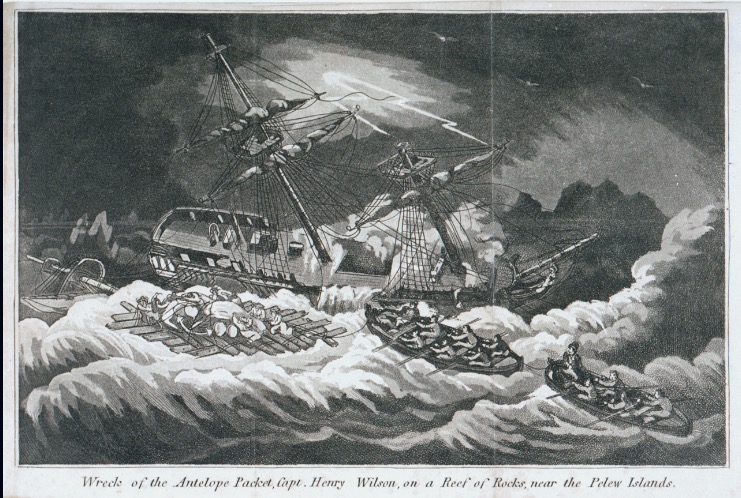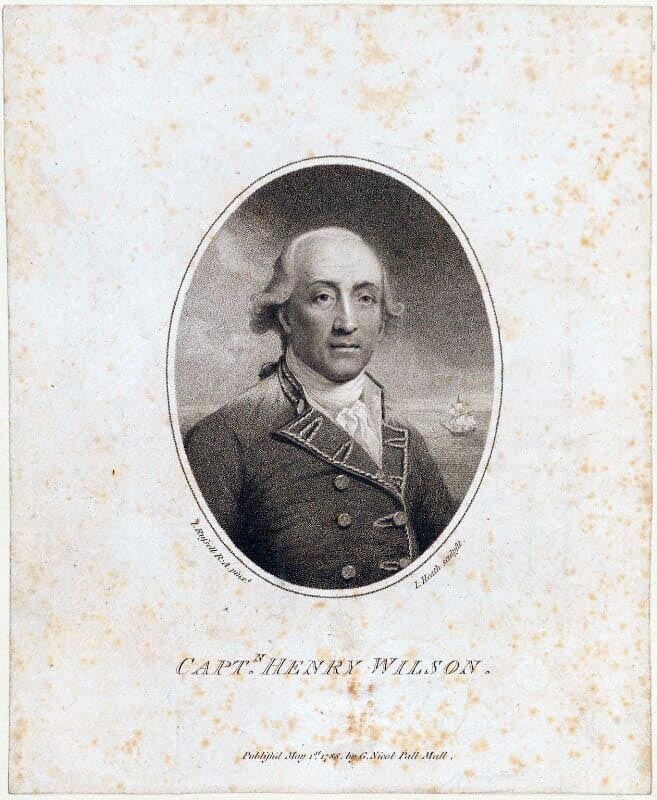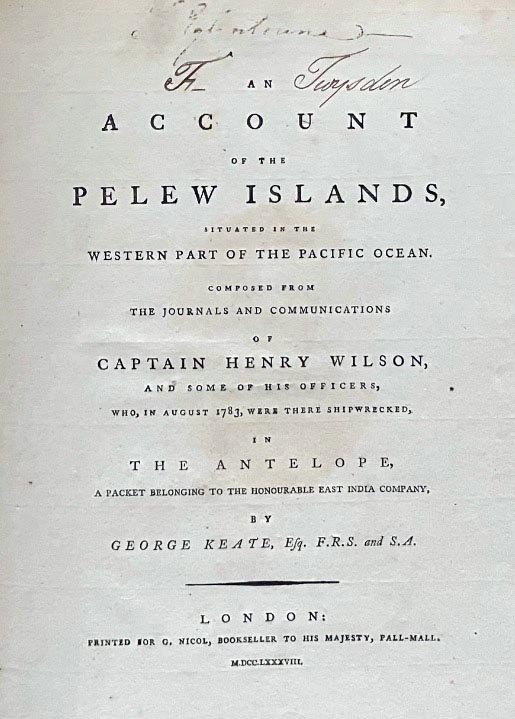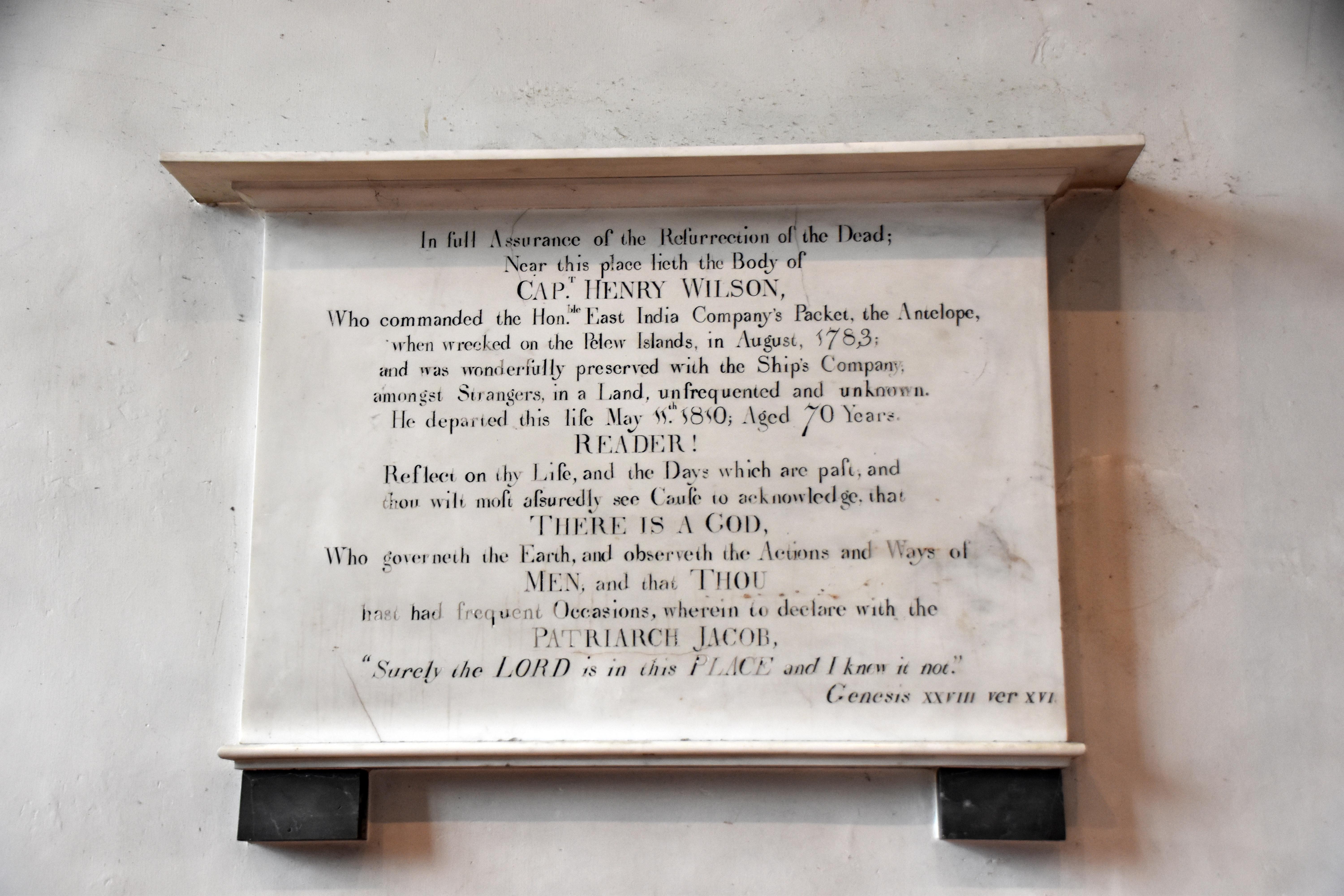
One of the most intriguing memorials in St Andrew’s Church, Colyton, commemorates Captain Henry Wilson of the British East India Company. The inscription records that Wilson commanded the packet ship Antelope when it was wrecked on the Pelew Islands (modern Palau) in August 1783, and that he was “wonderfully preserved with the Ship’s Company amongst Strangers in a Land unfrequented and unknown.” Behind these words lies a remarkable story of survival, ingenuity, and friendship far from home.
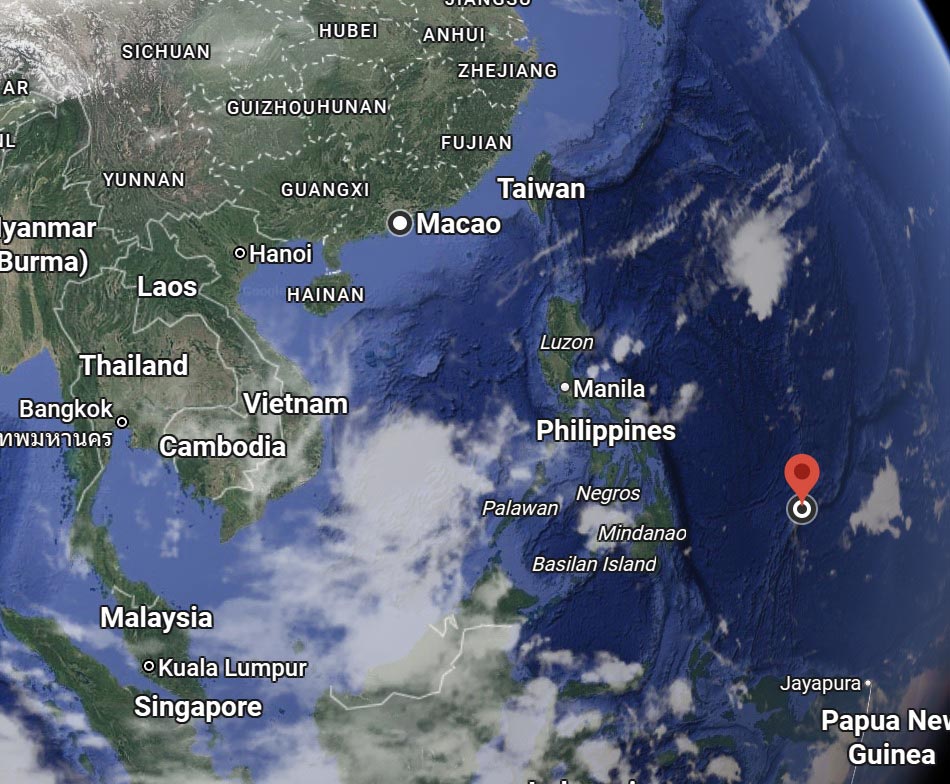
Henry Wilson (1740–1810), born in Rotherhithe, was an experienced East India Company officer. In 1783 he sailed from Macau aboard the Antelope, a packet ship carrying dispatches and cargo. The usual westward routes from China had been disrupted by Dutch control of the East Indies, so Wilson attempted the “Eastern Passage,” a route designed to avoid the south-west monsoon. Unfortunately, the Antelope strayed too far east and struck a reef off Ulong Island, near Koror in the Pelew Islands, on 9 August 1783.
Wilson’s own account describes the wreck as sudden and catastrophic, yet his leadership ensured that almost all the crew survived. With only one casualty, the men reached shore exhausted and uncertain of their fate. What followed was extraordinary. Far from hostility, they encountered generosity. The islanders, led by Chief Abba Thulle, provided food, shelter, and practical help. Wilson wrote with deep gratitude of their kindness, noting that without their assistance, “our situation must have been truly deplorable.” The chief offered not only hospitality but active support in salvaging timber and stores from the wreck.
Wilson’s dependence on the islanders was absolute. They supplied materials, labour, and local knowledge as he set about building a new vessel. From the remains of the Antelope, and with timber cut from the forest, Wilson oversaw the construction of a 45-foot schooner, christened the Oroolong. His journal records the cooperative spirit of the enterprise: British sailors and Palauan craftsmen working side by side, sharing tools and techniques. Without this alliance, escape would have been impossible.
After several weeks, the Oroolong was launched, and Wilson sailed for Macau, accompanied by Abba Thulle’s son, Prince Lee Boo. In England, Lee Boo became a figure of fascination for his intelligence and courtesy, but tragically died of smallpox within months—a common hazard in an age of global travel. His grave in Rotherhithe remains a poignant reminder of this extraordinary voyage.
Wilson never forgot the generosity of the Pelew islanders. His published account praised their honesty, courage, and humanity, qualities that challenged European assumptions about distant societies. The episode became widely known, not only as a tale of survival but as an example of mutual aid across cultures. Today, Wilson’s memorial in Colyton stands as a link between a Devon parish church and a dramatic chapter in the age of sail—a story in which seamanship and friendship proved as vital as any compass or chart.