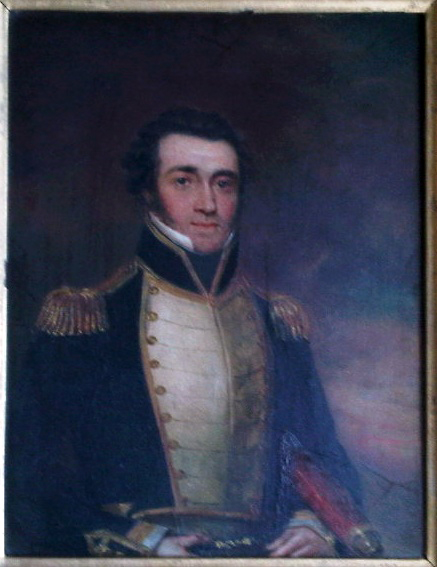
Captain Henry Kent, RN, was the youngest son of John Kent, a long‑serving naval purser and steward of the Royal Naval Hospital at Plymouth. Born in Glasgow, he entered the Navy as a midshipman and first served in HMS Goliah under Captains Charles Brisbane and Robert Barton, operating off Rochefort and Ferrol from 1803 to 1806. During this period he assisted in the capture of two French corvettes carrying part of the crew of HMS Blanche, taken by the enemy the previous year. He later joined the frigate Revolutionnaire under Captain Charles Fielding, and in 1807 transferred to HMS Hussar, which took part in the bombardment of Copenhagen before sailing to the West Indies, where she captured several letters of marque bound from Guadeloupe to Bordeaux.
In 1809 Kent was appointed acting lieutenant of HMS Horatio, and the following year moved to the sloop Fantome under Captain John Lawrence. He served on the North Sea station and on the coasts of Spain and North America until 1814. On leaving the ship he received a strong testimonial from Lawrence, praising his conduct in the attacks on enemy positions in Chesapeake Bay and his voluntary service on the Canadian Lakes, which required a winter march of nearly a thousand miles through snowbound country. His own account of the journey describes sleigh travel, snowshoes, toboggans, deep drifts, frostbite, and the death of several men from exposure. He himself broke a bone in his hand after a fall on the ice but continued the march.
On reaching Kingston, Lake Ontario, he was appointed senior lieutenant of HMS Princess Charlotte, then under construction. His efforts in fitting out the ship were later commended by Captain (Sir William Howe) Mulcaster, who also praised Kent’s conduct during the attack on Oswego. Kent entered the action already injured, his hand still recovering from the fracture sustained on the march, and was wounded again early in the engagement. When Mulcaster fell with a dangerous wound while leading the storming party, Kent took command of the ship and kept her engaged throughout the operation, maintaining control of the landing until the fort was carried. Mulcaster later certified that Kent’s exertions in bringing the ship into service and his conduct under fire were “officerlike, active, unremitting, and strenuous,” and that their Lordships might place “entire confidence in him.”
After the war he commanded a flotilla division and was later sent to Chippewa to assist in constructing two schooners, Tecumseh and Newash, for the defence of Lake Erie. He commanded both vessels at different times and spent several winters in remote Canadian settlements, often ice‑bound for months. In 1817 he was appointed superintendent of the new naval depot at Penetanguishene on Lake Huron, where he oversaw the construction of buildings, workshops and wharves in what was then an isolated forest region. Illness forced him to leave the post in 1819, and he later served on the naval establishment on Lake Champlain before returning to Britain in 1822, where he was promoted to commander.
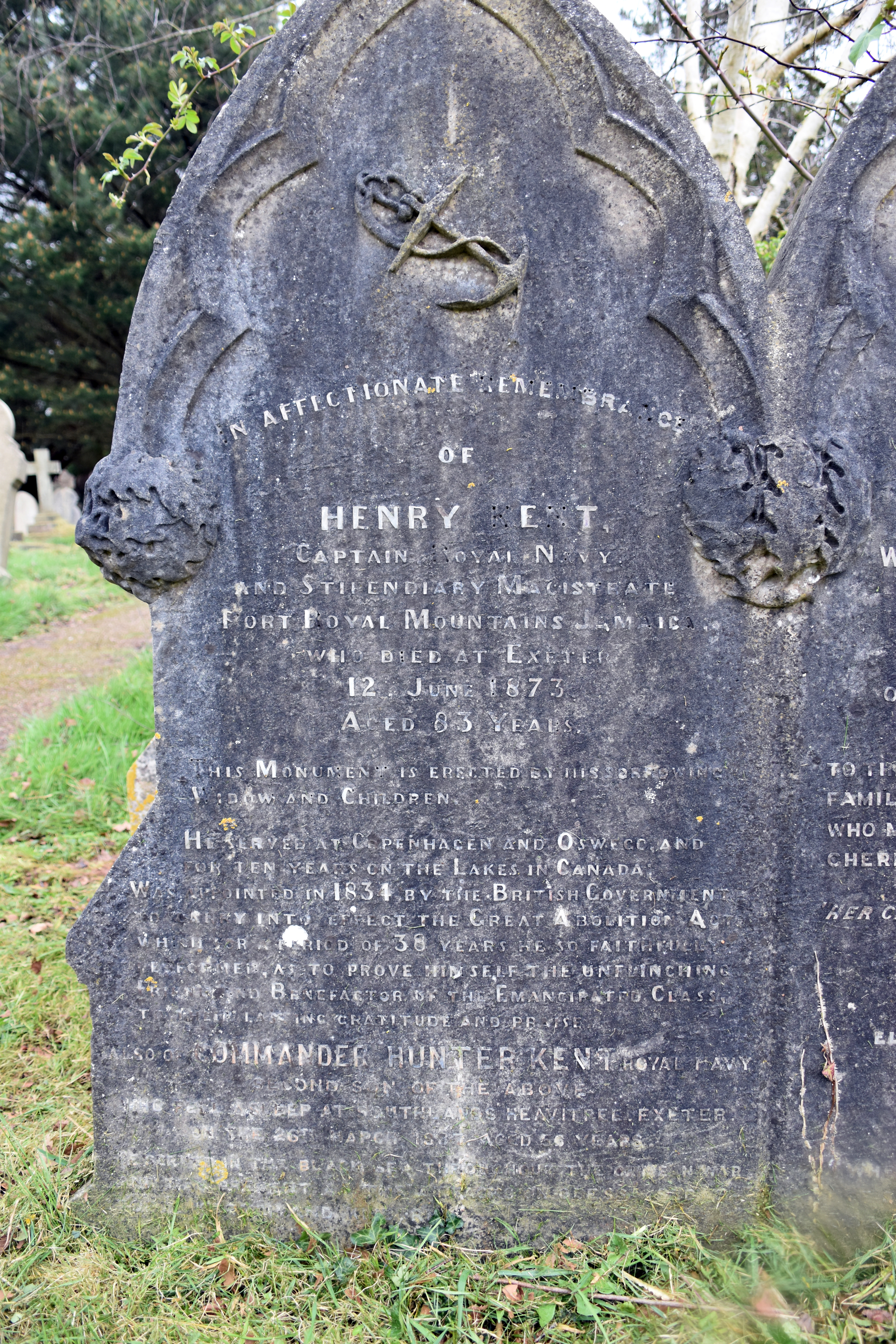
In November 1834 he was appointed a stipendiary magistrate in Jamaica, one of the posts created after the abolition of slavery to oversee the transition from enslaved labour to the apprenticeship system. He held the position for several years before returning to England. His gravestone records that he subsequently served for thirty‑eight years in enforcing the Abolition Acts, work that placed him within the wider operations of Britain’s anti‑slavery patrols. Officers engaged in suppression duties were authorised to stop and search vessels suspected of carrying enslaved people, verify papers, detain illegal slavers and escort captured ships to mixed commission courts. The work was often slow, bureaucratic and dangerous, requiring persistence as much as seamanship, and Kent’s long service in this field places him among the many lesser‑known naval officers whose careers were shaped by Britain’s nineteenth‑century campaign against the slave trade.
Kent married his first cousin, Eliza Grant, in 1824. She was the widow of James Charles Grant of London and the eldest daughter of Captain William Kent, who died in command of HMS Union in 1812. They had three children: Henry, Mary Carlisle and Hunter, the last of whom later served in the Royal Navy and is commemorated alongside his parents in Exeter Higher Cemetery. Captain Henry Kent died at the age of 83, his long and varied career spanning the Napoleonic Wars, the War of 1812, the Canadian Lakes campaign and Britain’s long struggle to suppress the transatlantic slave trade.