

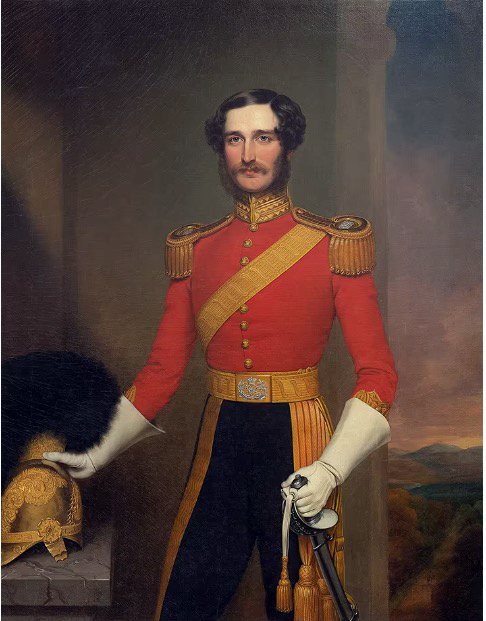
Francis Garratt was born on 19 November 1814, the son of John Garratt, a London goldsmith who served as Lord Mayor of London in 1824. He entered the British Army in 1832, joining the 3rd (Prince of Wales’s) Regiment of Dragoon Guards, a line cavalry regiment with a history dating back to 1685. His career in the regiment spanned sixteen years, during which he rose through the junior commissioned ranks and served on internal security duties in Britain and Ireland.
According to the Army Lists, Garratt was commissioned as a cornet in the 3rd Dragoon Guards in 1832. He was promoted lieutenant in 1835 and captain in 1842. His period of service coincided with a time of social and political unrest, and the regiment was employed on peacekeeping and aid‑to‑civil‑power duties rather than overseas campaigning. Detachments of the 3rd Dragoon Guards were used to support the civil authorities during disturbances in England and Ireland, a routine but important part of cavalry work in the decades after the Napoleonic Wars. Garratt left the regiment in 1848, having completed a full cavalry officer’s career from junior to company‑grade rank.
The most substantial surviving image of him is the full‑length portrait painted in 1841 by Richard Augustus Clack. Clack, who grew up in Devon and later worked as a portrait painter in London, exhibited at the Royal Academy between 1830 and 1857. The portrait shows Garratt in the uniform of a captain of the 3rd (Prince of Wales’s) Dragoon Guards, painted at a time when he had recently attained that rank. It was probably executed when his soldier‑brother Thomas was briefly in England, and both brothers sat for Clack. The painting is now held by the Royal Scots Dragoon Guards Regimental Museum in Edinburgh, where it forms the backdrop to a display of Dragoon Guards uniforms.
A later document associated with Garratt is his
Further biographical material, including the surviving 1875 passport issued to him in London, is discussed in detail at Passport, issued in London in 1875 when he was in his early sixties. Surviving examples show a carefully customised document, strengthened with linen and carried in a fitted leather case, reflecting the status of a retired officer of means. The passport confirms his continued use of the rank of captain in civilian life and provides a terminus ante quem for his death, which occurred on 23 May 1884 in London at the age of 69.
Captain Francis Garratt’s career illustrates the typical pattern of a nineteenth‑century cavalry officer whose service fell between major wars: steady promotion within a single regiment, routine but sometimes tense internal security duties in Britain and Ireland, and retirement into civilian life while retaining his regimental identity. His 1841 portrait by Clack, now in Edinburgh, preserves the image of an officer of the 3rd Dragoon Guards at a time when the regiment’s primary role was to project authority at home rather than on foreign battlefields.

