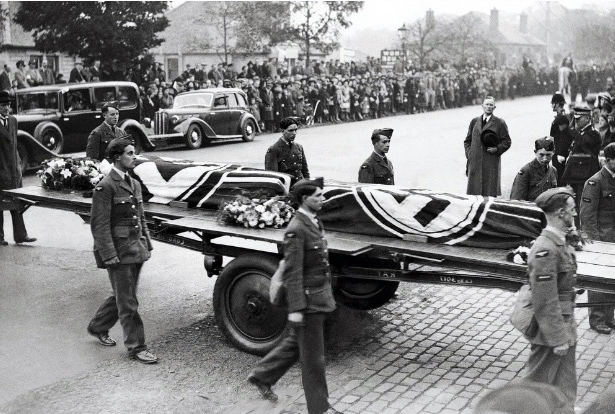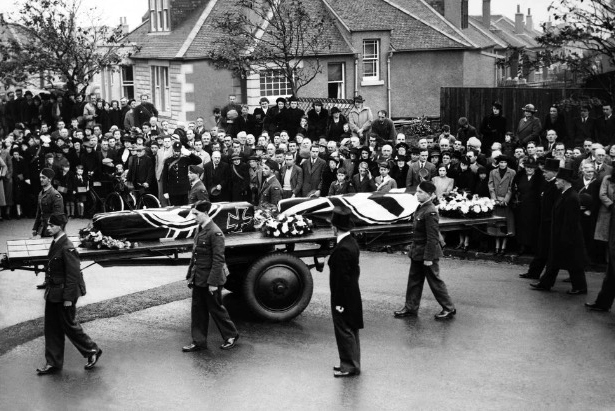
In the early months of the Second World War, Britain followed a practice that now seems almost inconceivable: German airmen killed over British territory were buried with full military honours. Coffins were carried through British streets by uniformed pallbearers, sometimes draped in the red‑and‑black Nazi flag, and laid to rest in local cemeteries with the same formalities accorded to British servicemen. The photographs from Edinburgh in 1939, showing Luftwaffe coffins covered with swastika flags and escorted by British troops, capture the starkness of this early‑war protocol.
The reasoning behind such ceremonies was not sympathy for the enemy but a combination of legal obligation, military tradition and calculated reciprocity. The Hague Conventions of 1899 and 1907, signed by both Britain and Germany, required that enemy dead be treated decently and, where possible, buried honourably. The British authorities therefore arranged formal funerals for downed German aircrew, often with RAF personnel acting as pallbearers and, where available, German prisoners of war attending as mourners.
These funerals were not concealed from the public. Processions moved through ordinary streets because there was no other route to the cemetery, and local residents often lined the pavements as the coffins passed. Newspapers occasionally published photographs of the ceremonies, including the Edinburgh images, which showed the full visual impact of Nazi flags in a British city. The intention was clear: Britain wished to demonstrate that it upheld the rules of war, even when the enemy did not.
There was also a practical motive. In 1940 and 1941 thousands of British airmen were flying over occupied Europe, and many were being captured or killed. By treating German bodies with dignity, the British government hoped that its own servicemen would receive similar treatment overseas. In the early air war, when both sides still retained traces of the older professional code of the First World War, this was a realistic expectation.
Local reactions varied. Some communities watched the processions in silence; others regarded them simply as part of wartime life. There were occasional objections, particularly after heavy raids, but most people accepted that the dead had to be buried somewhere and that the ceremonies were required by international law. The sight of German coffins in British towns was a reminder that the war had reached the home front in a very direct way.
The tone changed as the conflict intensified. The Blitz, the Baedeker raids and the rising civilian death toll hardened public feeling. By 1941–42 the authorities had quietly abandoned the use of German flags and full ceremonial honours. Burials continued, but with minimal formality: plain coffins, no military procession, and in many cases only a simple marker. The shift reflected both public sentiment and the sheer scale of casualties as the air war escalated.
By the later stages of the war, German aircrew were interred without ceremony, and after 1945 many graves were relocated to the purpose‑built German cemetery at Cannock Chase. The early‑war funerals, with their formalities and flag‑draped coffins, became a brief and unusual chapter in Britain’s wartime experience — a moment when the conventions of war were still observed before the conflict hardened into something far more uncompromising.
The photographs show the practice in the very earliest stages of war. These are not from Exeter they are from Edinburgh but given how few photographs were taken during the war years as only official photographers were permitted to do so, they evoke the kind of scenes that may have taken place in Exeter - at least for the earliest burials.