Berry Pomeroy Castle stands in the deep wooded valley east of Totnes, but its story has always brushed close to Marldon. The Seymours, who owned the castle from the mid‑sixteenth century, were the same family whose influence shaped much of the surrounding district, including the lands around Marldon and Compton. Their name appears repeatedly in the parish’s history, from church memorials to landholdings, and the great house they attempted to build at Berry Pomeroy was part of the same network of estates that once dominated this corner of Devon. The ruin that survives today — a mixture of late‑medieval fortification and unfinished Elizabethan ambition — is the physical residue of that influence.
The earliest remains on the site date from the late fifteenth century, when the Pomeroys built a defended residence within their deer park. It was one of the last private castles constructed in England, designed for the age of gunpowder rather than the age of knights. The gatehouse, St Margaret’s Tower, and the corner towers were fitted with intervisible gun‑ports, allowing a continuous line of fire along the dry moat. The layout reflects a moment when the idea of a castle was being reshaped by artillery: compact, angular, and built to withstand cannon rather than siege engines.
When Sir Thomas Pomeroy sold the estate in 1547, it passed to Edward Seymour, Duke of Somerset and Lord Protector to Edward VI. Whether the Protector ever visited is uncertain, but his son, Lord Seymour, made Berry Pomeroy his home and replaced the Pomeroys’ domestic buildings with a tall Tudor mansion built around a courtyard. His own son, Sir Edward Seymour, began an even grander scheme around 1600: a state range with a Renaissance loggia, a long gallery, and terraces overlooking the valley. The project was never completed, and by the end of the seventeenth century the castle was abandoned, stripped of materials, and left to decay. The Seymours moved their principal seat to Maiden Bradley, but their name remained woven into the history of the district, including Marldon, where their influence can still be traced in land boundaries and parish records.
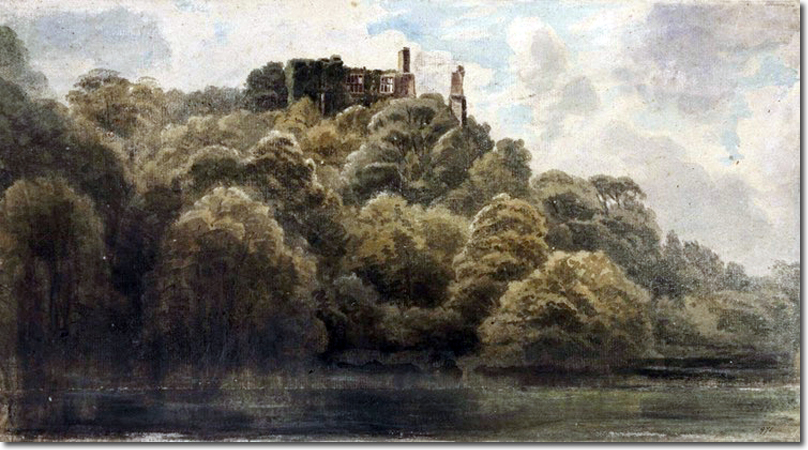
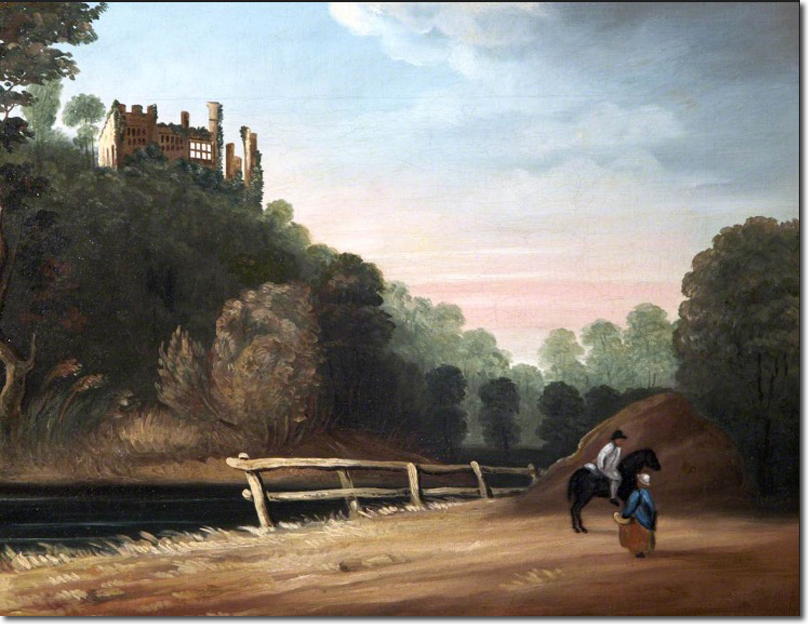
By the eighteenth century the castle had become a romantic ruin, its broken towers rising above the gorge, its reputation embroidered with ghost stories. This was the period when ruins were no longer seen as failures of architecture but as objects of aesthetic fascination. Berry Pomeroy’s combination of deep woodland, precipitous slopes, and roofless walls made it a natural subject for painters of the picturesque. Artists sketched it from the valley floor or from the wooded paths above, emphasising the contrast between the massive stonework and the encroaching trees. Poets, too, found in it the qualities they sought: solitude, melancholy, and the sense of a past that had slipped beyond recovery. The castle’s reputation for hauntings — embroidered over time into tales of the White Lady and the Blue Lady — only added to its appeal. Visitors came not for military history but for atmosphere, and the ruin became part of the imaginative landscape of the West Country.
When Elizabeth Goudge arrived in Marldon in 1939, she encountered this layered landscape at first hand. She lived only a few miles from the castle, and although she did not write directly about Berry Pomeroy, the qualities that drew earlier writers and painters to the ruin — the mixture of beauty, melancholy, and deep time — were the same qualities that shaped her own work. The wooded valleys, the sense of history embedded in the land, and the quiet presence of old houses and ruins all fed into the atmosphere of her Devon novels. The castle’s long association with the Seymours also echoed in her writing, which often explores the weight of family history and the way old houses carry the imprint of those who lived in them. For Goudge, as for the romantic artists before her, the landscape around Marldon was not simply scenery but a source of imaginative energy.
Berry Pomeroy Castle remains one of the most evocative ruins in Devon, not because of any single historical event but because of the way its unfinished architecture, its wooded setting, and its long abandonment have combined to create a place that invites interpretation. It stands at the intersection of local history, family ambition, and artistic imagination — a structure shaped by the Pomeroys and the Seymours, but also by the generations of writers, painters, and visitors who have found in its broken walls something that speaks across time.
The picture above is by British (English) School the one below is by Frederick Christian Lewis Snr (1779–1856)