

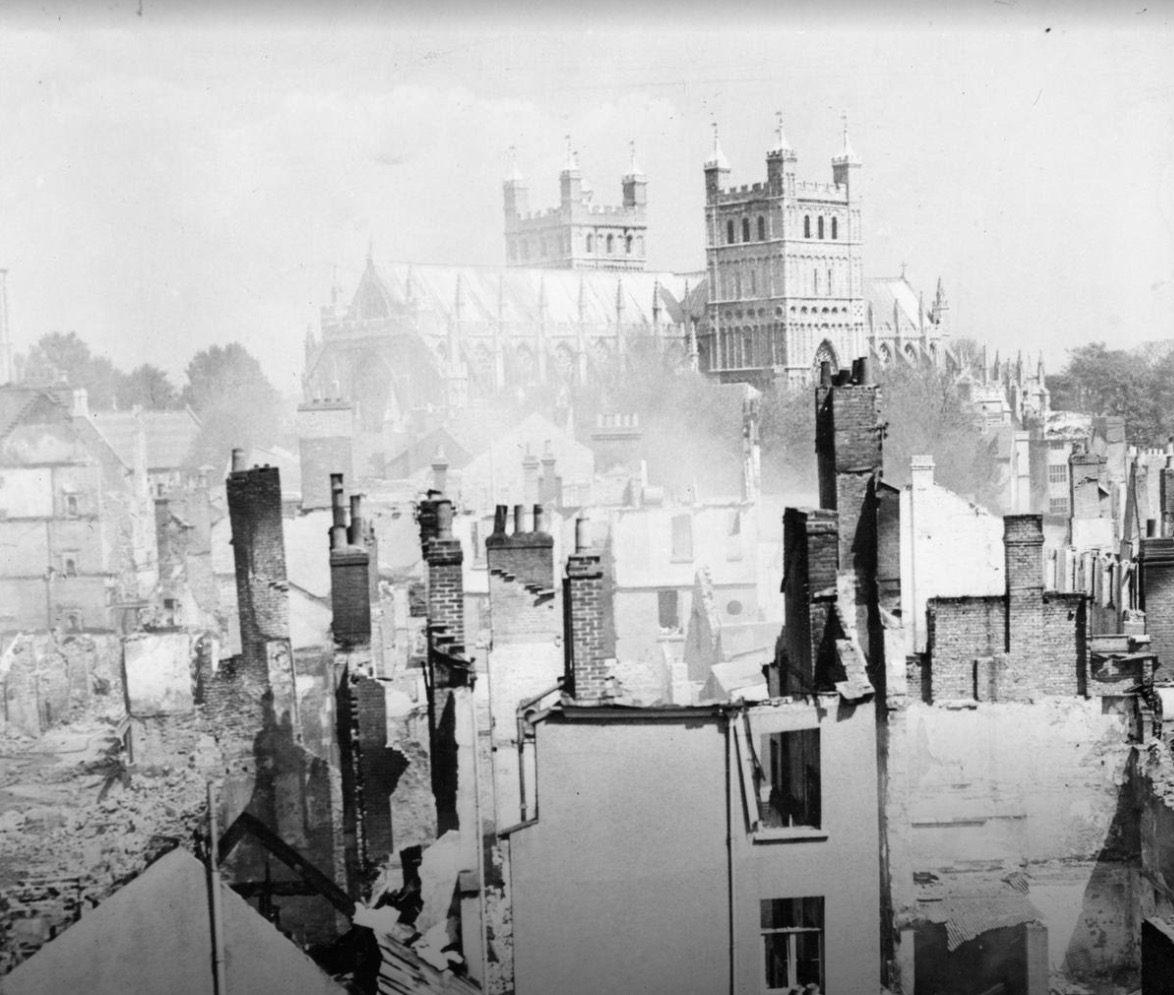
Exeter’s experience of the Second World War is often overshadowed by the larger industrial cities that bore the brunt of the Blitz, but in the spring of 1942 the city found itself at the centre of a very different kind of campaign. These were the so‑called Baedeker raids, Hitler’s reprisal for the RAF’s attack on Lübeck, a medieval German port whose timbered buildings burned all too readily. Enraged that a cultural jewel had been targeted, Hitler ordered the Luftwaffe to strike back at Britain’s historic towns, choosing places of architectural and symbolic value rather than military importance. Exeter, with its medieval street plan and Georgian terraces, was the first to suffer.
The city was attacked on three consecutive nights in April 1942 and again in early May. At the time Exeter had a population of around 72,000, supported by more than a thousand part‑time wardens and some 16,000 fire guards, plus military personnel. Wartime reports describe how a lone aircraft struck on the nights of 23–24 and 25–26 April, but on the clear moonlit night of 24–25 April around twenty‑five aircraft descended on the city. The Chief Constable later remarked that Exeter’s narrow streets and timbered buildings made it “a terrible fire risk”, and the raids proved him right.
The damage was severe. More than a thousand houses were destroyed and many of the city’s finest medieval and Georgian buildings were lost. Fire guard teams fought valiantly, though their success varied. At St Luke’s College, students attempted to tackle over two hundred incendiaries but the building was gutted. Elsewhere, small teams managed to save a cinema and an entire terrace of houses through quick action and coordination. Exeter Cathedral was also hit, with the Chapel of St James left open to the sky.
The raids also revealed the value of trained fire‑watching teams. One official report praised a group led by a Mr Restorick at the Co‑Operative store on Eastgate. Surrounded by fires, they extinguished half a dozen incendiaries using sand, with Restorick stationed on the roof as a watcher and his men positioned on each floor, communicating by whistle. Their efforts prevented the fire from taking hold. In the aftermath, Home Secretary Herbert Morrison and his junior minister Ellen Wilkinson commended the National Fire Service for its role in saving much of the city.
The suddenness of the attack inevitably caused panic, and rumours spread that the Germans had used a new type of “jumping” incendiary bomb. The Chief Constable reassured residents that the devices “did not hop about” and could be dealt with using sandbags or stirrup pumps. One resident, Marjorie Birch, later recalled how her mother attempted to remove an incendiary bomb from their home, burning her hands and arms in the process – a brave but hazardous act that reflected the confusion of the moment.
The heaviest attack came on the night of 3–4 May, when around thirty enemy aircraft dropped fifty‑four tons of bombs in forty‑six minutes. These included high explosives, parachute mines and thousands of incendiaries. In total, 164 people were killed and 476 injured. Fourteen fire guards, nine firefighters and three wardens were among the dead.
Exeter’s centre was rebuilt after the war, but the cemetery preserves the more immediate record. The victims of the raids lie only a short distance from several of the German aircrew shot down during the same operations, a reminder of how closely the consequences of the raids still sit together in the city.

