

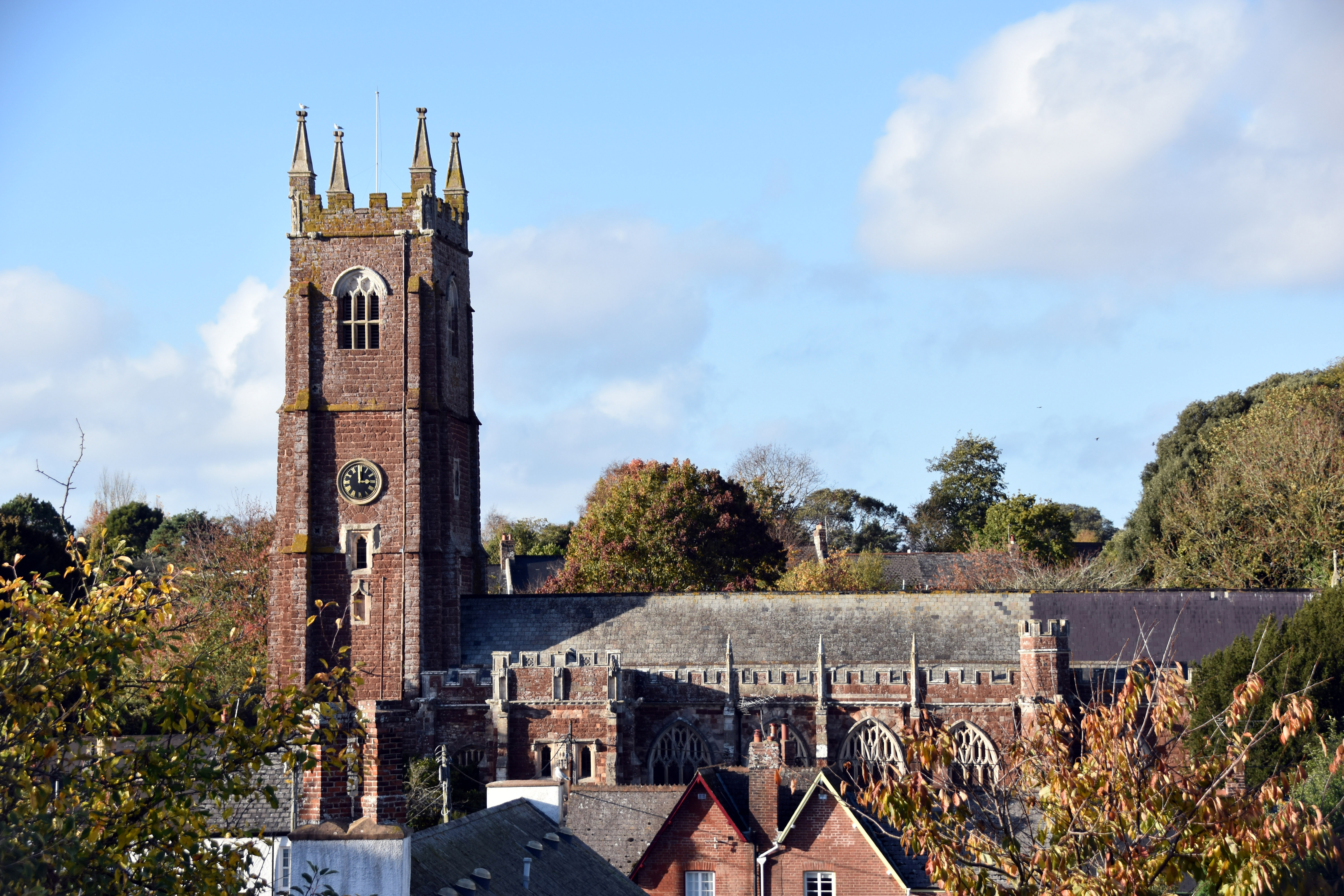
Dating from the later fourteenth century, All Saints Church in Kenton is at once a monument of Perpendicular ambition and a living parish space, where medieval craftsmanship and Victorian restoration meet in harmony. All Saints Church rises proudly from the heart of a parish once enriched by fertile farmland, saltworks, and estuary trade. Its very fabric tells the story of prosperity flowing into faith, with dressed red brecchia and pale Beerstone dressings glowing in the colours of Devon’s soil and sea.
Scholars Cresswell and Pevsner date the building to around 1360–70, citing the will of William Slighe (d. 1379), who wished to be buried in the aisle he had “recently built.” Some argue this may refer only to refurbishment, suggesting a later date (Slader). Whatever its precise origins, the church was restored and re-roofed in 1854 by David Mackintosh, with further repairs in the 1890s, and a vestry added in 1866. The result is a Perpendicular church of unusually grand character, possibly conceived as a single build.
The plan is generous: nave, chancel, west tower, seven-bay north and south aisles (one bay extending into the chancel), a south-west porch, and a north-east vestry. Externally, the church is large and impressive, its embattled aisles crowned with pinnacles and grotesques. The south side, facing the road, is the show front, richly carved with Beerstone coping, cornices, and a projecting stair turret adorned with grotesques. The grand two-storey porch, with gargoyles, niches, and a richly carved doorway, is a highlight of the exterior. The three-stage tower, with battlements, pinnacles, and rare surviving canopied niches containing fifteenth-century figures, dominates the west end.
Step through the priest’s doorway, its chamfered arch softened by centuries of weather, and the interior opens into a lofty, light-filled space. There is no chancel arch, but the division between nave and sanctuary is dramatically marked by the magnificent eleven-bay rood screen. Heraldry suggests a date during Bishop Peter Courtenay’s episcopate (1478–86). The coving and rood loft parapet were replaced by Herbert Read under the direction of Bligh Bond in the late nineteenth and early twentieth centuries, reinstating medieval proportions with scholarly imagination. Above, the open wagon roofs of nave and chancel (c.1865) soar, while the lean-to aisle roofs date from Mackintosh’s 1854 restoration.
The Beerstone arcades are a marvel in themselves: seven bays of Perpendicular grace, their piers with corner shafts and boldly carved foliage capitals. The capitals, expressive and almost modern in their punch, remain mysterious in meaning but delightful in execution. Shafted rear arches frame the windows, while the tower arch, with its panelled soffit and nineteenth-century stencilling, adds further drama.
The fittings are outstanding. The medieval wainscot paintings depict prophets and apostles in dialogue, each prophet quoting scripture foretelling Christ’s coming, each apostle responding with lines from the Creed. Though painted with naive charm, the theological depth and scholarly design are profound. Apostles carved in niches enrich the central doorway, while a silver rood by Henry Wilson, once on Exeter Cathedral’s high altar, now gleams here. Four-bay parclose screens with crocketted cresting enclose the chapels, their tracery delicate as lace.
The chancel is richly appointed. Sedilia, an aumbry, and a trefoil-headed hagioscope survive, alongside a massive carved timber triptych reredos erected in 1843 under Charles Kempe, with carving by Sebastian Zwink of Oberammergau. The Entombment of Christ, with its cluster of grieving figures, is particularly moving. The choir stalls (1865) have poppyhead ends, and the altar rail (1907) was designed by Bligh Bond. A monumental relief of the Raising of Lazarus by Stevens adorns the north wall, while the north parclose door incorporates carved late fifteenth- and early sixteenth-century bench ends.
The pulpit is a marvel of medieval carving: a fifteenth-century timber drum on a wineglass stem, richly carved and largely reconstructed by Herbert Read after Sabine Baring-Gould rediscovered its fragments. Every inch is exquisitely worked, with foliage, figures, and even mischievous demons peering from the vine scrolls. These “inhabited” carvings, where birds flit among tendrils and grapes, symbolise the redemption of souls through Christ’s blood. The artistry is breathtaking, a hymn in wood to the Divine.
Monuments abound. Dulcabella Hodges (d. 1628) reclines in the north chapel, her head resting on one hand. Sir Nicholas Martyn (d. 1653) is commemorated with Corinthian columns and cornice. The Swete family are remembered in a three-bay early nineteenth-century monument and a white marble tablet to John Swete (d. 1831). Numerous early nineteenth-century wall tablets line the nave, including a mosaic of the Good Shepherd for Frederick Marshall, churchwarden 1914–20.
The stained glass is equally rich: the east window is attributed to Clayton and Bell; the north and south chancel windows are by Drake of Exeter (1891); Beer supplied quarry and grisaille glass in 1865; and the west window was painted by Bannstyre of Edinburgh. Fragments of medieval glass survive in the north aisle, faint but precious echoes of the church’s earliest glazing.
Everywhere, Kenton’s All Saints Church reveals layers of devotion, artistry, and history. From its medieval rood screen and pulpit to its Victorian restorations and Bavarian-carved reredos, it is both a parish church and a gallery of craftsmanship. Externally imposing, internally filled with treasures, it remains one of Devon’s outstanding churches—an enduring marriage of faith, beauty, and community pride.

