

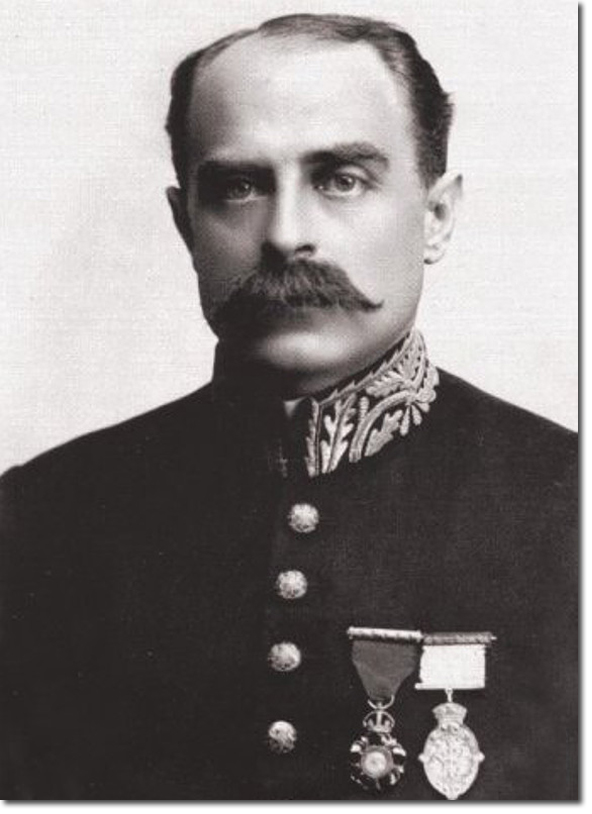
Younghusband was born in the Punjab on 31 May 1863, the son of Major-General John Younghusband and Clara Shaw, sister of Robert Shaw the Asian explorer. At the age of four he was taken to England and left in the care of two austere and strictly religious aunts. He was later educated at Clifton College and went on to Sandhurst. He joined the King’s Dragoon Guards as a Lieutenant on 10 May 1882.
Lieutenant Younghusband joined the regiment in Meerut. He had been recommended to Colonel Marter by Sir Dighton Probyn. He shared a bungalow with Lieutenant William Hennah, an officer he admired, but in April 1884 Hennah died. He also had a good relationship with Colonel Marter who left the regiment in 1884. Lieutenant Younghusband was a keen young intellectual who tried hard to fit in with his unimaginative fellow cavalry officers. He wrote:
‘The art of warfare was the last topic of conversation that was likely to rise. I found that these same men, as soon as there was any active service in sight, would move heaven and earth to get there. Keenness for sport did not mean indifference to service in the field. All it meant was disinclination to the monotony of preparation. On the other hand I was surprised at the friendship I experienced. To my surprise I found my brother officers excellent fellows; and in my heart of hearts I envied them their good nature. They never went to church except when paraded for service. Their talk was of little else than ponies or dogs. Their language was coarse. And yet they were a cheery lot, always ready to do each other, and even me, a good turn, and secretly possessing an ideal of their own to which I would have been thankful to attain: it was simply to be a “good fellow”, and a good fellow in their eyes was above a good Christian or even a good soldier.’
He went on leave in 1886 to go on an expedition across Asia, travelling through Manchuria and the Changbai Mountains. He pioneered a route from Kashgar to India through the uncharted Mustagh Pass and mapped the region of the Upper Oxus. At the age of 24 he was elected the youngest member of the Royal Geographical Society.
He was promoted to captain on 18 Feb 1889 and sent to explore the uncharted region of Karakoram north of Ladakh. On this expedition he met with a Russian officer called Bronislav Grombchevsky and talked at length about the ‘Great Game’ and the possibility of a Russian invasion of India. He was sent on a mission to Chinese Turkestan and Kashmir in 1890 to investigate Russian insurgency in the region. Youghusband left the KDG in 1895. In 1903 he was appointed head of the Tibet Frontier Commission and led the British Expedition to Tibet in that year. The aim was to settle disputes over the Sikkim-Tibet border but it turned into an invasion in which British Soldiers fought against militant monks.
It was on the return trek from Tibet that Younghusband experienced a spiritual revelation that changed his life. He lived in Kashmir until returning to Britain in 1909. He was promoted to lieutenant-colonel in 1908. In 1919 he was elected President of the Royal Geographical Society and became Chairman of the Mount Everest Committee and actively encouraged George Mallory to lead the expedition to climb Everest.
In 1897 Younghusband married Helen Augusta Magniac whose younger brother had accompanied him on the Tibet expedition. They had a daughter, Eileen who became a prominent social worker. They lived at Westerham in Kent. He was the author of 26 books on exploration, mountaineering, philosophy, spirituality, politics etc. He had been awarded the honour of Knight Commander of the Order of the Star of India in 1904 so being titled Sir Francis Younghusband. He died in Dorset on 31 July 1942.

