

|
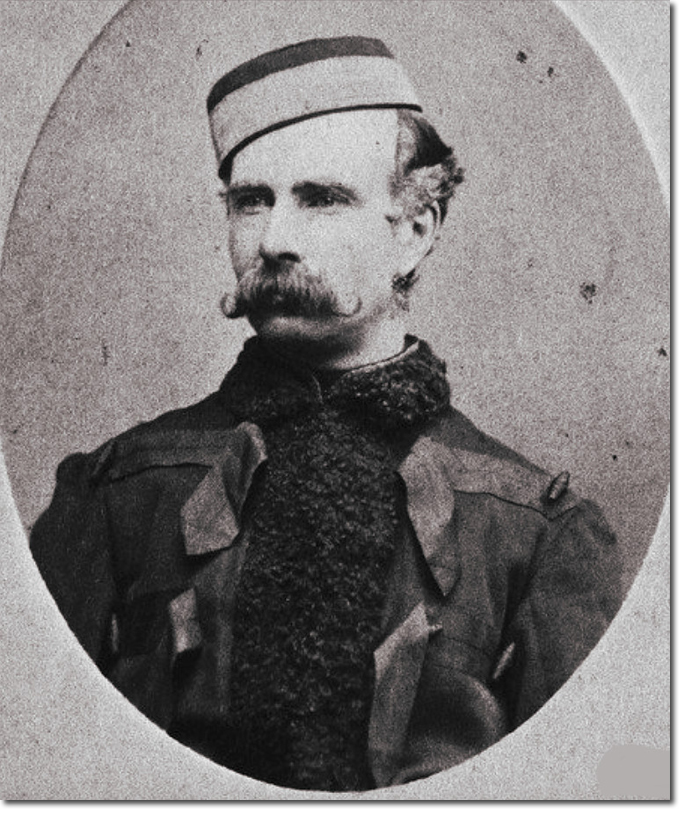
Born at Farnborough, Berkshire, on 27 Mar 1832, the son of the Reverend Richard Marter, nineteen year old Richard Marter Joined the regiment as a cornet on 18 Jan 1851 while they were stationed in Ireland. He had a very difficult life as a young cornet in the KDG. At that time the regiment was under the command of Henry Hankey who fostered a climate of hard drinking, immorality and bullying. The officers were all very rich and behaved like the character Flashman in Tom Brown’s Schooldays. Marter was poor in comparison, having only 100 pounds when the next poorest to him had 300 pounds. For more than a year his life was intolerable, until the arrival of a new CO, Anthony Spottiswode, who ‘brought about a much better state of things’.
He was promoted to lieutenant on 29 April 1853 at a time when the purchase system was still operating. In July 1854 the regiment was stationed in Edinburgh and Lieutenant Marter was ordered to take a draft of 41 recruits and 80 horses of the Scots Greys to Liverpool for embarkation to the Crimea. He was aided by a sergeant but the recruits were barely trained and difficult to control, especially as they were hard-drinking Scotsmen. They spent two days searching inns and pulling them out of bed in the morning to get them saddling up and moving. They finally managed to herd them on board HMS Assistance and get back to Edinburgh. The regiment went to the Crimea in July 1855, and went on to serve in India during the Mutiny and in China in 1860. Richard Marter was promoted to captain on 9 Dec 1862 and in 1869 rejoined the regiment after having been on staff duties. The KDG were based at Manchester but Captain Marter was given command of A Squadron at Birmingham. They were inspected by the CO, Colonel Herbert Slade who ‘was much pleased with the turn out and working of the men, condition of the horses, and the state of the barracks and quarters.’ On 28 Aug 1869 the squadron marched from Birmingham to Manchester. Marter reached his majority on 7 March 1877 and the regiment came south to be quartered in Aldershot in May 1878. There he commanded the regiment on a field day which he described as a scrimmage between the opposing forces, and some men were injured. In August they moved from North Camp to the East Cavalry barracks. Marter was married at this time and was given the commanding officer’s quarter. Colonel Henry Alexander was the actual CO but unmarried. In 1879 the KDG were sent to South Africa to fight in the Zulu War. It was here that Major Richard Marter made a name for himself when he commanded the detachment that hunted down and captured the Zulu King. The detachment included a squadron of KDG and some local troops. They set off on 27 Aug 1879 having been informed that Cetewayo was somewhere in the Ngombe Forest. They spotted the King’s kraal from a high point and approached quietly so that they were able to surprise him. It took a while to coax him from his hut but he emerged, according to Sgt Smith, ‘looking as stately as a General coming to review a few thousand men on parade.’ Cetewayo and his wives were uncooperative on the journey back to Ulundi, but the expedition was successful and Marter was given a brevet of lieutenant-colonel. In October 1879 Colonel Alexander was appointed to command the District so Major Marter commanded the regiment. But he officially took command on 18 April 1882 when the regiment was in India. Sergeant Smith wrote: ‘He quickly discovered that the difficulties with which he would have to deal were far more numerous and important than he expected. He took command with full intention of taking time in reforming abuses, avoiding friction, and endeavouring gradually to lead into better ways, but he found such a state of affairs, more particularly among the officers, that from his point of view, delay could not be tolerated. There was no thoroughness in duty anywhere, and a system of bribery had crept into Non Commissioned Officers and others for carrying out ordinary regimental matters. He worked as much as possible through his Second in Command, Major Thompson, a man possessing good temper and tact. Some two or three officers supported him, but the rest were sadly troublesome, and continued so throughout the period of his command. The Non Commissioned Officers and men came round to the new order of things, and gave no trouble whatsoever. ‘There was little recreation of a wholesome kind beyond the limits of their lines, while the canteen had the sole attraction of drink, Marter formed a Regimental institute, containing Refreshment tavern, Recreation Room, Library and Writing Room. The Regiment congregated there in the evening, hardly any men leaving the lines. Crime almost ceased. After much trouble and delay, Marter acquired a good piece of ground, well turfed, and close to the lines, as a cricket ground, and enclosed it with posts and chains.’ Lieutenant-Colonel Marter left the regiment in April 1884 when he was promoted to Major-General. His son William Maurice Marter joined the regiment in 1892 but was killed in action in 1900. Richard had married Salome Catherine Pears on 27 Oct 1859 in the Neilgherry Hills, Southern India. They had four children, Jane Emily who lived to old age, Richard Arnold Fane who died at the age of 27, William Maurice who was killed in the Boer War aged 32, and Alice Eleanor who lived to old age. Major-General Richard Marter died in Epping on 26 may 1902. |

