

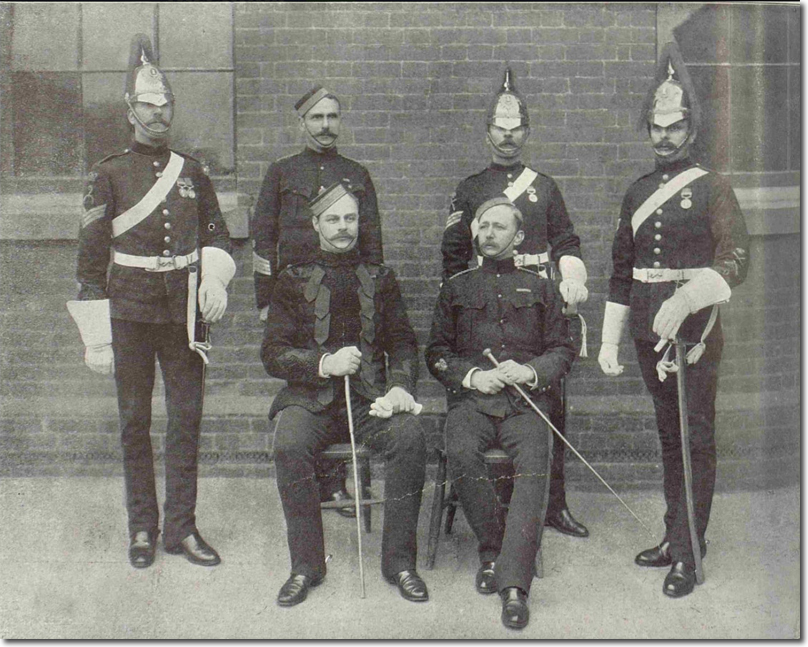
This group includes the Regimental Sergeant-Major who sits on the right of the photo. Next to him is an officer wearing a patrol jacket. The man behind the officer is the Regimental Quartermaster Sergeant. The RSM and RQMS both wear the blue undress frock which has gold cord twists on the shoulders. The RQMS has a star badge over four inverted chevrons and the RSM has an unusual badge, an embroidered Royal Crest (lion and crown) instead of the more usual crown. His classification had changed in the 1880s to Warrant Officer while the RQMS was 1st Class Staff.
The NCO standing on the left of the photo is in dismounted review order with arm badges showing that he is a Squadron Sergeant Major Rough Rider (SSMRR i.e. riding instructor), 2nd Class Staff. Behind the RSM is a sergeant with crossed rifles and a crown above his 3 stripes. The crown is not large like that of the TSMRR so he is most likely to be a Sergeant Instructor of Musketry (SIM) as opposed to a Squadron Sergeant-Major Instructor of Musketry (SSMIM). The NCO standing on the right has sergeant stripes but no other visible badges apart from proficiency badges on his left sleeve.
The exact year of this photo is not known but it must be before 1896 when Franz Josef was appointed Colonel-in-Chief because there are no collar badges worn. In 1896 the KDG adopted the double-headed eagle badge of the Austro-Hungarian Empire. And NCOs, a little later, took to wearing a similar badge on the right arm.
The three NCOs dressed in review order have medals that look like the South Africa General Service Medal of 1877-79 covering the Zulu War. The ribbon is orange-yellow with two wide and two narrow dark blue stripes. The TSMRR has another medal which could be the China medal from 1860 which would mean that he is in his 50s.
The pill box forage caps worn by the RSM and RQMS have gold lace cap bands that are about an inch and a quarter wide which compares with the officer’s cap that has gold lace one inch and three quarters wide.

