

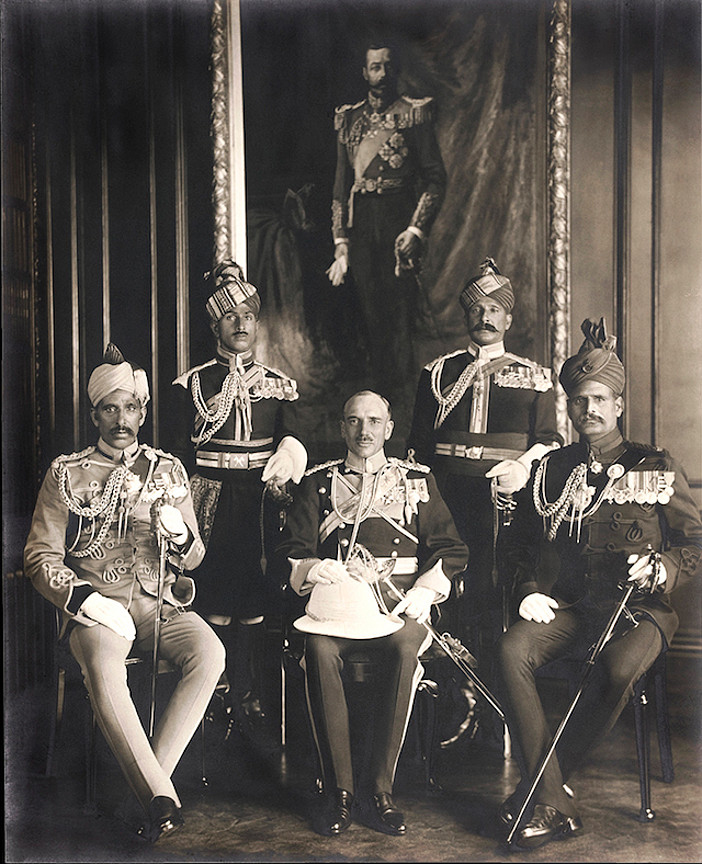
Seated left: Subadar-Major and Honorary Lieutenant Fateh Muhammad, Sardar Bahadur IOM OBI, 3rd Battalion (Sikhs) 12th Frontier Force Regiment. Before 1922 this was the 53rd Sikhs (Frontier Force). The 53rd, in 1914, was stationed at Kohat and comprised 4 companies of Sikhs, two of Khattaks, one of Dogras and one of Punjabi Muslims. Lieutenant Fateh Muhammad was the most senior of the King’s Indian Orderlies, all of whom were Punjabi Muslims. He had served 31 years in the Army and had been wounded in Iraq in January 1916. The 12th Frontier Force Regiment was formed in 1922 from the 51st, 52nd, 53rd, 54th Sikhs and the Guides Infantry. The uniform worn by this officer is drab with red facings and drab lace and cords.
Seated centre: Brevet Lieutenant-Colonel Geoffrey Bulmer Howell MVO MC, 19th King George’s Own Lancers. The regiment was the amalgamation of the 18th KGO Lancers and the 19th Lancers (Fane’s Horse). The 1915 Army List for the 19th Lancers says that Captain G B Howell was a squadron officer as from 31 Mar 1906, promoted to captain on 18 Jan 1914 and appointed adjutant 12 Mar 1914.
He wears the Indian Army cavalry uniform for British officers and it looks as if it is the uniform of the former 19th Lancers (Fane’s) which was dark blue with French grey facings and silver lace. From 1928 the uniform of the 19th KGO Lancers was supposed to conform to the former 18th Lancers; scarlet tunic with white facings and gold lace.
The London Gazette of 1 Jan 1946 announced the appointment of ‘Colonel Geoffrey Bulmer Howell M.V.O., M.C., Military Secretary to His Excellency the Governor of Madras.’
Seated right: Subadar-Major Rahimdad Khan, Sardar Bahadur MBE OBI IDSM. 1st (Wellesley’s) Battalion 6th Rajputana Rifles. The 6th Regiment was the senior rifle regiment in the Indian Army, an elite unit. The 1st Battalion was, prior to 1923, the 104th Wellesley’s Rifles, an illustrious Bombay regiment dating back to 1775. Subadar Rahimdad Khan was at the defence of Kut in Mesopotamia, wounded and captured by the Turks. He survived the appalling conditions of his captivity. He is a well decorated officer, having shown great courage in June 1920 fighting the Mahsuds, and appointed MBE for his service in Waziristan in 1921. His uniform is rifle green with scarlet facings.
Standing left: Risaldar-Major Malik Mihr Khan IOM IDSM, 20th Lancers. The 20th was an amalgamation of the 14th Murray’s Jat Lancers and the 15th Lancers (Cureton’s Multanis). Malik Mihr was from the 15th Lancers which, in 1914, was stationed at Jullundur, comprising four squadrons of Muslims (Multani Pashtuns and Muslims of the Derajat and Cis-Indus). Malik Mhir Khan was a Jemadar when he was awarded the Indian Order of Merit for service with the 15th Lancers in France. He was a Ressaidar when he served with the regiment in Bushire, Persia, and awarded the Indian Distinguished Service Medal. He wears a blue kurta with scarlet facings and gold lace.
Standing right: Risaldar Painda Khan MBE IDSM, No.2 Cavalry Brigade Transport Company, Indian Army Service Corps. In 1901 this was the Supply and Transport Corps, but in 1923 it was renamed the Indian Army Service Corps (granted ‘Royal’ in 1935). The transport units were either Mechanical or Animal. Painda Khan was a naik in the Mule Corps when he was awarded the Indian Distinguished Service Medal for service in France. He also served in Iraq during WW1. In 1903–4 he was part of the expedition to Tibet, and in 1919 served on the Northwest Frontier.
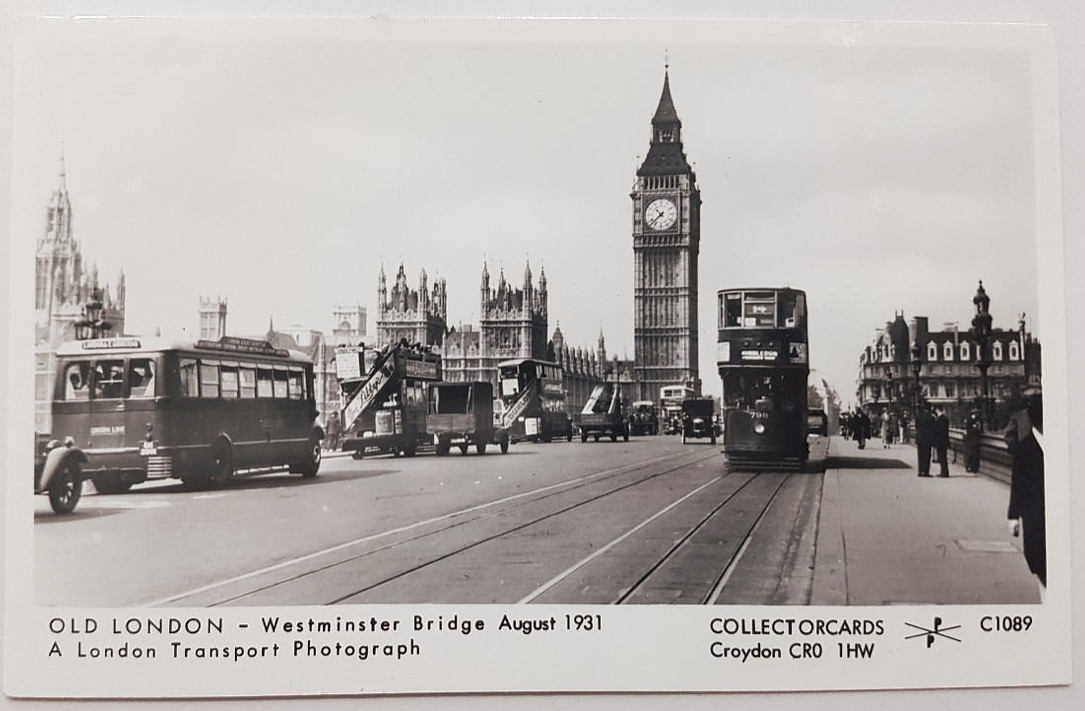
A newspaper report in April 1931 headlined ‘WONDERS OF LONDON’ sub-headed ‘INDIAN OFFICERS AWED’ and ‘BODYGUARD FOR THE KING’ had this:
‘The four officers of the Indian Army who have been selected as the King’s Orderly Officers for this year had more breathless moments in their first few hours in London recently than they have had in many a battle.
They arrived, with four servants and two native cooks. None of them had been to England before; none of them can speak more than a few words of broken English. After the excitement of the busy docks, they were driven in a motor-coach through the East End, the City, and part of the West End, to the house near Victoria which will be their home until the end of the Court season.
It was there that they gave their first vivid impressions of a new land. They told, through an interpreter, that the greatest surprise of all in that breathless drive was the way in which such a vast amount of traffic streamed through the streets without colliding. The next thing that impressed them was the cleanliness of the streets, the buildings and the people, and the next—Big Ben!
Subadah-Major Fateh Muhammad, who has a row of medals on his broad chest—he has 31 years’ service, and his native title means “Chief and Hero” -- said he liked London already and was going to enjoy every minute.
“We were all surprised,” he said, “at the order of everything here; the houses all in a straight line, the streets so clean and neat, the millions of cars and omnibuses moving along so calmly. We none of us expected anything like it. We saw some policemen on horseback—fine animals, which did not move even their heads as the lorries went round them an inch or two away. London buildings are magnificent, and we are going to visit lots of them, also the parks and the theatres and cinemas.”
All the officers agreed that there was one moment to which they were looking forward intensely—the moment of meeting the King. They were to be received by the King, and after that their official duties were to begin—attendance, as a Royal Bodyguard, at all State occasions.
They spent some hours moving into their new home— the servants watched by a crowd as they ran in and out of the house [49 St George’s Road, Pimlico] with luggage from a pile on the pavement. All four are Mohammedans. They are teetotallers, but smoke cigarettes. When in England they will have Indian food prepared by their own native cooks.’