

|
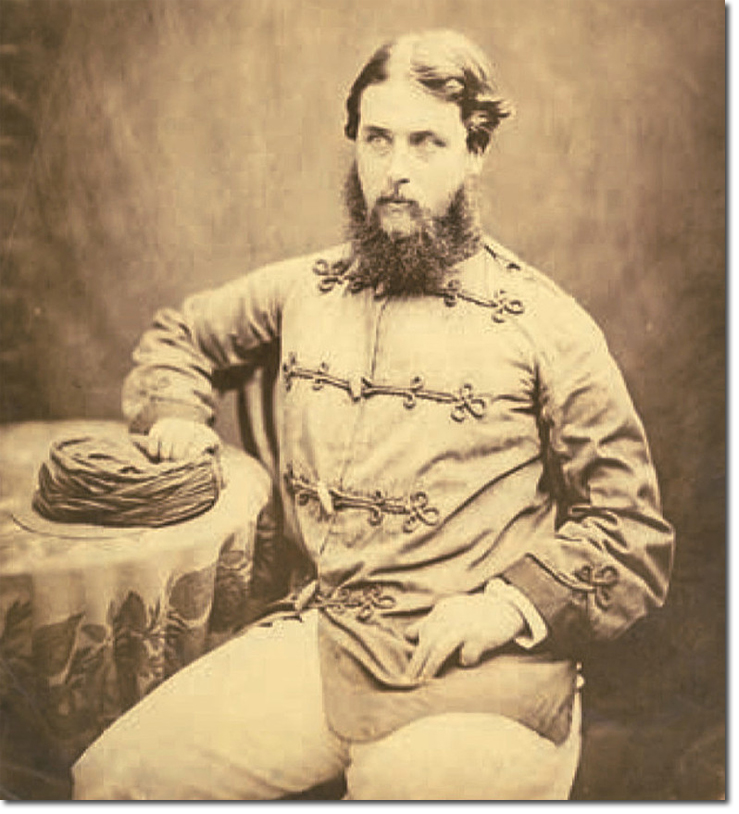
Robert Haydon Shebbeare was born in Clapham, London on 13 January 1827 and educated at King’s College School. He left school at the age of 17 and was appointed as a cadet in the 60th Bengal Native Infantry who were stationed at Benares in 1845. He was a talented linguist and was appointed regimental interpreter in 1852. In May 1857 the 60th BNI mutinied at Camp Mundlana, Umballa, but were pacified and pardoned. They marched to Kurnaul but were redirected to Rohtuck where the Treasury was in danger. They met Mr Lock the Collector who had escaped but lost his house which was burned down. At this point Shebbeare wrote home that the sepoys were behaving well. But in June the officers came under fire from their own grenadiers and had to flee.
He finished up at Delhi Ridge and was co-opted into the Corps of Guides which consisted of 8 companies of infantry and 3 Troops of cavalry. He commanded the infantry while Major Hodson commanded the cavalry. Shebbeare was able to converse with the Sikhs in their own language, and wrote, “I shall pick up Pooshtoo from the Cabool people, I doubt not.” He was engaged in many firefights, including Metcalfe House on 12 June, and constant fighting around Hindoo Roa’s House which was attacked 22 times. Shebbeare and Hodson were given the task of bringing boats down to the British camp either to make a bridge or a ‘stop’ for the enemy. They had great difficulty, working day and night, but succeeded in bringing every boat in. On 14 July they came under attack from rebels who occupied gardens and villages outside Delhi. The Guides drove them back, along with the Fusiliers and Coke’s men. They came under heavy grapeshot and musket fire from every direction but they managed to kill many rebels and drive them into the city. They were ordered to retire but it was carried out too quickly, allowing the rebels to rally and counter-attack. Enemy cavalry was bearing down on them but the Guides remained steady and fired on them which caused the enemy to retreat. Shebbeare was wounded three times in this action. He wrote to reassure his mother telling her that his wounds were slight, one bullet hit his right side, another on the muscle of his right arm and a third just above his right wrist. But Robert Shebbeare earned the Victoria Cross for his bravery on 14 Sep 1857. The citation said that he led the Guides with the 4th assault column and charged the wall twice under murderous fire. His friend, Murray was killed next to him, but the body was retrieved. They failed to get to the breach in the wall and Shebbeare was shot through the cheek and received a severe scalp wound. He managed to bring his men out of a very dangerous situation. When he recovered from his wounds he was given command of a new regiment of Mazhabi Sikhs in early 1858 at Lahore. He raised the regiment himself, reaching a strength of 900 men. They were known as the 15th Punjab Pioneers. They were sent to China, but on 26 July 1860 Shebbeare was struck down by illness which caused a fever and enlargement of the liver which gave him much pain. This prevented him from taking part in the capture of the Taku Forts. He remained on board the ‘Bentinck’ but when he heard the guns firing he unwisely rose from his sick bed and mounted a horse to join his regiment. He rode for 10 miles to their camp in intense heat and this caused his health to deteriorate. He was ordered back to England and taken onboard the ‘SS Emau’ where he died on 16 September 1860. He was 33 years old. Captain Daly, Commandant of the Corps of Guides wrote a letter to Shebbeare’s father in November which said, ‘I mourn for the loss of so good a soldier - few men of his standing possessed so much power over those under him, that is, he could and did command men. He was a rare soldier and as such he has left a name and performed services which will long be a cheering example to many in his profession.’ His VC was gazetted on 21 Oct 1859. Sad to relate that his medal was stolen from RMA Sandhurst at the end of the Centenary Exhibition of the Victoria Cross in 1954. His family had lent it to the exhibition but it was never seen again. There was much press coverage and a debate in the Commons. Eventually, in 1959, a replacement medal was sanctioned. This sold for 30,000 pounds at Spink in April 2018. |

