|
1815 Raised at Dinapore on the orders of Lt-Colonel Burton, initially as the 2nd Battalion of the 30th Bengal NI. It was commanded by Major Henry Carter.
1816 Marched to Barrackpore. The march took one month.
1817 Marched to Cuttack, one month’s march. They served for 6 months during the Khurda rebellion in the Cuttack district which lasted until 1818.
1819 In April they marched to Barrackpore, one month’s march. They stayed for 6 months
1820 They were at Chittagong and Dacca from November, stationed there for one year.
1822 They arrived at Bhopalpore in April. While stationed here, a mess was established in October 1824. They stayed until Feb 1825. During this time, in 1824, the regiment was re-designated as the 60th Regiment of Bengal Native Infantry. In the same year the regiment was in action against the Pindaris at Nursinghur (Bhopal) where Havildar Benee Sing was promoted to Jemadar for conspicuous gallantry. The Pindari Chief, Sheik Dullah, was pursued, during which one officer, Captain Dewaal, died of cholera.
1824 The Barrackpore Mutiny broke out in November 1824, although it was more of a peaceful protest against being required by Lord Amherst to march into Burma. Not only that but the expedition was without bullock carts to carry heavy equipment. The 47th BNI, stationed at Barrackpore in East Bengal, paraded without their packs in protest and some sepoys of the other two regiments, the 24th BNI and 62nd BNI supported the protest. When they refused to lay down their arms the British officers, on the orders of Sir Edward Paget, opened fire with artillery and killed up to 180 rebels.
The 60th BNI was stationed at Bhopalpore at the time of this mutiny and Riddell’s history states that Lady Amhurst wrote in her journal that the 39th and 60th Regiments ‘volunteered their services to go anywhere that the Government ordered them’, although they were apparently not required to march into Burma.
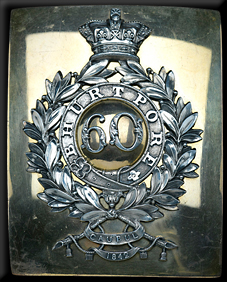
1825 Arrived at Cawnpore in May and, with a strength of 1,200, served at the final siege and capture of Bhurtpore in 1925-26. On 18 Jan 1826 they formed part of the column of attack which stormed the right breach under the command of Major-General Sir Thomas Reynell. In May that year the 60th was awarded the battle honour BHURTPORE.
1826 Arrived at Meerut in March after a 5 month march.
1828 Arrived at Bareilly in December. In 1829 the regiment must have served in the Terai (marshy land near the foothills of the Himalayas) as Riddell records that Lieutenant Dyke ‘a promising young officer’ died of exposure there. Another, less promising officer, Lieutenant Whitaker, went on a three day riotous bender in August 1829 with two other officers when he should have been supervising a company of pioneers at Landour. He was court marshalled and cashiered.
1831 Arrived at Cawnpore in October after 2 weeks marching. The march was probably made more bearable because of musical accompaniment. A regimental band had been established in 1830. In 1833 there was an outbreak of sickness and fever.
1834 The regiment was employed in quelling a mutiny among the troops of His Highness the Bazee Baee of Gwalior.
1835 Arrived at Futtehgurh in January.
1835 Arrived Mhow in December having marched for two months. The regiment joined the Bundelkund Field Force operating against Jhansi. They were part of the besieging troops that captured the fort.
1839 The regiment was ordered to proceed to Benares but the destination was altered. They turned Northwest and marched for almost four months by way of Calpee, Etawah, Agra, Muttra and Delhi, to Kurnaul which they reached in March 1839 amid reports of trouble in Afghanistan.
1840 Arrived at Ferozepore in November and were then ordered to Peshawar where it joined Wild’s Brigade which marched into Afghanistan. The regiment were with Major-General Pollock’s army at the forcing of the Khyber Pass, where they sustained heavy casualties, and the battle of Tezeen where Lieutenant James Montgomery was severely wounded (mentioned in dispatches) and died 7 months later in Simla. They were involved in other operations leading to the reoccupation of Kabul in 1842. The 60th was awarded the battle honour CABOOL.
1843 Returned to Ferozepore in January after marching for 13 months and 19 days.
1844 Arrived at Kurnaul in May. The sepoys suffered from widespread sickness so were evacuated to Umballa.
1845 Arrived at Benares in January after a 2 month march. It was while they were stationed there that they were joined by Ensign Shebbeare who was later to earn the VC in the Indian Mutiny.
1846 Arrived at Barrackpore in February after a six week march.
1848 Arrived at Mirzapore in January after a march of 6 weeks. At this station they were part of the Army of Reserve in the Punjab during the Second Sikh War. Brevet Major William Riddell was appointed Deputy Assistant Adjutant General to the Force.
1849 Arrived at Wuzeerabad in April after a 6 month march. The regiment was required to build hutments for themselves on arrival, but their CO, Lt-Colonel Smith died from fatigue and exposure. They left Wuzeerabad on 14 Dec 1849.
1850 Arrived at Cawnpore on 28th February after a march lasting eleven weeks.
1850 Arrived at Banda in November to relieve the 48th BNI.
1851 Major Riddell, CO of the regiment, went on furlough to England and his place was taken by Brevet Major Drought. In this year 126 men received medals for Bhurtpore.
1852 Major Riddell returned from furlough and resumed command. In 1855 he was promoted to lieutenant-colonel.
1857 The 60th mutinied at Umballa on 10 May, but both the 5th BNI and the 60th were brought under control and pardoned on condition that they took a fresh oath of fidelity by kissing the Colours. Colonel Seaton took over command on 15 May. It was decided that because the regiment was still mutinous they should be separated from the 5th BNI, and accordingly, they were marched to Kernaul to join British troops who were assembling for the siege of Delhi which had been occupied by the mutineers.
In June the 60th BNI, numbering 900 officers and men, began the march to Delhi. They were engaged at Rohtuck but the Grenadier Company mutinied and opened fire on the officers. They escaped but had to march for 45 miles.
|