

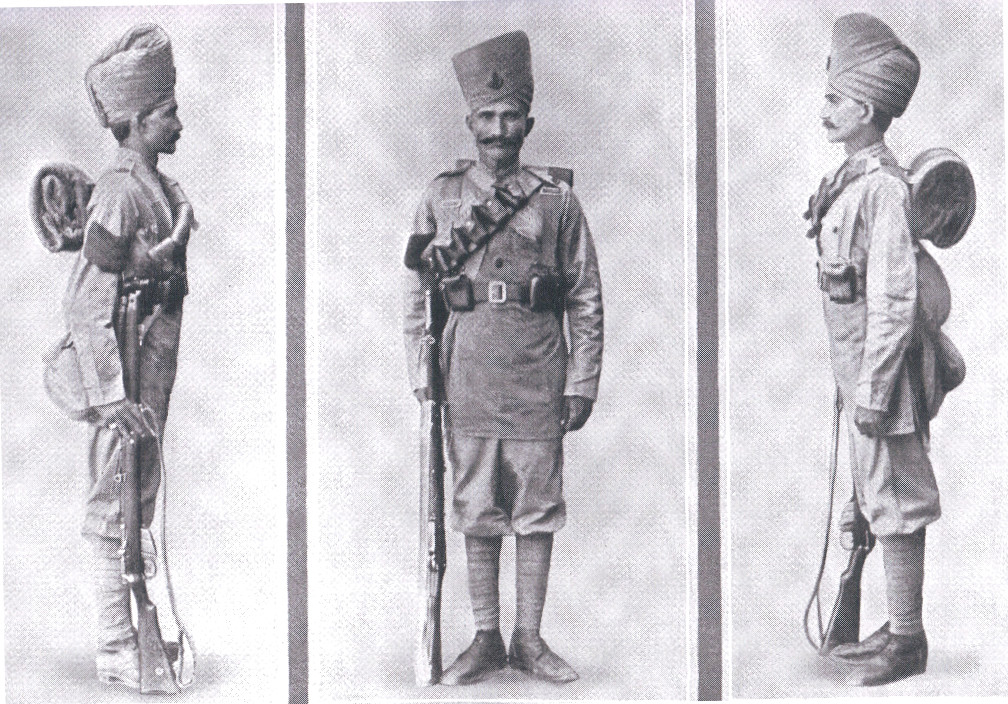
The regiment mobilised on 14 Aug 1914 and served in Mesopotamia during WW1. The uniform was khaki drill; a kurta and pantaloons with khaki puttees and turban. His rank stripes were black chevrons on a scarlet backing cloth. In 1909, during Lt-Col Walton’s command, there was a change in the regulations with regard to turbans (puggris). The History says:
‘Up till this time, for guard duties and all ceremonial occasions the green puggri with scarlet kullah and green puttees was worn, while for ordinary parade work a long khaki puggri, tied tight and looking rather like a top-hat, with a khaki kullah was worn by all classes. As this was regarded as being too heavy and cumbersome, it was decided to do away with the khaki kullah for Hindus and to reduce the length of the puggri for all, by half. Each class was to tie the puggri according to its racial pattern. This change proved popular and very useful in helping to distinguish the different Double Companies in the field.’
The three photos show Havildar Sedu Ram who was a Jat. The puggri (turban) still looks large despite the reduction to half the length of the cloth. The caption says that shorts were worn in place of pantaloons in hot weather. His rifle is the SMLE mark III which was the popular weapon for British and Empire soldiers in WW1. More than 3 million of them were produced in Britain, India and Australia. But the description of the rifleman’s equipment in the text mentions the Long Lee-Enfield;
‘The Regiment was still armed with the Long Lee-Enfield Magazine Rifle adapted for charger loading. This took the old ammunition with the round-nosed bullet. The bandolier equipment consisted of a brown leather belt which carried four pouches to hold fifty rounds, and a brown leather bandolier which held another fifty. The great-coat was carried on the back with braces which hooked on to the top of the pouches on the belt in front. The Sirhind rapid entrenching tool was carried across the back, under the great-coat, attached to the bandolier, while the helve was strapped to the sword scabbard [i.e. the bayonet]. The haversack and water-bottle, not being a Government issue, were of regimental pattern. The former, made of khaki drill, carried the aluminium ration tin which contained a lota in which the emergency ration was placed. The water-bottle was very large and made of aluminium covered with felt and khaki drill. These were carried slung over the left and right shoulder respectively. Khaki shorts, which had been adopted during Hyderabad, Sind days [1906], were worn on field service.’
