

Prior to 1881 the local Militia battalions were the West Norfolk Militia and the East Norfolk Militia. But the 1881 reforms authorised that each line regiment should have two regular battalions and two militia battalions. The West Norfolk Militia thus became the 3rd Battalion of The Norfolk Regiment, and the East Norfolk Militia became the 4th Battalion, The Norfolk Regiment.
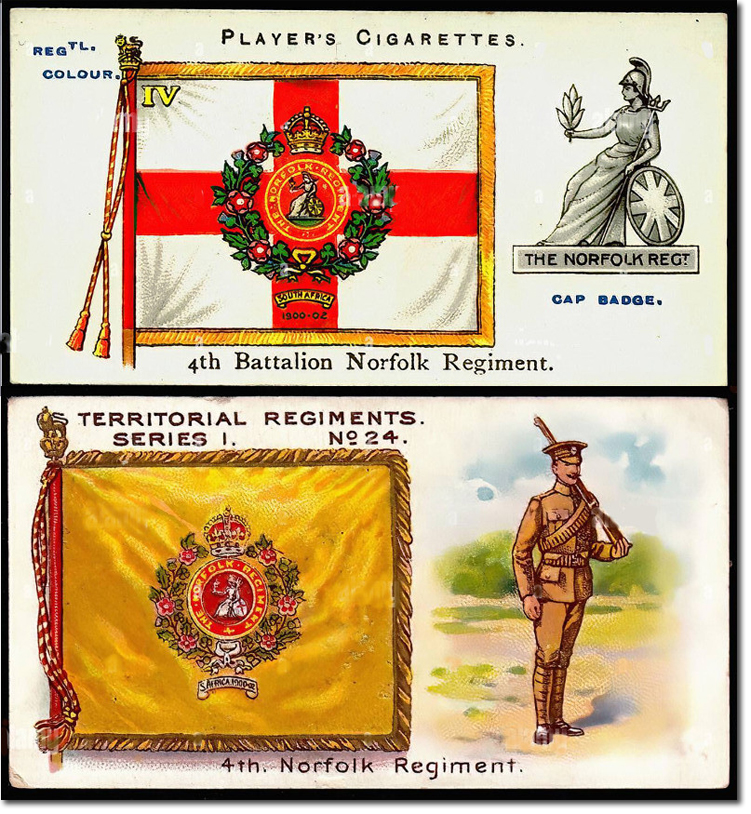
These two cigarette cards illustrate the Regimental Colours of the 4th Battalion as they could have been before and after 1905, the year that the Norfolk Regiment had their yellow facings restored to them. It is clear that, although the 1st and 2nd Battalions were entitled to bear identical sets of battle honours awarded to either battalion, the 3rd and 4th Battalions did not have that privilege. There is only one battle honour, SOUTH AFRICA 1900-02, on both of these Colours, indicating that the older Colour is post-Boer War.
The top Colour has the cross of St George throughout, as stipulated in 1881, and has the regimental badge of Britannia in the centre. The Roman numeral IV in the top corner identifies the battalion. The lower Colour is post-1905, so is yellow, again with no battle honours apart from South Africa, and no Roman numeral. The Britannia badge replaced the Castle badge worne by the militia battalions before 1881.
It is not clear if these illustrations show Colours that actually existed, most likely only the yellow Colour. The regimental History says this on its last page:
‘In October 1909, King Edward VII reviewed, at Norwich, the whole territorial force of Norfolk and presented colours to the 4th, 5th, and 6th battalions of the Norfolk Regiment. On the regimental colours appeared the battle honour “South Africa, 1900-1902.”'

