

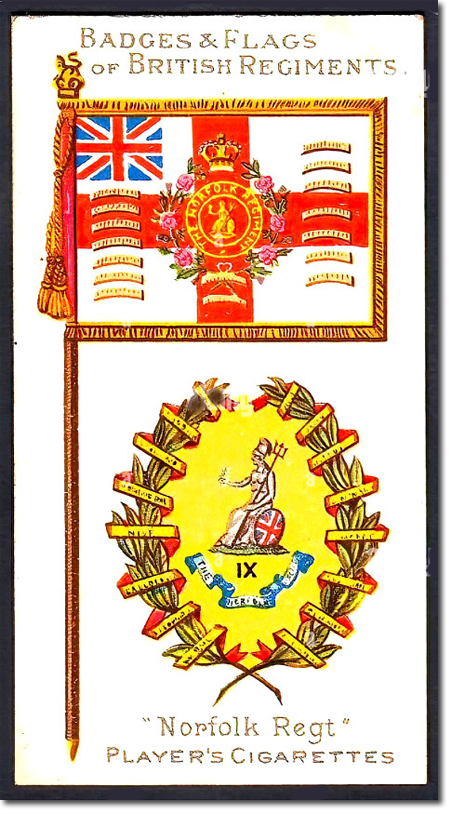
The size of the Colours was successively reduced in 1855, 1858 and 1868 so that by then the Colour was 3ft 9ins flying by 3ft deep. In 1881 the non-royal English regiments were required to conform to white facings, thus losing their distinctions. The 9th lost its yellow facings as well as the numbering of 9th. They were also to be known as The Norfolk Regiment.
Also in 1881 there were regulations concerning the design of the Colours. From 1868 the top of the pike had to have a gilt Royal Crest instead of a spearhead. The flag itself was to have the red cross of St George with white corners, conforming to other non-royal English regiments. The Colour shown on this cigarette card has the small Union flag and the battle honours arranged in columns. However this was the design used prior to 1881. The new regulations demanded the abolition of the Union flag and the arrangement of the battle honours in a circular formation around the central device. The Norfolks' new Colour adopted the basis of the St George cross but ignored the instructions concerning the layout.
There are 16 battle honours on the Colour (the King’s Colour had no battle honours). So three more honours had been added to the 1848 version. These were SEVASTOPOL, KABUL 1879 and AFGHANISTAN 1879-80. This Colour was probably presented to the regiment, along with the King’s Colour, on 24 Sept 1887, at Aldershot. The presentation was made by the Prince of Wales, the future King Edward VII. The Army and Navy Gazette of 1 Oct 1887 said that these Colours were to replace the ones carried by the 9th since 1848.

